





By Yantoultra Ngui and Samuel Shen
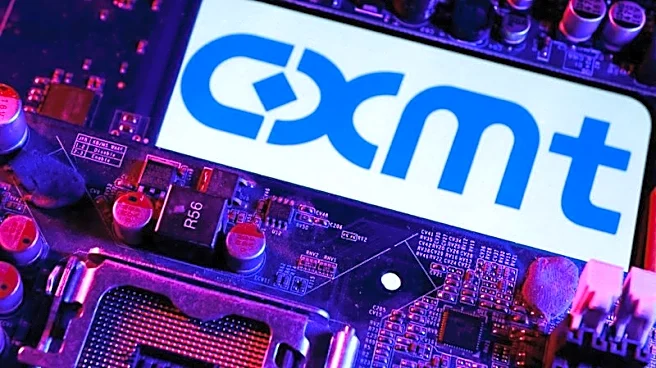
SINGAPORE/SHANGHAI, July 27 (Reuters) - Shares of CXMT Corp surged more than 500% on their Shanghai trading debut on Monday following Asia's biggest IPO this year, catapulting the chipmaker to the top of China's stock market by valuation despite a recent selloff in global tech stocks.
The stock reached 54.65 yuan mid-session compared to its sale price of 8.66 yuan per share. The rally lifted CXMT's market capitalisation to 3.65 trillion yuan ($539.21 billion), sharply
up from $85.5 billion during the IPO process.
The explosive debut makes CXMT the most valuable company listed in China, overtaking Industrial and Commercial Bank of China (ICBC), the market's previous heavyweight.
With U.S. restrictions raising the stakes in the global technology race, the chipmaker has become a cornerstone of China's effort to anchor its semiconductor ecosystem and narrow the gap in strategic sectors such as AI.
CXMT's first-day rally easily outstripped the more-than-doubling recorded by China Resources New Energy after its $3.6 billion IPO in China earlier this month.
MARQUEE CHINESE CHIPMAKER
The strong debut provides a gauge of how much investors are willing to pay for a marquee Chinese chip firm, as local markets navigate volatility following an AI-led selloff.
There was 122 billion yuan worth of CXMT shares traded in Shanghai during the morning session. CXMT became the first A-share stock to exceed 100 billion yuan turnover in a day, according to local media reports.
Chinese chipmaking and semiconductor stocks <.CSI932087> <.CSIH30184> fell on Monday, as fund managers repositioned for CXMT shares.
CXMT's astronomical rally, which values it at nearly half of U.S. rival Micron, has also sparked concerns of a bubble. Its expanding dominance in China has enabled it to raise prices for tech customers such as Huawei.
"At such a price, I don't dare to hold, or buy the stock," said Wu Zhou, fund manager at Shenzhen Deyuan Investment, who bought CXMT's IPO shares, adding he sold them all when the stock began trading.
AI-linked stocks, including chipmakers, have been at the forefront of global equity market gains this year. But concerns about stretched valuations and whether hefty AI-related capital expenditures will generate earnings growth quickly enough have recently dampened investor enthusiasm.
"The (CXMT) stock is too expensive and smells of speculation," said Yuan Yuwei, hedge fund manager at Trinity Synergy Investments, adding that "it's hard to say the optimism is sustainable."
In other Asian markets, tech-heavy South Korea's KOSPI and Taiwan stocks were down over 1% on Monday, while MSCI's IT index for Asia-Pacific shares outside Japan fell 0.5%.
Only 6.73% of CXMT's enlarged share capital was freely tradable at listing, as most shares are locked up. The small initial float could magnify price swings and attract strong turnover.
SEVERE MEMORY SHORTAGE
CXMT, formerly ChangXin Memory Technologies, raised 57.92 billion yuan ($8.6 billion) in the IPO, the biggest mainland Chinese semiconductor offering on record. It surpasses SMIC's $7.5 billion Shanghai share sale in 2020 and the IPO proceeds could rise to 66.61 billion yuan if an over-allotment option is fully used.
Asian chipmakers and companies building data centers and related infrastructure have ridden a wave of spending worth hundreds of billions of dollars from big tech firms. Earnings from so-called hyperscalers this week are likely to set the tone for near-term sentiment around the AI trade.
"The memory market remains tight with price increases expected to continue through the end of 2027," Ellie Wong, an analyst at TrendForce, a technology research firm, said.
"Amid persistent supply shortages, many customers are seeking to diversify their memory supplier base, which should significantly benefit CXMT and create more business opportunities."
Morningstar analyst Jing Jie said CXMT was well-placed to benefit from rising domestic AI demand, but its technology gap with global leaders could limit its share of the market for memory chips used in AI systems.
In its prospectus, CXMT said AI demand had fuelled the latest upswing in memory chips, but warned the market could weaken if AI investment slowed or rivals added too much supply.
The company expects first-half revenue to rise more than sevenfold to 110 billion yuan to 120 billion yuan. It expects net profit of 66 billion yuan to 75 billion yuan, reversing a year-earlier loss.
($1 = 6.7691 Chinese yuan renminbi)
(Reporting by Yantoultra Ngui in Singapore and Yiming Shen in Shanghai; Writing by Scott Murdoch; Editing by Sumeet Chatterjee, Jamie Freed and Shri Navaratnam)