
By Shi Bu and Kevin Yao
BEIJING, Feb 13 (Reuters) - China’s new bank lending jumped in January from the previous month but was below expectations and far short of the record level a year earlier, as subdued
credit demand continued to weigh on borrowing in the world's second-largest economy.
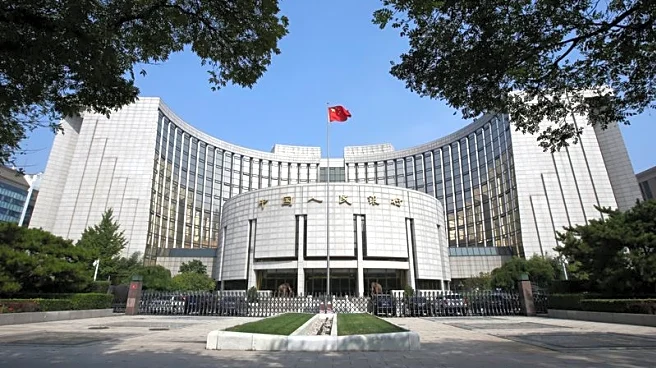
Banks extended 4.71 trillion yuan ($681.56 billion) in new yuan loans in January, surging from 910 billion yuan in December but missing analysts' forecasts, according to data from the People's Bank of China on Friday.
The number was lower than 5.0 trillion yuan predicted by analysts in a Reuters' poll and below a record 5.13 trillion yuan seen a year earlier.
Credit typically spikes in January as Chinese banks front-load lending at the start of the year, competing for higher-quality customers and market share.
But companies' short-term financing needs might have been weaker in January this year compared with 2025 due to the late Spring Festival holiday, which falls in mid-February this year.
“China’s credit data for the first month of 2026 came in with mixed signals. Aggregate financing exceeded expectations, while new loan growth slightly undershot consensus,” said Zhou Hao, chief economist at Guotai Junan International,
The share of new loans in total social financing has kept sliding, staying below 50% through most of the second half of 2025, indicating that government‑driven funding is increasingly leading credit growth, Zhou said.
"We expect this trend to persist through 2026, with fiscal policy remaining expansionary and the fiscal deficit likely staying above 4% of GDP in the new year," he added.
China's official business survey showed factory activity faltered in January, recording the slowdown for some types of manufacturers typical in this period in the face of weak domestic demand.
While China's reported economic growth hit the official target of around 5% last year due to an export boom, structural imbalances, trade tensions and growing geopolitical uncertainty pose significant risks to the outlook. A Reuters forecast showed economic growth is likely to slow to 4.5% in 2026.
New bank lending in China slipped to a seven-year low of 16.27 trillion yuan in 2025, pointing to soft demand as a prolonged property downturn and weak domestic consumption weigh on business and consumer confidence.
Policymakers have signalled readiness to deploy further stimulus to boost the economy this year, with the central bank saying there remains room for cuts in banks' reserve requirement ratios and broad interest rates. Beijing already announced cuts to sector-specific interest rates last month.
Household loans, including mortgages, rose 456.5 billion yuan in January after a contraction of 91.6 billion yuan in December, while corporate loans jumped to 4.45 trillion yuan from 1.07 trillion yuan, according to Reuters' calculations.
Beijing has been driving a campaign to boost consumption to balance out the economy's reliance on exports and investments, as soft household spending, persistent deflation and a prolonged crisis in the property sector drag growth.
Broad M2 money supply grew 9.0% from a year earlier in January, central bank data showed, above analysts' 8.4% forecast in the Reuters poll. In December, M2 grew 8.5%.
The narrower M1 money supply grew 4.9% in January from a year earlier, from 3.8% in December.
Outstanding yuan loans grew 6.1% in January from a year earlier - a record low and slower than 6.4% in December. Analysts had expected 6.2% growth.
Outstanding total social financing (TSF) - a broad measure of credit and liquidity - rose 8.2% in January from a year earlier, slowing from 8.3% in December. Any acceleration in government bond issuance could boost such financing.
The TSF measure includes off-balance-sheet forms of financing beyond conventional bank lending, such as initial public offerings, bond sales and loans from trust companies.
"A pick-up in credit growth thanks to fiscal easing meant the PBOC was able to largely stay on the sidelines throughout most of last year," Julian Evans-Pritchard, head of China economics at Capital Economics said in a note to clients.
"But with the tailwind from fiscal policy likely to be more modest this year, the PBOC will have to work harder to prevent credit growth, and therefore wider economic activity, from slowing too quickly."
(Reporting by Shi Bu and Kevin Yao; Editing by Kim Coghill)