







By Ashitha Shivaprasad
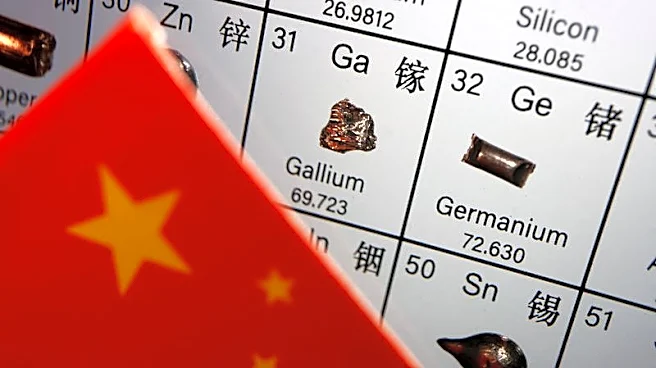
Sept 18 (Reuters) - Three years on from China curbing exports of two niche metals vital to the chipmaking, clean energy and defence sectors, the West is still feeling the price pain and waiting for its own production to come to the rescue.
The export curbs on gallium and germanium have forced Western companies to stockpile, seek alternative supplies, and explore new designs and substitutes.But the decisive response is only now taking shape, with several Western production projects
announced in recent months aimed at finally breaking China's stranglehold on the niche but vital market.
With prices now at 9 to 10 times 2023 levels, that new supply cannot come soon enough.
"These export controls have acted as a real wake-up call... In response, companies are increasingly diversifying their procurement strategies, turning to recycling, alternative suppliers and emerging non-China projects where possible," said Cristina Belda, senior analyst at Argus.
Manufacturers of infrared optics used in defence and thermal imaging systems have particularly struggled with tight supply, she said.
AI CONTRIBUTING TO RISING DEMAND
While production projects take shape, the AI boom, expanding fibreoptic networks and growing use of infrared imaging are pushing up demand.
Gallium demand is seen rising by about 12% per year through 2030 from about 1,000 metric tons in 2025, preliminary S&P Global estimates show.
Global germanium demand is set to rise by 3.3% annually over the same period from an estimated 343 tons in 2025, S&P Global said.
Yet consultancy Project Blue estimates China in 2025 still accounted for 98.9% of primary gallium supply and 68.6% of germanium supply, underscoring the scant progress made so far in reducing China's dominance.
In introducing its export controls in 2023, later expanded to include rare earths and other critical minerals, Beijing used that dominance as leverage in trade and other disputes.
METALS SUBSTITUTION
Replacing either metal — primarily byproducts of alumina and zinc processing — with other materials brings its own challenges.
"There is no one-to-one substitute for germanium," said Jessica DeGroote Nelson, senior vice president of precision optics at US-based Edmund Optics, noting using other materials would require redesigns.
"It's not impossible, but it is very challenging."
A source at another optics company said it has succeeded in switching to substitutes in some applications, halving germanium use over the past 18 months, using Western suppliers and raising its prices.
"We do have many customers who are willing to purchase at current prices, the issue here is the availability of supply," the person said.
Industry participants say gallium arsenide is being replaced by indium phosphide in some semiconductor applications while zinc selenide, zinc sulphide, silicon and chalcogenide glass are gaining traction as germanium alternatives in some infrared applications. Still, all those require costly technological adjustments that take time, industry insiders say.
Stockpiling is another response. DeGroote Nelson said some customers buy germanium before designs are even finalised in order to ensure availability when production begins.Recycling is yet another route being taken by US-based Lattice Materials, which uses germanium to produce crystals for displays in fighter jets, tanks and other military equipment.
"We don't see supply loosening up anytime in the near-term," company president Travis Wood told Reuters.
"Every data point we've seen shows prices to at least stay at current high levels or even continue the upward trend," Wood said.
Belgium's Umicore has also been working with STL, a unit of Gécamines that processes mining waste in the Democratic Republic of Congo, to boost germanium recovery.
PLAYING CATCH-UP
As the race to build new supply gathers momentum, the pressure from ever rising demand means some producers say they are already playing catch-up.
In Greece, METLEN, which has begun pilot-scale production and aims to produce 50 tons of gallium annually by 2028, says demand from potential customers now already exceeds that target several times.
In April, Australia and the US pledged over $3.5 billion to support a range of critical minerals projects, including gallium and germanium, nearly doubling an initial amount agreed last year.
Underscoring the need for that support, S&P Global expects ex-China gallium supply capacity to total 20 tons by the end of 2026, leaving a supply gap of about 678 tons. Non-Chinese germanium metal production is seen at 31 tons, or 177 tons short of demand.
Jack Bedder, founder and director of consultancy Project Blue, told Reuters that the emergence of credible projects with government support offers a chance for greater diversification, but the economies of scale still favour China with its enormous capacity and production costs new Western projects will struggle to match."We think a material reduction in dependence is achievable over five years, but eliminating dependence on China is much less realistic."
Government support such as price floors will probably be needed to bring new supply and ensure its long-term commercial viability, said Piyush Goel, consultant at London-based consultancy CRU.
By 2030, S&P Global estimates eight announced projects, including Wagerup in Australia and Clarksville in the United States, could boost ex-China gallium supply to about 386 tons from roughly 5 tons currently.
Yet even that will leave ex-China demand looking to China for 65% of its supply, Reuters calculations based on S&P data show.
New germanium projects in Canada, South Korea and the United States are expected to help lift ex-China germanium refining capacity to 126 tons by 2030. But even with five ex-China refineries potentially operating, capacity would cover only about 48% of projected ex-China demand, according to S&P.
EARLY STAGES
Several of the announced gallium projects, including those planned by METLEN in Greece, Alcoa and Sojitz in Australia, Rio Tinto and Indium Corporation in Canada, and Nalco in India, are still being developed and have yet to reach full commercial production.
New entrants complement those efforts — Korea Zinc is developing gallium and germanium capacity at home and at a planned Tennessee refinery, and US-based ReElement Technologies is developing a refining complex in Indiana.
Titan Mining, a zinc and graphite producer, expects to start germanium production in New York state by year-end at 2.5 to 3 tons, or about 7% to 10% of US demand.
At the same time, a handful of established non-Chinese germanium suppliers are working to boost their output.
Canada's Teck Resources struck a deal with Ottawa in July to support an expansion of production at its facility in Trail, British Columbia.
(Reporting by Ashitha Shivaprasad; additional reporting by Eric Onstad, Ernest Scheyder, Solomon Cefai and Divya Rajagopal; editing by Pratima Desai, Tomasz Janowski and Jason Neely)