
By Will Dunham
June 3 (Reuters) - Ötzi the Iceman died violently roughly 5,300 years ago in the Alpine region of the modern border between Italy and Austria. An arrowhead was found lodged in his left shoulder,
having caused fatal bleeding when he was attacked in mountainous terrain. But, in some sense, Ötzi still lives, as new research shows.
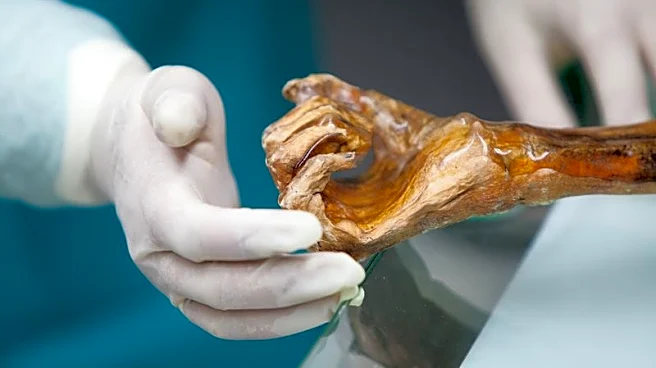
Scientists have conducted the most comprehensive analysis to date of the microbial landscape of Ötzi's mummy, detailing bacteria, fungi and yeasts across multiple tissue sites spanning more than three decades of sampling. Ötzi's body, preserved by millennia of entombment in glacial conditions, was discovered in 1991. He represents Europe's oldest-known natural mummy.
The researchers identified three distinct microbial worlds inside and on Ötzi's body. They encompass ancient gut bacteria that were part of his microbiome during his lifetime, cold-adapted microorganisms derived from the glacier environment where his body lay, and modern microbes introduced during three decades of museum conservation.
"Our study reveals that Ötzi is not a static, biologically inert relic - he is a dynamic ecosystem," said microbiologist Mohamed Sarhan of Eurac Research's Institute for Mummy Studies in Bolzano, Italy, lead author of the study published in the journal Microbiome.
"His body hosts living, metabolically capable organisms that are actively responding to their environment," Sarhan said. "The cold-adapted yeasts are growing. Certain bacteria have colonized and persisted across his tissues for decades. The mummy is, in a very real sense, a living biological interface - a meeting point between the ancient world and the present, where microbes from 5,000 years ago coexist with organisms that arrived last decade."
For archaeology and human history, Sarhan said, the ancient gut bacteria provide a rare window into the intestinal ecosystem of a Copper Age human - before industrialization, antibiotics and processed food transformed human microbiomes, the collection of microbes that naturally live in and on the body.
For conservation science, Sarhan said, the discovery that cold-loving yeasts are actively growing on Ötzi - preserved at 21 degrees Fahrenheit (minus-6 degrees Celsius) at the South Tyrol Museum of Archaeology in Bolzano to mimic the conditions of his glacial entombment - raises questions about the mummy's long-term integrity.
The microbes found in Ötzi's gut that date to his lifetime included bacteria associated with fiber-rich pre-industrial diets, rarely found in people living modern Western lifestyles.
"Their disappearance from Western guts is likely linked to dietary shifts, antibiotic use and reduced exposure to natural environments. Ötzi essentially shows us what we have lost, and potentially what we might one day want to restore for health reasons," Sarhan said.
Were any of these original gut microbes still biologically active?
"This is one of the most fascinating and nuanced questions our study addresses," Sarhan said.
"The ancient gut bacteria show clear DNA damage signatures consistent with thousands of years of chemical degradation. This tells us their DNA is genuinely ancient. However, whether the cells themselves retain any metabolic activity is something we cannot fully determine from DNA analysis alone. What we can say is that they have been remarkably preserved in the protected anaerobic environment of the intestinal tract for over five millennia," Sarhan said.
'PRECIOUS INSIGHTS'
Previous research on Ötzi's stomach contents revealed his last meals - deer and goat meat as well as wheat. Previous research showed he was about age 45 when he died, relatively old for his era, and was physically robust. He wore clothing fashioned from multiple animal species, toted items including a copper ax, longbow, arrows and quiver, flint dagger and backpack, and bore geometric tattoos.
"He is a visitor who provides us precious insights into the past," said microbiologist and study co-author Frank Maixner, director of Eurac's Institute for Mummy Studies.
The researchers differentiated which microbes were present during Ötzi's lifetime and which ones colonized his body post-death. After death, the glacier environment introduced its own microbial community to his body - cold-tolerant bacteria and yeasts from the surrounding ice and soil.
Microbes found exclusively in deep internal tissues, showing high DNA damage, were almost certainly present during Ötzi's life or shortly after, Sarhan said.
Those without DNA damage and matching the conservation environment were modern introductions, while the glacier-derived microbes sit in between, representing post-death but pre-discovery colonization, Sarhan said. The living and biologically active microbes were the cold-adapted yeasts on Ötzi's skin and internal body water.
His post-discovery transfer to the museum initiated a new wave of microbial colonization.
"We found that the spray water used to keep the mummy humid has introduced a dominant signature of bacteria onto his external surfaces. These modern introductions are effectively reshaping the mummy's external microbiome - a consequence of conservation practices that was previously unrecognized," Sarhan said.
(Reporting by Will Dunham in Washington; Editing by Daniel Wallis)