



By Jonathan Stempel and Manya Saini
Sept 18 (Reuters) - Berkshire Hathaway has been synonymous with Warren Buffett. It now falls to his oldest son, Howard Buffett, to keep the conglomerate's culture alive.
Friday's announcement that Warren Buffett, 96, stepped down as chairman means the investing legend won't have a management role at the company he took over in 1965, or even be a regular sounding board for Greg Abel, who succeeded him as chief executive officer in January.
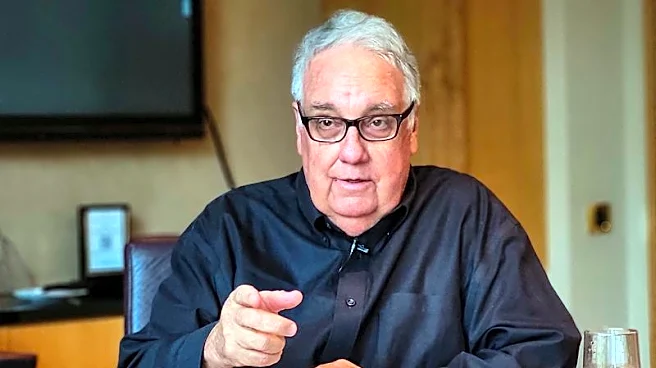
Howard Buffett, 71, will
assume a far different role as non-executive chairman, focused on preserving Berkshire's culture and values. It is the latest move in a years-long leadership transition.
"This one is really about continuity," said Michael Withers, a management professor at the University of Notre Dame's business school. "The test moving forward will be whether Abel and Howard can honor [Warren Buffett's] legacy while still giving Berkshire room to adapt to a market that looks very different from the one Buffett mastered."
Their longtime presence may assure investors and analysts who don't expect, or necessarily want, big changes at the approximately $1.1 trillion conglomerate, which owns the BNSF railroad, car insurer Geico, and a slew of energy, industrial and retail companies, along with a stock portfolio that includes American Express, Apple and Coca-Cola.
Abel joined Berkshire in 2000 when it bought the former MidAmerican Energy, and became part of Berkshire's leadership team in 2018. Howard Buffett has been with Berkshire even longer, as a director since 1993.
"Howie's there as a watchdog," said James Armstrong, president of Henry H. Armstrong Associates in Pittsburgh, and a longtime Berkshire investor. "Minimize bureaucracy, stay focused on long-term goals, put the shareholders first, no self-dealing, no corruption, and widen the moat that protects Berkshire's businesses."
KNOWING WHAT'S DOABLE
Abel, 64, has largely followed Buffett's playbook since becoming CEO. Berkshire's near-record $364.7 billion of cash as of June 30 gives him freedom to buy more companies and stocks, repurchase the Omaha, Nebraska-based company's own shares and perhaps institute a dividend.
Warren Buffett wrote on Friday in a shareholder letter that Abel has exceeded his "sky high" expectations.
"Think of Howard as a policy the shareholders own and hope never to claim against," Buffett wrote.
Buffett still controls more than 13% of Berkshire's stock and about 30% of its voting power. These percentages will decline as his shares get distributed to foundations overseen by his children.
"Warren built one of the great American companies," said Macrae Sykes, a portfolio manager at Gabelli Funds. "This ends Warren's corporate career, but not his influence at Berkshire."
NOT ROCKET SCIENCE
Renowned for his charitable work, Howard Buffett has also been a farmer, sheriff, and member of several corporate boards, but never led a public company. He sees his role at Berkshire as more focused than his father's.
"It's not rocket science," he told the Wall Street Journal in January 2025. "The culture is to keep things simple, to do what you need to do but don't do a lot of things you don't need to do, treat people fairly, respect your managers, respect your shareholders. Tell them the bad news upfront, be honest."
Cathy Seifert, analyst at CFRA Research, called Howard Buffett's lack of management experience a shortcoming in Berkshire's succession plan.
"Compared to other family dynasties, typically when you have the heir apparent's son he's usually involved in day-to-day operations," she said. "Howard Buffett doesn't have that."
Berkshire's board nonetheless has several directors with management experience who can act as guides.
"New managers do not have the same intuition that only time and experience can bring," said Brian Mulberry, chief market strategist at Zacks Investment Management. "Buffett’s son and Abel have been in the Berkshire ecosystem for long enough that this lag should be minimal but not nothing."
Tom Russo, a partner at Gardner, Russo & Quinn and also a longtime Berkshire investor, recalled Warren Buffett telling him and other Stanford Business School students in 1983 that "you couldn't make a good deal with a bad person." He expects Abel and Howard Buffett to respect that thinking. Time will tell how.
"This is new territory," Russo said.
(Reporting by Jonathan Stempel in New York and Manya Saini in Bengaluru; editing by Megan Davies and David Gaffen)