
By Alessandro Parodi and Bernadette Hogg
Feb 11 (Reuters) - Swatch needs to revive innovation, slim its brand portfolio and overhaul governance if the Swiss watchmaker is to reverse years of falling profits
and rebuild investor confidence.
The company last week proposed adding Swiss businessman Andreas Rickenbacher to its board at its May shareholder meeting. He would be only the second new board member in a decade - a period during which Swatch's market value has dropped to about a third of its 2013 peak.
Analysts and investors say deeper reforms are required.
"The problem is not do they produce great watches. The problem is they're no longer relevant," said Steven Wood, founder of U.S. activist investor GreenWood, which owns around 0.5% of Swatch's bearer shares.
FALLING BEHIND
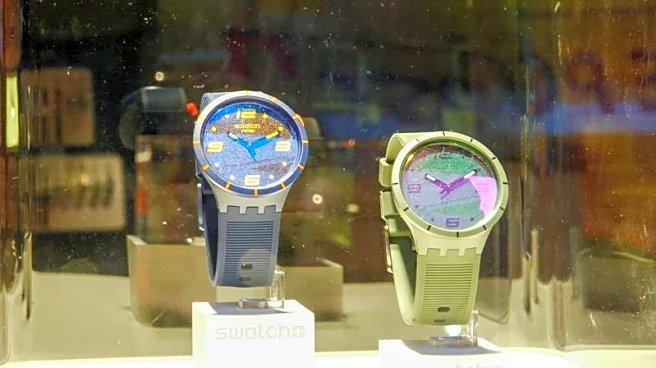
Swatch, once a global pioneer thanks to its affordable, tech-forward plastic watches of the 1980s, has failed to rekindle innovation since the 2010 death of founder Nicolas Hayek.
Hayek established Swatch in 1985 by revamping a traditional watchmaking conglomerate, revitalised the Omega brand and pushed into luxury with acquisitions such as Blancpain in 1992 and Breguet in 1999. After his death, his daughter Nayla became chairperson and his son Nick, CEO since 2003, joined the board.
Under their tenure, Swatch has made no major acquisitions and delivered few significant product advances, leaving its brands looking dated, according to analysts and investors.
Swatch declined to comment. The Hayek family has previously said leadership change was possible but not imminent, and that the share price did not reflect its long-term strategy.
The shares rose modestly after stronger-than-expected fourth-quarter sales and are up 18% this year. But they have significantly lagged rivals including Richemont and Watches of Switzerland, as well as the broader European luxury index over the past 15 years.
FAMILY CONTROL UNDER SCRUTINY
Critics argue that Swatch's dual-class share structure entrenches Hayek family control, giving it disproportionate voting power despite it holding only a quarter of the equity.
"The Swatch board needs to be substantially renewed," said Markus Menz of the University of Geneva's Center for Corporate Governance.
Rickenbacher, who also sits on the boards of BKW and Aebi Schmidt, is a step in the right direction, he said, but added the board still needed more independent directors and at least one "industry heavyweight" with international experience.
Rickenbacher told Reuters that his knowledge of large organisations and the Swiss market would guide his work.
GreenWood has also pressed for governance reforms, recently filing proposals to increase board diversity and broaden shareholder representation. "Any change to the board represents a step forward and is likely to alter its dynamics," Wood said.
WEAKER BRANDS SLOWING PROGRESS
Swatch's 16-brand portfolio has drawn criticism from those who say mid-market names such as Longines and Tissot are limiting growth, even as luxury marques like Blancpain have the potential to perform well.
UBS analyst Zuzanna Pusz said Swatch should consider selling struggling brands to focus on its high-margin luxury watches.
"If these more lower-end brands are going to come under pressure because of what we are generally seeing in the market, it probably makes more sense to focus on the likely winners," she said.
Luxury demand remains resilient as affluent buyers are less exposed to economic strains.
"The potential of a Breguet and Blancpain is there," said Pascal Pruess, analyst and portfolio manager at Swiss value investor BWM.
INVENTORY AND PRODUCTION STRAINS
Swatch's operational inefficiencies - notably maintaining high production despite soft demand - have pushed inventories higher and eroded margins, analysts say.
Inventory values have grown 16% over five years, while core earnings fell 56% in the last fiscal year.
Pusz said margins were squeezed because Swatch refused to cut production. The company has deliberately taken losses in its production arm to preserve jobs and capacity, denting overall profitability.
VALUATION DEBATE
Some investors argue Swatch is undervalued, saying its assets outweigh its market price.
BWM estimates Swatch's liquidation value at more than 200 Swiss francs per share. Swatch shares closed on Tuesday at 198.5 francs, valuing the group at around 10 billion francs ($13 billion).
Pruess said his firm bought an undisclosed stake early last year, betting on a long-term improvement.
But he warned: "It would take four or five years to really see the right figures if they make a real turnaround."
($1 = 0.7644 Swiss francs)
(Reporting by Alessandro Parodi and Bernadette Hogg. Editing by Matt Scuffham and Mark Potter)