
By Marianna Parraga and Shariq Khan
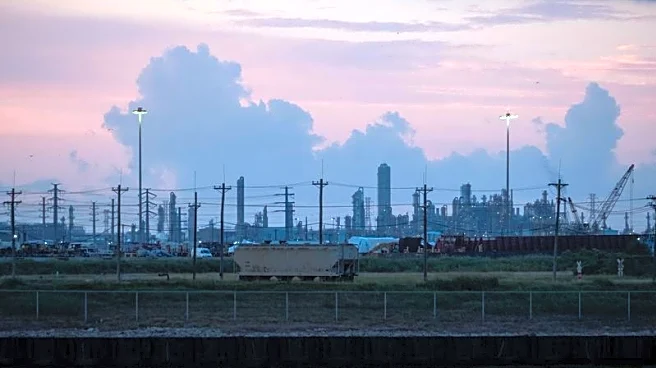
HOUSTON/NEW YORK, Feb 3 (Reuters) - Oil refiners on the U.S. Gulf Coast are struggling to absorb a rapid surge in Venezuelan crude shipments since last month's flagship
$2 billion supply deal between Caracas and Washington, pressuring prices and leaving some volumes unsold, according to traders and shipping data.
The soft U.S. demand represents an early obstacle for President Donald Trump's hopes of sending the majority of the South American country's oil to the United States since U.S. forces captured Venezuela's President Nicolas Maduro last month in a raid in Caracas.
Trading houses Vitol and Trafigura were granted U.S. licenses to market and sell millions of barrels of Venezuelan oil following the U.S. operation and a subsequent supply agreement with interim President Delcy Rodriguez.
The trading houses, which joined energy major Chevron in holding approval to export Venezuelan oil, struck several early deals to sell some cargoes to refiners in the U.S. and Europe. However, with Chevron also raising exports quickly, the trading companies are now finding it harder to secure enough buyers among Gulf Coast refiners, traders said.
"We're all facing this issue where there's more to place and not enough takers," one of the traders said, citing reluctance from U.S. refiners to buy Venezuelan crude. Some refiners are complaining that prices, albeit declining, remain high compared to competing Canadian heavy grades.
Venezuelan heavy oil cargoes for delivery at the Gulf Coast are being offered at about $9.50 per barrel below benchmark Brent, versus discounts of between $6 and $7.50 per barrel in mid-January.
Last month, total Venezuelan oil exports to the U.S. almost tripled to 284,000 barrels per day (bpd), according to data based on tanker movements.
The U.S. was absorbing some 500,000 bpd of Venezuelan oil before Washington imposed sanctions on the country in 2019. But exports to the U.S. went to zero in mid-2025 after Trump revoked all licenses to trade and ship.
Reaching the U.S. refiners' maximum capacity again will require time, one of the traders said, in part because some facilities would require adjustments to process heavier oil.
The chief executive of refiner Phillips 66, Mark Lashier, said on Tuesday the company can process around 250,000 bpd of Venezuelan crude, but prices must be competitive for Venezuelan grades to displace other sources of heavy oil.
Chevron and Trafigura declined to comment. Venezuela's state oil firm PDVSA and Vitol did not reply to requests for comment.
INCREASED COMPETITION
Chevron, whose current Venezuela license authorizes it to export to the U.S. only, increased exports to 220,000 bpd in January from 99,000 bpd in December.
Chevron CEO Mike Wirth told investors on Friday that the company's refining network can process up to 150,000 bpd of Venezuela's heavy grades, which implies it must store or market the remaining portion among other refiners.
The firm, which is the only U.S. oil major operating in Venezuela, is producing some 250,000 bpd there. Wirth said the company sees potential for a 50% output increase over the next 18 to 24 months, provided the U.S. authorizes it to expand operations.
Vessel monitoring data this week showed several Chevron-chartered tankers loaded with Venezuelan crude waiting for days to discharge at U.S. ports or slowing down navigation.
A person familiar with Chevron's operations said the company had to negotiate new discharge dates with customers after a U.S. blockade on Venezuela caused shipping delays between December and January. But all cargoes had been sold before departure, the person added.
Meanwhile, Vitol and Trafigura exported some 12 million barrels - equivalent to around 392,000 bpd - from Venezuelan ports in January, mostly to storage terminals in the Caribbean, the data showed.
Much of it has not yet been sold, sources said.
Total Venezuelan oil exports bounced to near 800,000 bpd last month, from 498,000 bpd in December.
China was previously the top destination for Venezuelan oil, but none has been sent there since Maduro's capture in early January, according to the data. The U.S. said after seizing Maduro that it would control Venezuela's oil sales indefinitely.
While China is allowed to purchase the oil, it must not be at "unfair, undercut" prices at which Caracas sold the crude previously, a U.S. official said last month.
Beijing has rejected the U.S. takeover of Venezuela's oil exports.
China's state-owned PetroChina, previously the largest receiver of Venezuelan crude, has told traders not to buy or trade Venezuelan oil while it assesses the situation, separate sources told Reuters last week.
A potential relief valve for the Venezuelan oil could come from India.
On Monday, Trump announced a trade deal with India that slashes U.S. tariffs on Indian goods in exchange for India lowering trade barriers, stopping its purchases of Russian oil and buying oil instead from the U.S. and potentially Venezuela.
India's Reliance Industries last month said it was considering importing Venezuelan oil.
(Reporting by Marianna Parraga in Houston and Shariq Khan in New York; additional reporting by Georgina McCartney and Sheila Dang; Editing by Rosalba O'Brien)