









By Steve Gorman
July 9 (Reuters) - Wally Funk, the trailblazing aviator who became the oldest person to fly to space some 60 years after first undergoing astronaut training with 12 other American women at the dawn of the Space Age, has died in Texas at age 87.
Her death was announced in a statement posted on Thursday to social media by the city of Grapevine, Texas, a suburb of Dallas, where Funk resided and died at her home the night before, according to the statement. No cause of death was given.
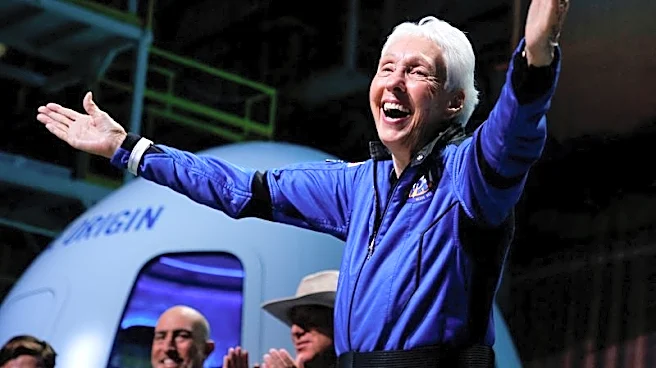
Funk, who was barred from NASA's early astronaut corps because of her gender, made headlines late in life when she joined billionaire Amazon.com founder Jeff Bezos as his honored guest along with two other passengers on the debut spaceflight of his company Blue Origin's New Shepard rocketship in July 2021.
"I didn't think I'd ever get to go up," she said in a video interview posted on Blue Origin's website when Bezos' first crew list was unveiled weeks before the flight.
The 10-minute suborbital voyage established Funk, then 82, as the oldest person ever to reach outer space, surpassing the previous record claimed by retired Mercury astronaut John Glenn, who was 77 when he returned to space in 1998 as a U.S. senator flying aboard a NASA space shuttle.
'I WANT TO GO AGAIN'
The two other passengers of Bezos' inaugural space tourism flight were his brother Mark and an 18-year-old Dutch high school graduate who became the youngest person to reach space.
Emerging from the New Shepard capsule shortly after its safe parachute landing on the floor of the Texas desert, Funk told reporters, "I've been waiting a long time," adding, "I want to go again, fast."
Visibly exuberant with her broad smile, royal blue flight suit and short-cropped head of white hair, Funk instantly won a new generation of admirers on social media and beyond as White House spokesperson Jen Psaki proclaimed her "America's new sweetheart."
Funk's record as the oldest person to reach space stood for nearly three months, until actor William Shatner, who played Captain Kirk on the 1960s sci-fi television series "Star Trek," was launched aboard Blue Origin's second New Shepard flight in October 2021.
Shatner was 90 years old at the time. Air Force veteran Ed Dwight eclipsed Shatner's record, also at 90, on a Blue Origin flight in 2024. But Funk remains in the record books as the oldest woman to have traveled to space.
Long before finally achieving her ultimate ambition of spaceflight, Funk had trained more than 3,000 pilots, logged more than 19,000 hours of flight time and amassed a list of other achievements breaking aviation-related gender barriers.
Born in 1939, Mary Wallace Funk was the first female flight instructor at a U.S. military base, Fort Sill in Oklahoma, the first female inspector for the Federal Aviation Administration and first female air safety investigator for the National Transportation Safety Board.
In 1961, Funk became the youngest of 13 women who passed the same rigorous battery of physical and psychological tests as the seven men selected for NASA's original Mercury program that sent the first Americans into space between 1961 and 1963.
Ranking among the program's leading performers, she outscored many of her male counterparts on several tests. But the women's group, dubbed the Mercury 13, were ultimately excluded from NASA's astronaut corps at the time because of their gender.
Glenn, one of the original seven Mercury astronauts and the first American to orbit Earth, had once testified before Congress in opposition to enlisting women into the spaceflight program, according to the Washington Post.
By contrast, the United States' archenemy in the Cold War-era space race, the Soviet Union, welcomed women into its early program, with Valentina Tereshkova becoming the first woman in space in 1963. The first female U.S. astronaut to reach space, Sally Ride, was finally launched to orbit in 1983.
The last surviving member of the Mercury 13, Funk went on to become the only one of the group to eventually fly to space.
(Reporting by Steve Gorman in Los Angeles; Editing by Jamie Freed)