
By Libby George and Karin Strohecker
LONDON, Jan 6 (Reuters) - After nearly a decade of default limbo, the U.S. removal of Venezuela's Nicolas Maduro has turned debt restructuring from a distant hope into
a real possibility for bondholders, fuelling a rally in its bonds.
Yet a long and formidable challenge will lie ahead to untangle more than $150 billion Venezuela owes to a web of creditors ranging from commercial bondholders and arbitration claimants to oil-backed loans to countries including China.
"I can't really see anything happening inside a couple of years," said Graham Stock of RBC BlueBay Asset Management, which holds Venezuelan debt.
"The complexity of the situation, the uncertainty on the politics, the uncertainty on the economic numbers, it's just hard to imagine it being an easy thing to achieve," he added.
Venezuela, under pressure from U.S. sanctions, defaulted on its external debts in 2017 and investors who snapped up its bonds early saw them more than double in value last year.
Some bet Washington could now play a major role in what would be among the largest and most complex restructurings ever in order to open the door for investment by U.S. oil companies.
Analysts estimate Venezuela now owes $150-$170 billion and JP Morgan calculates that $102 billion of that is in the form of bonds, while bilateral debt to China totals $13-$15 billion.
Venezuela has not reported debt figures for around a decade and state oil company Petroleos de Venezuela (PDVSA) has in the meantime struck complex oil-backed debt deals with China.
SANCTIONS, POLITICAL RISK ARE HURDLES
Despite Washington's ousting of Maduro, the main hurdles to a debt restructuring remain in place.
U.S. sanctions -- including against Venezuela's interim President Delcy Rodriguez - mean that even sitting down for creditor talks could breach U.S. Treasury Department curbs.
As well as hedge funds and asset managers such as RBC BlueBay and Canaima, which snapped up the debt at ultra-low prices in a bet on regime change, U.S. pension funds and other asset managers such as T. Rowe Price and Fidelity are also exposed. Some found themselves stuck with the debt when U.S. sanctions in 2019 prevented trading in the bonds.
"Before we figure out the sequencing of a debt restructuring, there has to be a complete change in the sanctions regime," said Gramercy chief investment officer Robert Koenigsberger, also invested in Venezuela debt.
"And that will probably be incremental," added Koenigsberger, who along with others said it was highly unlikely a restructuring deal could come this year.
Eileen Gavin, head of sovereign analysis for Verisk Maplecroft, also says investor optimism could be premature.
"It's still very high risk and very unpredictable and you know Venezuela's ability and willingness to pay or its ability to pay at least remains highly constrained," Gavin said.
BYPASSING IMF
Sovereign debt restructurings are usually underpinned by a new International Monetary Fund lending programme. However, the IMF has not published a full economic assessment on Venezuela since 2004.
Meanwhile, some investors say the United States could effectively backstop a restructuring instead of the Fund.
"The U.S. administration has an interest in moving the restructuring forward, because without that restructuring, these oil companies will not be participating and will not be investing anything," said Ed Al-Hussainy of Columbia Threadneedle Investments, which has Venezuelan bond exposure.
"The possibility of a U.S. government financial line of credit or a guarantee or a backstop of some sort is going to be music to the ears of investors," the portfolio manager added.
Lee Robinson, founder of Altana Wealth which also holds Venezuelan bonds, said there was enough at stake for the U.S. itself to put a loan in place to kickstart Venezuela's recovery.
JP Morgan said a recognition of Rodriguez's new government by the Trump administration would open many questions.
"Should the Fund be bypassed in favour of a faster-track, oil-based bilateral program, we could be going down the road of a faster-track, less orthodox bond restructuring than what we have seen in the years since the pandemic and the advent of the Common Framework," JP Morgan said.
MORE FAVOURABLE FOR SOME?
But heavy U.S. involvement could open thornier issues.
"We get down to the issue of whether Trump is going to try to favour, encourage U.S.-based financial service (companies) rather than the hedge funds that are in London," said senior fellow for Latin America at Chatham House Christopher Sabatini.
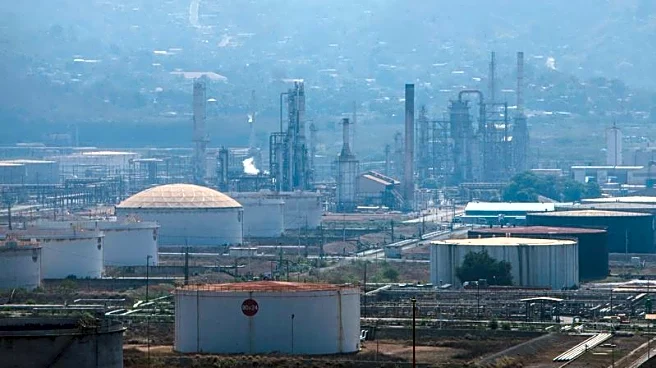
And investors have little clarity on the future shape of the economy or how much oil Venezuela could pump. After peaking above 3.7 million barrels per day in 1970, output slumped below 1 million following years of mismanagement and underinvestment.
The shadow of huge political uncertainty also looms large, with no clarity on whether or when elections might take place, whether any of those loyal to Maduro might try to disrupt the new government or how the Trump administration might follow up.
"The biggest risk is purely political," said Celestino Amore, co-founder of the Venezuela debt-focussed Canaima Global Opportunities Fund.
"This is not an investment for the faint-hearted," he added.
(Reporting by Libby George and Karin Strohecker, additional reporting by Nell Mackenzie in London and Davide Barbuscia in New York. Graphic by Marc Jones. editing by Alexander Smith)