
SHANGHAI/NEW YORK, Dec 18 (Reuters) - Lured by the promise of richer margins, a wave of Chinese consumer brands is making deeper inroads into American retail to offset sluggish spending at home.
Throughout
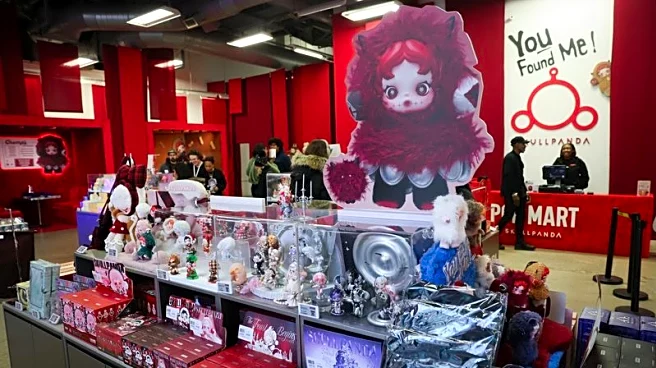
2025, companies including Labubu-maker Pop Mart, trinket purveyor Miniso, sportswear giant Anta and fast‑fashion label Urban Revivo have announced new U.S. stores or retail expansions, trying to establish a foothold in the world’s richest consumer market despite harsh U.S. tariffs and talk of economic decoupling.
The counterintuitive trend, which started to emerge in 2023 after the COVID pandemic, accelerated this year as lethargic local spending prompted Chinese consumer companies to look abroad, initially in Southeast Asia.
NEW YORK A LITMUS TEST FOR BROADER EXPANSION
Urban Revivo, often called 'China's Zara,' opened its New York flagship in March.
The company's presence in a fashion capital like New York was a litmus test for broader success elsewhere, said Leo Li, chairman and CEO of Urban Revivo's parent Fashion Momentum Group, which last year saw sales revenue approach $1 billion.
"We're only in the early stage of entering this market," Li told Reuters. "We need to continuously expand our scale and be profitable to be considered truly successful."
He said Urban Revivo’s success in the West would hinge on strategy, product and brand value, and played down the heightened U.S.–China trade tensions that have marked U.S. President Donald Trump’s return to office.
A Reuters review of company filings and social media posts found that Chinese brands, including Urban Revivo, Auntea Jenny, Chagee, Luckin Coffee and Mixue, opened their first U.S. stores in 2025. Anta soon plans to open a store in Beverly Hills.
Miniso, which celebrated its 100th store opening in 2023, had grown to 421 North American stores as of September.
A CHANCE AT 'FOUR TIMES THE MONEY'
Pop Mart, which debuted in the U.S. in 2023, operated 41 locations there by mid-2025 and signaled plans for rapid expansion.
"The U.S. market is enormous, with strong purchasing power," CEO Wang Ning said, following the release of half-year results, which showed more than 1,000% growth in North America.
The brands targeting America were already winners in China's fiercely competitive consumer market. If rewarded with success also in the U.S., they could reap profit margins far higher than they are accustomed to in Asia.
"A lot of these Chinese companies are saying: 'We grew up in China with tremendous competition, enormous pressure, and if we could do exactly the same thing in America as we did in China, we would make four times the money'," said Gabor Holch, founder of consultancy East-West Leadership.
CHINESE FIRMS ARE WINNING ON PRICE
Younger, cost-conscious Western consumers - already shopping on Chinese platforms like Shein and PDD Holdings-owned Temu offering better value with prices - would be the most likely target market, analysts said.
"Chinese brands today are positioning themselves as more affordable alternatives while building reliability," said Morningstar analyst Ivan Su. "Have you tried a pair of Chinese running shoes? They’re good."
Anta, the largest sportswear brand by market share in China ahead of Nike and Adidas, might win global consumers with its lower prices, said Andreas Döring, portfolio manager at Union Investment in Frankfurt, which holds shares in Anta.
BRAND AWARENESS POSES A CHALLENGE IN THE U.S.
Still, a broader push into the U.S. poses challenges for Chinese brands, often little known outside their homeland.
Anta's Beverly Hills store, and its sponsorship of U.S. basketball stars like Kyrie Irving, are aimed at boosting brand recognition, said Sagar Thanki, portfolio manager at Guinness Global Investors in London, another Anta shareholder.
"It's about building trust in a new market rather than going completely gung-ho with their efforts to break into the U.S.,” said Thanki.
But price, and the freshness of new brands, may sway some younger customers.
"Zara has a more sophisticated shopper," said Trina Jackson, 50, as she visited Urban Revivo's New York store last week:
"For the price," she added, "the quality is better here."
($1 = 7.1082 Chinese yuan renminbi)
(Reporting by Casey Hall in Shanghai, Nicholas Brown in New York and Helen Reid in London; additional reporting by Jessica DiNapoli in New York and Chenxi Yang in Shanghai, Editing by Lisa Jucca and Bernadette Baum)