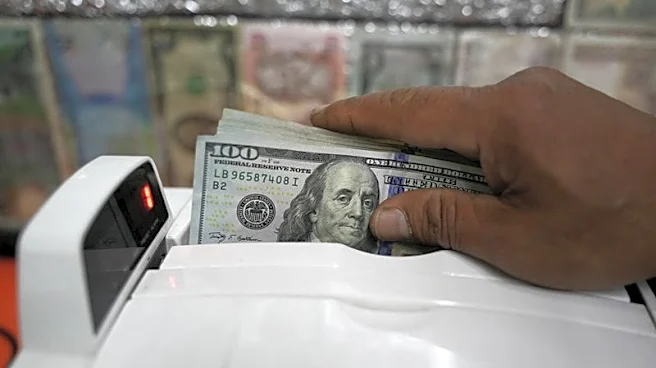






LONDON, May 28 (Reuters) - The U.S. dollar will likely weaken over the long-term given concerns over elevated debt levels in the world's biggest economy, the EMEA CEO of JPMorgan Asset Management said on Thursday.
"The hegemony of the U.S. Treasury is still alive and well...but as fixed income investors we look at the fiscal balance and trade and the ability to pay back that debt," Patrick Thomson told a panel at an International Capital Markets Association conference in London.
"There is an argument
to say over the long term the U.S. dollar will weaken. The dynamic of the fiscal position in the U.S. is creating that level of debt that is not sustainable in the long run," he added.
The dollar, typically seen as a safe-haven, has risen almost 2% against a basket of peers since the Iran war broke out in late February. It has also been helped by the U.S. position as a net energy exporter.
But recent gains followed a sharp fall last year as U.S. policy uncertainty, exacerbated by April's Liberation Day tariffs, prompted investors to seek diversification, with the euro and Chinese yuan seen as key beneficiaries.
While the Iran war has challenged Europe's economy and markets, officials speaking at the panel noted strong demand for European assets, while urging reforms to develop the region's financial markets, which lag the United States' in scope.
JPMorgan Asset Management's Thomson said Europe has a "great opportunity" to serve as a safe haven for investors, but this is predicated on reforms.
"Our business is growing substantially in Europe. We run over a trillion dollars of assets," Thomson said, adding this was driven by Germany boosting fiscal spending, European policymakers' push to put household savings to work, and diversification.
"We're seeing much more appeal to move capital back into Europe as a diversifier, because there are very attractive companies and investment opportunities."
He added that Europe could do more to encourage more retail participation in European markets.
"This is the single biggest opportunity to unlock these deposits which will lead to more issuance and more demand," he added.
If Europe really wants to compete with the United States, it needs deeper capital markets, said Valerie Urbain, chief executive officer at depository Euroclear.
"For that, we need to have more investors and more issuers," she added.
(Reporting by Yoruk Bacheli and Nell Mackenzie; Writing by Dhara Ranasinghe; editing by Alun John)