



By David Shepardson
WASHINGTON, Feb 10 (Reuters) - The Federal Aviation Administration said on Tuesday its contract with national security firm Peraton, the project manager of a $12.5-billion effort to overhaul the aging U.S. air traffic control system, was worth $1.5 billion.
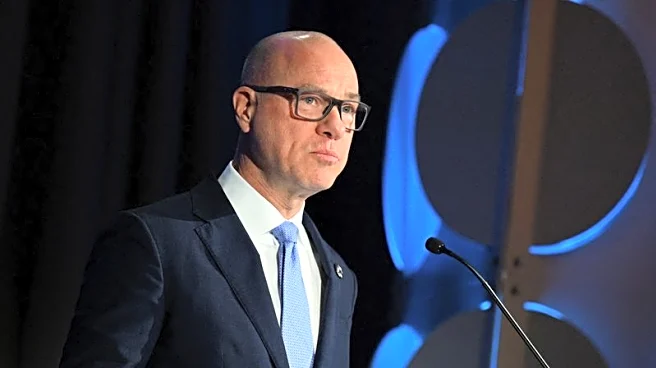
In a briefing to House of Representative lawmakers, FAA Administrator Bryan Bedford said U.S. President Donald Trump in December negotiated a $200 million discount off the initial proposed contract price for Peraton, which is owned
by Veritas Capital.
"The FAA was always going to need an implementation and integration partner," Bedford said.
The FAA made public on Tuesday a presentation it gave to Congress that included the $1.5 billion figure and details of the innovative contract that includes a "No Excuses" requirement and fees are earned or lost based on achieving schedule, quality, cost control and management metrics.
Bedford said one key issue in overhauling air traffic control is to take the various computer systems at 318 FAA facilities and put them into a modern cloud-based system.
"We've got to get out of these tiny facility computers and into infinite compute power in the cloud," Bedford said. "That is going to be what unlocks true airspace redesign opportunities."
Bedford said $1.6 billion has been obligated through December 31 and 40% of telecommunications connections have been upgraded as it moves from copper wire to fiber and wireless connections and 612 radar systems will be installed by June 2028 at a cost of $1.1 billion. A $420 million contract to RTX includes another $270 million performance-based payment.
Bedford will brief Senators on Wednesday.
Congress approved the air traffic control overhaul in June to boost controller hiring, following decades of complaints over airport congestion, technology failures and flight delays. Transportation Secretary Sean Duffy has asked for another $19-$20 billion to complete the overhaul and build a new system.
The FAA is about 3,500 air traffic controllers short of targeted staffing levels and many are working mandatory overtime and six-day weeks. The FAA also faces a more than 30% failure rate at its air trafffic control academy.
The FAA has a scorecard to track where reform efforts are ahead or behind its plans and now can take a multi-year approach.
"It actually allowed the FAA to do what it needed to do all along, which was take a multi-year approach to modernization," Bedford said.
(Reporting by David Shepardson; Editing by Chris Reese and Michael Perry)