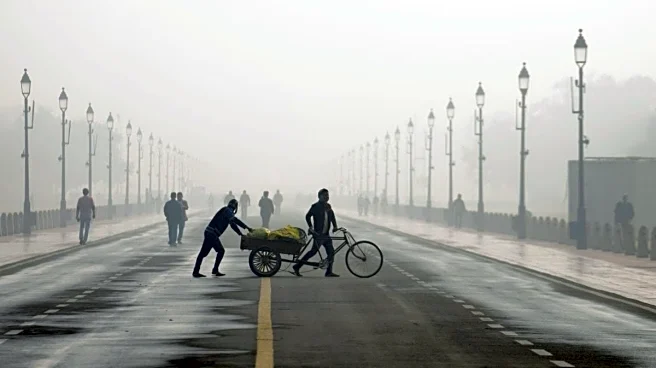

As New Delhi remained enveloped in a toxic haze in the last two months, a new assessment has shown the worsening air quality in the national capital is not solely due to high PM2.5 concentration.
While
the attention remains on daily PM2.5 peaks, the rising levels of equally harmful gases – nitrogen dioxide (NO2) and carbon monoxide (CO) – have largely gone unnoticed, which underscores the need to intensify action on local sources.
According to the latest winter air assessment led by New Delhi-based Centre for Science and Environment (CSE) – based on air quality data accessed from the Central Pollution Control Board (CPCB) from October 1 to November 15 – PM2.5 dominated the air quality index (AQI), but other harmful gases went unnoticed.
The assessment shows that PM.2.5 (particulate matter) rose and fell almost in tandem with NO2 in the morning (from 7 am to 10 am) and evening hours (6 pm to 9 pm), as both pollutants surge with traffic emissions and get trapped under the shallow winter boundary layers. But the surge in NO2 is sharper and more immediate as compared to PM2.5, which tends to accumulate and disperse more slowly.
Experts warned against the harmful impacts of another toxic gas, CO, which is predominantly emitted by vehicles and has shown widespread spikes across Delhi this winter. At least 22 monitoring stations recorded CO levels above the eight-hour standard on more than 30 of the 59 days, indicating persistent traffic-linked emissions.
“Dwarka Sector-8 was the worst-affected with 55 exceedance days, followed by Jahangirpuri and North Campus (Delhi University), each reporting 50 days of violations,” the report noted.
“This cocktail of pollutants also makes the air more toxic to breathe. Yet, every winter, pollution control efforts are dominated by dust control measures with feeble action on vehicles, industry, waste and solid fuel burning. What’s more worrying is the daily synchronised rise of PM2.5 and other toxic gases such as nitrogen dioxide (NO2) and carbon monoxide (CO), largely from vehicles and combustion sources,” said Anumita Roychowdhury, executive director-research and advocacy, CSE.
PEAK PM2.5 LOWER THAN LAST YEAR, BUT AIR STILL TOXIC
Even though the overall pollution levels remained elevated at dangerous levels, the peak pollution during this early winter reduced due to lower impact of farm fires.
The contribution of farm fires to the daily pollution levels remained below 5 percent for most part of the early winter, surging to 5 percent to 15 percent on some days and peaking to 22 percent on November 12 and 13. The report stated that both the average and peak levels were lower compared to the previous three winters.
The October-November PM2.5 average was 9 percent lower than the previous year, and even the worst peaks appear slightly reduced. But experts highlighted that even though the peak pollution spikes were lower this winter due to lesser contribution of farm fires, the airshed is becoming increasingly more saturated.
“When compared to the 3-year baseline for early winter, the average has not changed at all, it has plateaued at the same unhealthy level. Winter looks better only when compared to last year’s extreme, in real terms, pollution remains consistently high,” said Sharanjeet Kaur, deputy programme manager, Urban Lab, Clean Air unit, CSE.
MORE POLLUTION HOTSPOTS EMERGING ACROSS DELHI
The report raised an alarm over the increase in the number of pollution hotspots across Delhi. In 2018, about 13 hotspots were officially identified where the pollution levels exceeded not just the standard levels but also the city average levels.
Jahangirpuri was found to be the most-polluted hotspot, followed by Bawana and Wazirpur, Anand Vihar and Mundka, Rohini and Ashok Vihar. Over the years, however, more hotspots have emerged – like Vivek Vihar, Nehru Nagar, Alipur, Siri Fort, Dwarka Sector-8 and Patparganj.
The long-term air quality trend in Delhi showed a decline in year-on-year PM2.5 levels between 2018 and 2020, but since 2021-2022, the levels have remained largely elevated – recording a sharp increase in 2024 – signalling urgent need to upscale action to cut emissions from vehicles, industry, power plants, waste, construction and household energy.


/images/ppid_a911dc6a-image-177092774715746114.webp)

/images/ppid_a911dc6a-image-177092767520012684.webp)
/images/ppid_a911dc6a-image-177092763347449403.webp)
/images/ppid_a911dc6a-image-177092652580356823.webp)





/images/ppid_a911dc6a-image-177092306157991736.webp)