
/images/ppid_a911dc6a-image-177098257337184325.webp)

/images/ppid_59c68470-image-177098253498858527.webp)
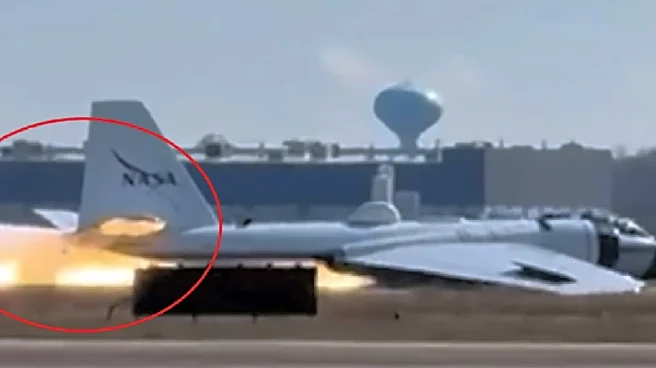
A NASA research aircraft made a gear-up landing at Ellington Airport in Houston late Tuesday morning after experiencing a mechanical issue, according to US broadcaster KHOU 11.
Video footage that circulated on social media showed the aircraft landing without its landing gear deployed and sliding along the runway before coming to a stop.
Ground video shared by X account @rawsalerts appeared to show a brief burst of flames near the rear section of the aircraft as it slid along the runway. The fire was short-lived and quickly contained.
KHOU 11 reported that the pilot was able to climb out of the cockpit with the assistance of emergency responders.
Houston Airports said the incident occurred at around 11.30 am local time as the aircraft was landing
on Runway 17R–35L at Ellington Airport. First responders associated with a military subcontractor handled the emergency response, the airport authority said.
NASA later confirmed that a mechanical issue led to the gear-up landing involving one of its WB-57 high-altitude research aircraft. The space agency said all crew members on board were safe and no injuries were reported.
🚨#BREAKING: Watch as a NASA research jet made a belly landing when it bursted into flames at after its landing gear apparently failed to deploy
⁰📌#Houston | #Texas⁰
Watch wild footage captured after a NASA WB-57 research aircraft was forced to make a belly landing at… pic.twitter.com/mkb27JVWeC— R A W S A L E R T S (@rawsalerts) January 27, 2026
The runway was temporarily closed while crews worked to secure and remove the aircraft, Houston Airports officials told the broadcaster.
The aircraft involved was a NASA WB-57 research plane based at the Johnson Space Center near Ellington Field. NASA operates three WB-57 aircraft from the facility as part of its High Altitude Research Program.
According to NASA, the WB-57 is a long-range, mid-wing research aircraft capable of flying at altitudes above 63,000 feet. It typically carries two crew members — a pilot and a sensor equipment operator — and is used for scientific and atmospheric research missions.
NASA said it will conduct a thorough investigation into the incident and will provide updates as more information becomes available.








/images/ppid_59c68470-image-177098254670211340.webp)

/images/ppid_59c68470-image-177098259278152467.webp)
/images/ppid_59c68470-image-177098263100352519.webp)