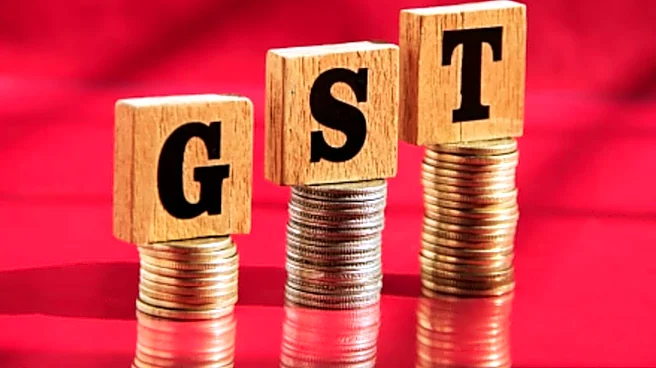




Smartphone makers and manufacturers have renewed their demand for a steep reduction in the goods and services tax (GST) on mobile phones, arguing that the current 18% levy is making devices increasingly unaffordable and hurting demand, particularly in the entry-level segment.
The India Cellular and Electronics Association (ICEA), which represents companies including Apple, Xiaomi, Oppo, Vivo, Dixon, Bhagwati and Lava, has urged the government to consider cutting the GST on smartphones to 5% from the current 18%.
In representations dated September 2 and 3, the industry body urged Finance Minister Nirmala Sitharaman and Electronics and IT Minister Ashwini Vaishnaw to take up the proposal at the next meeting of the GST Council.
The GST Council meeting
is expected to take place on October 7, according to news agency PTI citing sources.
ICEA has also called for a corresponding rationalisation of GST rates on mobile-phone components. The association said the move is necessary as domestic smartphone consumption remains under pressure, replacement cycles are getting longer and prices have risen sharply.
One of the key concerns highlighted by ICEA is the sharp increase in memory costs. According to the industry body, prices of mobile DRAM and NAND flash have risen roughly fourfold since September 2025, partly because AI data centres are consuming a growing share of global memory capacity.
The increase has fed into smartphone prices in India. ICEA estimates that entry-level handset prices have climbed by around 35-45% across brands over the past year.
The impact has been particularly visible in the sub-Rs 10,000 category. ICEA said the availability of smartphones below this price point has fallen to less than 5% of the market.
Manufacturers, the association said, are able to absorb only a portion of the higher memory costs, with the remaining burden eventually passed on to consumers.
ICEA has pointed out that under the existing 18% GST structure, every Rs 1 increase in the pre-tax cost of a handset effectively adds another 18 paise to the tax burden.
The industry body believes a reduction in GST would bring down the upfront price of smartphones and help revive replacement demand. The impact, it said, would be particularly important for first-time smartphone buyers, rural consumers and households with lower incomes. Cheaper devices could also accelerate the migration of feature-phone and 2G users to smartphones.
ICEA is also making a case based on the tax structure that existed before GST was introduced. When GST came into force in July 2017, mobile phones were placed in the 12% GST slab. The rate was subsequently raised to 18% in April 2020.
Before GST, mobile phones attracted 1% basic excise duty, while VAT imposed by most states was generally 5% or lower, although the actual rates varied across states. ICEA’s earlier representations had estimated the effective composite tax incidence at around 6%, while its latest submission puts the weighted-average pre-GST incidence at approximately 7%. The association therefore argues that a 5% GST rate would be closer to the original tax-fitment approach.
ICEA’s demand for a lower GST rate comes even as India’s mobile-phone manufacturing industry has expanded dramatically. According to the association, domestic mobile-phone production increased from Rs 18,900 crore in FY2014-15 to Rs 6.27 lakh crore in FY2025-26. During the same period, mobile-phone exports rose from Rs 1,566 crore to Rs 2.60 lakh crore.
India is now the world’s second-largest mobile-phone manufacturer by volume, while mobile phones emerged as the country’s largest export product in FY2025-26, ICEA said. However, the association believes the rapid growth in manufacturing and exports needs to be supported by stronger domestic consumption.
A larger and more predictable Indian market, it argued, would give manufacturers and suppliers greater visibility on production volumes and encourage further investment in components, product development, distribution networks and after-sales services.
ICEA has also sought to address concerns over the potential revenue impact of lowering GST on smartphones. The association argued that the government may not necessarily lose revenue in proportion to the reduction in the tax rate. Higher handset volumes, increased formalisation of purchases that currently take place through the grey market, and GST collections generated from mobile data, subscriptions and other digital services could partly offset the initial revenue impact.
The industry body had raised a similar proposal during the GST restructuring exercise last year. It now believes the case for a lower rate has become stronger because smartphone prices have increased further while domestic demand has remained subdued.
In its representation to Vaishnaw, ICEA has specifically sought his support in taking up the issue with Sitharaman and recommended that the proposal be placed before the forthcoming GST Council meeting.
The proposed reduction, if accepted, would mark a significant reversal from the 18% GST rate currently applicable to smartphones and could provide some relief to consumers at a time when higher component costs are pushing up handset prices.
/images/ppid_59c68470-image-178946005551469742.webp)






/images/ppid_59c68470-image-178929502525078723.webp)