
/images/ppid_a911dc6a-image-177909553142630500.webp)


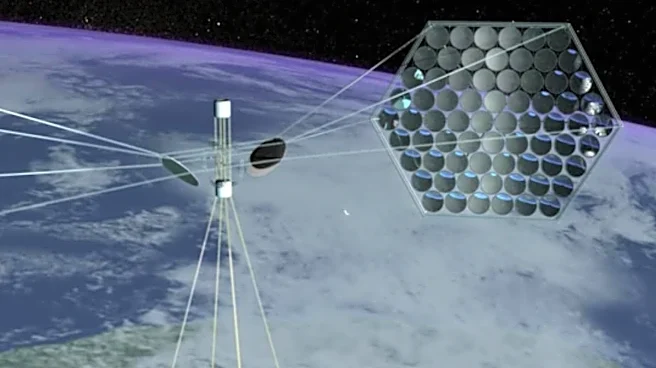
A futuristic idea once confined largely to science fiction- orbiting solar power stations beaming energy wirelessly back to Earth- may be inching closer to reality after Chinese researchers successfully tested a system capable of transmitting power to multiple moving targets simultaneously. Scientists at Xidian University in Xian developed a wireless power transmission platform that can beam kilowatt-level microwave energy across distances while accurately tracking moving objects, South China Morning Post reported.
Read more: New Way To Fire? Mark Zuckerberg’s Meta Tells Employees To Work From Home Before 8,000 Job Cuts
The breakthrough is being viewed as a key step in China’s long-term ambitions to build space-based solar power stations that
collect energy in orbit and wirelessly transmit it to satellites, drones, lunar bases and potentially even Earth.
How The System Works?
At the centre of the project is a 75-metre tower built as part of a ground verification platform designed to simulate the full process of space-based energy transmission before any orbital deployment. The system reportedly transmitted 1,180 watts of power across roughly 100 metres while maintaining precise microwave beam control. Researchers also successfully powered a moving drone flying at around 30 km/h, transmitting 143 watts from approximately 30 metres away.
The ability to continuously track and power moving targets is considered one of the biggest engineering hurdles in wireless energy transmission systems. The project is being led by senior engineer Duan Baoyan, who has spent years promoting China’s “Zhuri” or “Chasing the Sun” initiative focused on orbital solar power.
Why Space-Based Solar Power Matters
Unlike solar panels on Earth, orbiting solar power stations would receive uninterrupted sunlight in space, potentially generating electricity 24 hours a day without weather disruptions or nighttime losses. The idea involves collecting solar energy in orbit, converting it into microwave beams and transmitting it wirelessly to receiving stations on Earth or other spacecraft.
Read more: ‘World Not Becoming Safer’: Why Ebola, Hantavirus And Other Outbreaks Are Spreading Faster
China first proposed an ambitious orbital solar power station project called Omega in 2014. The original plan envisioned a giant structure positioned in geostationary orbit roughly 36,000 kilometres above Earth. However, newer designs published in 2023 shifted towards smaller modular systems working together, an approach intended to overcome the immense engineering challenges of constructing a single massive orbital structure.
How China Compares Globally
China is not alone in pursuing wireless power transmission technology. In 2023, researchers at the California Institute of Technology successfully transmitted microwave energy between lightweight components in orbit using a prototype launched aboard a SpaceX rocket. NASA has also experimented with microwave power transmission for decades. A 1975 experiment by NASA Jet Propulsion Laboratory achieved a higher overall efficiency of 54 per cent under controlled laboratory conditions.
/images/ppid_a911dc6a-image-177911656340458566.webp)

/images/ppid_a911dc6a-image-177908152831176407.webp)
/images/ppid_59c68470-image-177908510231472887.webp)


/images/ppid_59c68470-image-177920502915469177.webp)
/images/ppid_59c68470-image-177915505907040707.webp)
/images/ppid_59c68470-image-177910506462195765.webp)
/images/imfZ6nBC-image-177916280469219736.webp)

/images/ppid_59c68470-image-177906753204556835.webp)