
/images/ppid_a911dc6a-image-178224552881138952.webp)
/images/ppid_a911dc6a-image-178224543031178249.webp)
/images/ppid_a911dc6a-image-178224546420834408.webp)


Hollywood sequels often arrive with big expectations, bigger budgets, and an even bigger pressure to match the legacy of what came before. But sometimes, even with all the scale and star power, something still feels off to audiences—and, as it turns out, to the original cast as well.
That conversation has resurfaced after actor Russell Crowe recently reflected on why the 2024 film Gladiator II didn’t manage to land the same impact as the classic it followed.
Speaking at a panel during the Taormina Film Festival, Crowe revisited not just the sequel, but also the creative philosophy behind the original 2000 epic Gladiator, where he played the iconic role of Maximus.
Crowe recalled the intense discussions that took place during the making of the first
film, especially around the direction of his character arc. He shared that there was early pressure from the studio to introduce romantic or sexual subplots that he felt would weaken the emotional foundation of the story.
“When we were shooting that film, there was a lot of pressure. The studio, the producers [thought] there should be sex between Maximus and the female characters. I kept pushing back. This is the story of a man avenging the death of his wife and his child. There cannot be a moment in that journey where he stops and has sex with somebody. It doesn’t make any sense because that destroys the journey,”
According to Crowe, director Ridley Scott ultimately agreed with his perspective, and those narrative elements were dropped. The focus, he suggested, remained tightly locked on Maximus’ emotional and moral drive.
Crowe then shifted to the performance of the follow-up film. Despite the scale and anticipation surrounding it, Gladiator II struggled to replicate the commercial and critical momentum of the original.
Released in 2024, the sequel earned around $462 million globally. However, with a reported production budget of about $310 million, industry analysis suggested it only just about broke even after marketing and distribution costs were considered.
By contrast, the original Gladiator, made on a far smaller budget of roughly $100 million, went on to collect $466 million worldwide in 2000. Beyond the box office numbers, it also became a major awards-season success, winning five Academy Awards, including Best Picture and Best Actor for Crowe.
In his comments, Crowe pointed toward a fundamental difference in storytelling approach between the two films. He suggested that the sequel missed the emotional foundation that helped the original resonate so widely with audiences.
“It’s very interesting because the second movie barely took the same box office that the first movie took. That’s 20 years later. When you apply how much of a change there’s been on the value of a dollar, they failed. They failed because they didn’t understand why [the original movie] was successful — it had a moral core.”
His remarks underline a broader point about legacy sequels: scale alone doesn’t guarantee impact, especially if the emotional or thematic backbone is diluted.
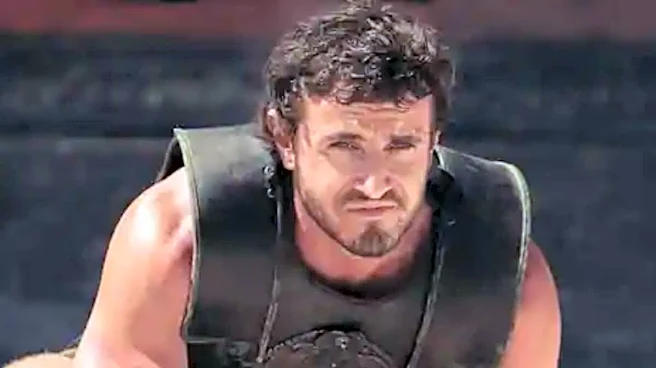
The sequel stars Paul Mescal as Lucius, a character returning to Rome under drastically changed circumstances. The story follows him as he is taken prisoner and trained as a gladiator under Macrinus, played by Denzel Washington, a former slave with his own ambitions tied to the empire’s power struggle.
Set years after the events of the original film, the narrative attempts to expand the Roman world while introducing new political tensions and character arcs.




/images/ppid_a911dc6a-image-178225252889317608.webp)

/images/ppid_a911dc6a-image-178225252600774263.webp)
/images/ppid_a911dc6a-image-17822490329161765.webp)