
/images/ppid_59c68470-image-178089256131494212.webp)

/images/ppid_59c68470-image-178089503142770047.webp)
India’s huge population has long been seen as a major advantage, which allows companies, both Indian and abroad, to utilize human capital at lower rates than in other developed countries. For several decades, this demographic edge has been hailed by experts and industry veterans and being seen as a major factor in India’s growth story and development.
India’s demographic advantage has historically been closely tied to the global outsourcing industry. Multinational companies have long shifted customer support, operations, back-office processes, software development and other business functions to India due to its large pool of skilled workers and lower labour costs.
India’s IT industry, one of the country’s biggest economic success stories, was
built on the back of a large, skilled workforce that attracted outsourcing contracts from companies across the world.
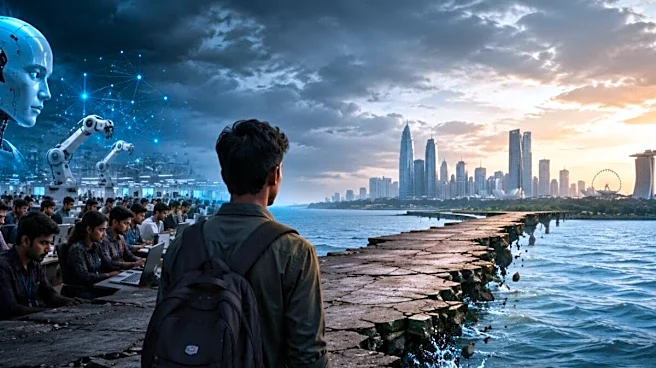
But dynamics have now changed after the emergence of artificial intelligence.
A US-based prop-tech company, Opendoor, has announced shutting down its India operations by laying off the entire 250 staff at one go. This move came in less than two years after expanding its presence in India. It has raised a lot of questions on outsourcing and demographic advantage.
“Opendoor had nearly 250 employees in India. Over the last few months, some of these jobs have been relocated back to the United States. Today, we are finalizing bringing these roles to our customers in America and beginning the process of winding down our India-based operations,” Opendoor CEO Kaz Nejatian wrote in the X post.
Explaining the rationale behind the move, Nejatin said that they have hired small AI-native customer-facing teams throughout the US to handle manual workflows across fragmented systems. “For years, Opendoor built a large team in India to handle across fragmented systems. As we’ve unified these systems and have hired small AI-native customer-facing teams throughout the US, we need all this operational work to be done in person and close to our customers,” Nejatian added in the post.
The CEO said that Opendoor 2.0 will be a small company by headcount. “Our people, aided by the tools we have built, will own more, build more, and have broader scope than ever before,” he added.
There are a lot of talks and debates about whether AI will change manual work.
Keshav Lohia, early stage VC at Emergent Ventures, wrote on X that ‘the entire outsourcing playbook has moved’. He calls it a ‘watershed moment’ in AI ops and believes that they might see the do away with operations-heavy workforces to nimble AI-native teams on-shore.
Echoing the same tone, Sheel Mohnot co-founder of Better Tomorrow Ventures, believes that a lot of jobs will be lost in India due to AI. “As manual work gets replaced by AI, a lot of jobs will be lost in India,” Mohnot wrote in the X post.
Shriram Krishnamurthi, a professor of Computer Science at Brown University, said, “AI is coming for offshored Indian jobs”.
Investors welcomed Opendoor Technologies’ move as shares climbed 3.23 per cent to $4.48 per share.
It’s too early to extrapolate or say anything. But AI is rapidly advancing and has put a question to all people across the globe.


/images/ppid_59c68470-image-178101753836759673.webp)

/images/ppid_59c68470-image-178103010147018680.webp)


/images/ppid_59c68470-image-178115753185867871.webp)


/images/ppid_59c68470-image-178091007117058933.webp)