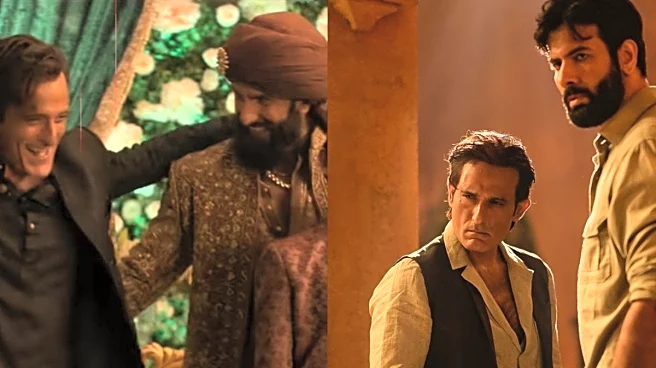

Aditya Dhar’s Dhurandhar is packed with controlled violence, moral ambiguity, and characters who rarely wear their emotions on their sleeves. Yet, tucked inside its tense world are fleeting moments of
unexpected warmth. One such moment arrives during the song Shararat, when Akshaye Khanna’s character suddenly breaks into dance, a gesture that feels spontaneous, intimate, and deeply human.
According to actor Danish Pandor, who played Uzair Baloch in the film, that moment was never choreographed in the conventional sense.
The Dance Was Never Planned
Pandor confirms that Akshaye Khanna’s movement during Shararat was entirely improvised.
“Yes, it was,” Pandor says. “There was already a dance sequence happening, and we were meant to greet Hamza and Sara on stage. But what Akshaye sir did in that moment came purely from how the character was feeling.”
Are we seriously gonna ignore Akshaye Khanna’s smooth exit in the song “Shararat”, just because “Sher-e-Baloch” exists?#Dhurandhar #DhurandharMovie #AkshayeKhanna pic.twitter.com/HsSHgNoHKb
— Akash Srivastava (@thisizakash) December 12, 2025
Much like Khanna’s now-discussed impromptu dance in FA9LA, this moment emerged organically on set, without premeditation or rehearsal.
Understanding Rehman’s Emotional Language
Pandor explains that Rehman, Akshaye Khanna’s character, is written as a man of few words. Throughout Dhurandhar, he remains restrained, controlled, and emotionally guarded.
“If you look at Rehman across the film, he’s a man of very few words. He’s restrained, measured, almost closed-off,” Pandor notes.
But the wedding sequence changes the emotional temperature.
“At the end of the day, he’s still human. He feels joy. He wants to celebrate. Someone from his own gang is getting married. There’s happiness, relief, and a rare sense of lightness.”
The dance, Pandor says, was not about performance or flair. It was Rehman’s way of expressing joy without dialogue.
“That sudden burst into dance wasn’t about choreography. It was emotional expression. It was his way of saying ‘I’m happy’ without saying anything at all.”
When Choreography Recognised Emotion
Interestingly, even the film’s choreographer recognised the authenticity of the moment.
Pandor recalls watching an interview with choreographer Vijay Ganguly, who spoke about discovering the significance of the movement during editing.
“While editing, he felt the moment needed a signature movement. When he saw what Akshaye sir had done organically, he immediately understood that this was the moment,” Pandor shares.
What makes the anecdote striking is that Ganguly, despite being a choreographer, did not try to enhance or stylise the movement.
“Even as a choreographer, he recognised what the character was trying to communicate emotionally. It was exactly what the scene demanded.”
/images/ppid_a911dc6a-image-177099523372082313.webp)

/images/ppid_a911dc6a-image-177099523000247381.webp)
/images/ppid_59c68470-image-177099507473134483.webp)

/images/ppid_59c68470-image-177099511909742240.webp)
/images/ppid_59c68470-image-177099503123072195.webp)