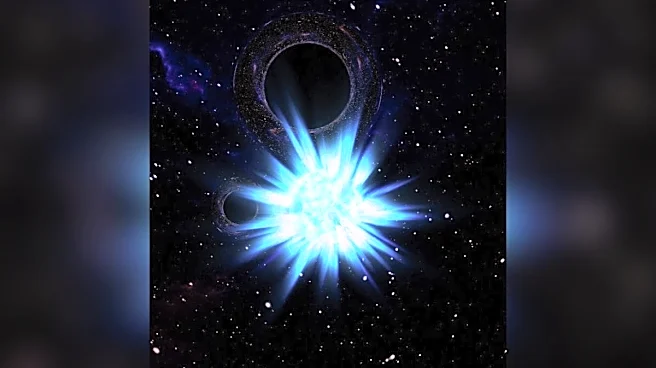




Some of the most massive stars in the universe may die in explosions so powerful they leave no trace behind, according to new research that offers the strongest evidence yet for a long-theorised class of “obliterating” supernovas.
Astronomers have long known that when most stars exhaust their nuclear fuel, they end their lives in violent supernovas that fling stellar material into space and leave behind dense remnants such as neutron stars or black holes.
But for the largest stars, scientists have suspected since the 1960s that their deaths might be even more extreme: instead of collapsing into a compact object, they could be completely destroyed.
According to a report by Reuters, a new study published on Wednesday in the journal Nature provides
indirect support for this idea, using observations of black holes and gravitational waves – ripples in spacetime – to probe the final moments of these cosmic giants.
The work focuses on stars with masses between about 140 and 260 times that of the sun, said lead author Hui Tong, a doctoral student in astrophysics at Monash University in Australia. Despite their enormous size, these stars live fast and die young.
“Despite their enormous mass, they live relatively short lives, about a few million years. For comparison, the sun will live for about 10 billion years, so these stars burn out roughly a thousand times faster – like a massive firework that burns intensely and briefly before exploding,” Tong said.
Ordinarily, the explosion of a massive star leaves behind a neutron star, the collapsed core of the original object. Even larger stars typically form black holes, extraordinarily dense objects whose gravity is so strong that not even light can escape. In these cases, the black hole retains part of the original star’s mass while the rest is blasted into space.
To test what happens to the very largest stars, the researchers analysed data from 153 pairs of black holes whose masses were measured using gravitational waves emitted as they spiralled together and merged. They first removed from the sample any black holes that had clearly formed from previous mergers of smaller black holes.
What remained revealed a striking pattern: a complete absence of black holes with masses between about 44 and 116 times that of the sun, a gap the team described as a “forbidden range”.
The scientists argue that this missing population is best explained if stars that would be expected to leave behind black holes in that mass range instead end their lives in a rare and catastrophic event known as a pair-instability supernova, which destroys the star entirely.
“A pair-instability supernova is one of the most violently explosive types of stellar deaths,” said astrophysicist and study co-author Maya Fishbach of the University of Toronto’s Canadian Institute for Theoretical Astrophysics.
“For the most part, massive stars make black holes. The more massive the star, the heavier the black hole,” Fishbach said, until stars reach a certain mass threshold beyond which the physics of their explosive demise dictates that there is no stellar remnant left behind.
These huge stars evolve much like other massive stars at first, fusing hydrogen and helium in their cores and building up a large core composed mainly of carbon and oxygen. The core’s stability depends on a balance between the inward pull of gravity and the outward push of energy, carried in this case by high-energy photons – the particles that make up light.
At the extreme temperatures inside such stars, some of these photons convert into pairs of subatomic particles called electrons and positrons. This process weakens the outward pressure that had been helping to support the core against gravitational collapse. The creation of these particle pairs, and the instability they trigger, gives this type of supernova its name.
“The core becomes unstable, leading to a runaway collapse and then a violent thermonuclear explosion that blows the star apart,” Tong said.
While these supernovas were first predicted six decades ago, Fishbach said, “they are rare and difficult to find and identify.”
Astronomers have observed a class of stellar explosions known as superluminous supernovas that are considered candidates for pair-instability events. These blasts can shine more than 10 billion times brighter than the sun. But the new black hole mass gap revealed in this study may be the strongest evidence yet that pair-instability supernovas really occur.
“We are essentially using something invisible, black holes, as a record of some of the brightest explosions in the universe,” Tong said.


/images/ppid_a911dc6a-image-177524552946592325.webp)








/images/ppid_59c68470-image-177524252899637980.webp)

/images/ppid_a911dc6a-image-177524206328463302.webp)
/images/ppid_a911dc6a-image-177524214123849498.webp)