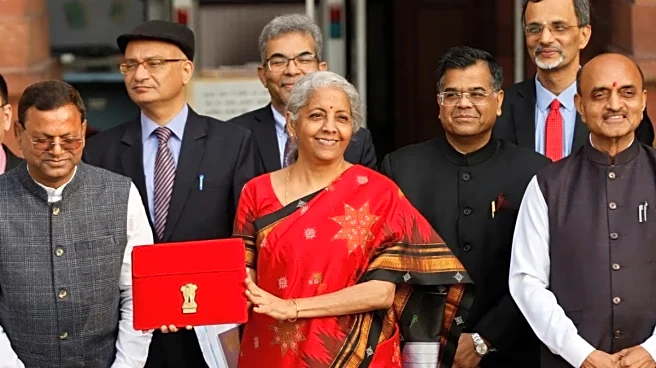

In the annals of India’s economic history, the Union Budgets presented under Prime Minister Narendra Modi’s leadership have consistently marked turning points, steering the nation toward unprecedented
growth and self-reliance. As we approach the 2026 Union Budget, set to be unveiled on February 1, 2026, anticipation is at an all-time high. This budget, the ninth consecutive one under Finance Minister Nirmala Sitharaman, promises to be a cornerstone in realising the vision of Viksit Bharat by 2047—a developed India that stands as a global economic powerhouse. Building on the foundations laid by previous Budgets, which have propelled India from a fragile economy under the erstwhile Congress, to the fastest-growing major economy in the world, the 2026 Budget is poised to accelerate this momentum with innovative policies, strategic investments and inclusive reforms.
Under PM Modi’s stewardship, India has witnessed transformative changes. From the implementation of the Goods and Services Tax (GST 1.0 & 2.0) that unified the market to the Atmanirbhar Bharat initiative that boosted domestic manufacturing, each step has been geared towards sustainable development. The economy has rebounded strongly post-pandemic, with real GDP growth estimated at 7.4 per cent for FY 2025-26, surpassing earlier projections of 6.5 per cent. This resilience is a testament to the government’s proactive measures, including record capital expenditure (capex) and targeted fiscal stimulus. The 2026 Budget will likely build on this by setting a fiscal deficit target of 4.3 per cent or thereabouts for FY27, ensuring fiscal discipline while fuelling growth.
What makes this budget path-breaking is its holistic approach: blending economic prudence with social equity, technological innovation with traditional sectors, and global ambitions with local empowerment. It will not just allocate funds but redefine India’s developmental trajectory, making it more inclusive, innovative, and invincible. At the heart of this optimism is PM Modi’s unwavering commitment to ‘Sabka Saath, Sabka Vikas, Sabka Vishwas’—inclusive growth that leaves no one behind. Pre-budget consultations, involving economists, industry leaders, farmers, start-ups, and state representatives, have been extensive, ensuring diverse voices shape the policy framework. These discussions highlight priorities like job creation, infrastructure boost and tax reforms, all aligned with making India a $5 trillion economy sooner than anticipated. As the world grapples with geopolitical uncertainties, India’s Budget will showcase its ability to thrive amidst challenges, drawing praise from international bodies like the IMF, which credits Modinomics for reforms and public investments.
This Budget will be path-breaking because it embodies a forward-looking vision, turning aspirations into actionable plans that propel India towards global leadership. The 2026 Budget is expected to cement India’s position as a global growth engine by emphasising robust economic expansion coupled with impeccable fiscal management. With GDP growth projected at 7.4 per cent for FY26, driven by strong domestic demand and resilient exports, the Budget will likely prioritise measures that sustain this upward trajectory.
PM Modi’s economic policies have already transformed India into a beacon of stability, with the Reserve Bank of India upgrading its growth forecast to 7.3 per cent, fuelled by private consumption and rural demand. This optimism stems from strategic reforms like GST rate reductions on nearly 375 goods and services, which have eased inflationary pressures and boosted consumer spending. A key highlight will be the Modi government’s commitment to fiscal consolidation without compromising on growth. Economists anticipate a realistic fiscal deficit target of around 4.3 per cent, down from previous years, allowing for increased borrowing efficiency and reduced interest burdens. This prudence will free up resources for productive investments, ensuring long-term fiscal resilience.
The Budget may also feature enhanced RBI dividends and optimised revenue streams, further strengthening the fiscal position. Such measures will not only maintain investor confidence but also attract foreign direct investment (FDI), which has surged under Modi due to ease-of-doing-business (EODB) related reforms. Moreover, the Budget will likely introduce tax reliefs to stimulate consumption and investment. Expectations include raising the income tax slab for the highest bracket from Rs 15 lakh to Rs 20 lakh or more, providing relief to the middle class and encouraging savings.
For businesses, simplified compliance and incentives for mergers and acquisitions will foster a competitive environment. The new tax regime, already popular, could be sweetened with deductions for housing and education, making it more appealing. These reforms will drive private sector participation, complementing the Modi government’s capex push, projected to rise by 12 per cent as recommended by industry bodies like CII.
What sets this Budget apart is its focus on high-quality job creation, addressing the needs of India’s youthful workforce. Initiatives like designating 350 poorest districts as Special Employment Zones, with incentives of Rs 2000 per month for new hires, will generate millions of opportunities. Coupled with labour reforms that enhance workforce readiness, this will create a virtuous cycle of employment, consumption and growth. The Budget’s emphasis on macroeconomic stability, controlled inflation, a narrowing current account deficit and a strong banking sector, will ensure India remains resilient against global headwinds.
By balancing ambition with accountability, the 2026 Budget will lay a solid foundation for India’s journey to a $10 trillion economy, making it truly path-breaking. Building the backbone of a modern infrastructure has been the hallmark of PM Modi’s governance and clearly, the 2026 Budget is set to elevate it to new heights, transforming India into a world-class hub of connectivity and urbanisation. With pre-Budget consultations involving experts from infrastructure, energy and urban sectors, the Budget will allocate substantial funds to projects that enhance productivity and quality of life.
Expectations point to a 10-12 per cent increase in central government capex, pushing total investment to over Rs 11 lakh crore, focusing on roads, railways, ports and airports. The Budget will likely accelerate the National Infrastructure Pipeline (NIP), with emphasis on high-speed rail corridors, expressways and smart cities. Initiatives like the PM Gati Shakti scheme will see enhanced funding, integrating multimodal transport to reduce logistics costs and boost exports. In energy, a thrust on renewable sources—solar, wind and green hydrogen—will align with India’s net-zero goals by 2070, creating jobs in emerging sectors while ensuring energy security.
Urban development may receive a major boost, with allocations for upgrading 5000 census towns through Rs 10-20 crore annual grants, improving infrastructure and generating service jobs. Top cities may get Rs 5000-10,000 crore for mobility enhancements, making urban living more sustainable and efficient. This focus is path-breaking because it addresses urbanisation challenges head-on, turning cities into engines of growth.
By investing in affordable housing, water management and digital infrastructure, the Budget will promote inclusive urbanism, benefiting millions. The multiplier effect of these investments—every rupee in capex generates 2-3 times in economic output, will drive broad-based prosperity. PM Modi’s vision ensures that infrastructure isn’t just about building assets but about empowering communities, making the 2026 Budget a blueprint for a connected, vibrant India. The 2026 Budget will shine in its commitment to social welfare, ensuring growth benefits reach the grassroots. Drawing from consultations with multiple stakeholders, it will prioritise human development.
Education allocations are expected to rise, focusing on quality, access and global competitiveness, with measures like skilling programmes for agriculture and rural sectors to address under-employment. Health initiatives will build on Ayushman Bharat, expanding coverage and investing in preventive care, enhancing India’s human capital. Women empowerment will be a cornerstone, with schemes like Lakhpati Didi scaled up to create more self-reliant entrepreneurs. The Budget’s inclusive approach will extend to marginalised groups, through targeted welfare for SC/ST communities and differently-abled individuals. Job creation in BFSI, manufacturing and services will be bolstered by incentives, ensuring equitable opportunities. This Budget’s path-breaking nature lies in its integration of social goals with economic ones, fostering a society where progress is shared by all. Innovation will be a game-changer in the 2026 Budget, with strong incentives for Start-ups, including easier credit, tax relief and policy support. Consultations with IT and Start-up ecosystems highlight the need for funding deeptech and AI, positioning India as a global leader.
The Budget may introduce funds for R&D, tax breaks for stock options and streamlined regulations, boosting the trifecta of labour reforms, workforce readiness and employer incentives. Digital India will see expansions in broadband, cybersecurity and e-governance, driving efficiency and inclusion. This focus on technology will create high-value jobs and enhance competitiveness, making the Budget a catalyst for India’s innovation-led growth.
Expectations include higher MSPs, irrigation projects and export incentives, boosting farm incomes and rural consumption, with respect to agriculture. This will create a resilient rural economy, contributing to overall GDP growth. Environmental sustainability will be integral, with allocations for green energy and climate-resilient infrastructure. This forward-thinking approach will ensure long-term viability, aligning economic progress with planetary health.
In conclusion, the 2026 Union Budget under PM Modi will be path-breaking for its visionary blend of growth, inclusion and innovation. By addressing key sectors with precision and positivity, it will accelerate India’s march toward Viksit Bharat, inspiring generations and solidifying its global stature. With strong fundamentals—7.4 per cent growth, fiscal prudence, and people-centric policies, this Budget will not just meet expectations but exceed them, charting a prosperous future for all Indians, who aspire for a better quality of life. Clearly, like all other Budgets under the Modi government, this too shall herald structural reforms, with no room for tokenism. Prime Minister Narendra Modi has never shied away from addressing the elephant in the room. In that spirit, this Budget promises to be one that is attuned to changing global dynamics, without losing sight of what PM Modi has always stressed upon–a thriving Atmanirbhar Bharat that is held hostage by none, whosoever.
Sanju Verma is an Economist, National Spokesperson of the BJP and the Bestselling Author of ‘The Modi Gambit’. Views expressed in the above piece are personal and solely those of the writer. They do not necessarily reflect News18’s views.
/images/ppid_59c68470-image-177096510334513942.webp)

/images/ppid_59c68470-image-177096513967066327.webp)
/images/ppid_59c68470-image-177096502906732579.webp)


/images/ppid_a911dc6a-image-177096503287281705.webp)

/images/ppid_a911dc6a-image-177096507436755946.webp)
/images/ppid_59c68470-image-177096503953428764.webp)