
On 21 December 2025, Parliament enacted a statute that may well come to be judged as one of the most consequential policy shifts in the country’s social contract since independence. The Viksit Bharat–Guarantee
for Rozgar and Ajeevika Mission (Gramin) Act — the VB-G-RAM-G Act — formally replaced the two-decade-old Mahatma Gandhi National Rural Employment Guarantee Act (MGNREGA), signalling not simply a legal transition but a philosophical reorientation in how the state envisages rural livelihoods.
To the uninitiated, this may appear to be a matter of nomenclature and bureaucratic re-engineering — a familiar alphabet soup of acronyms and mission statements. But the simple question remains: is the new Act better or worse than its predecessor?
When MGNREGA was enacted in 2005, it marked the first time the Indian state enshrined a legal right to work for rural households. Under the Act, any adult in a rural household willing to do unskilled manual labour was entitled to at least 100 days of wage employment in a financial year. Should the state fail to provide work within 15 days of a request, the worker became eligible for an unemployment allowance — a provision that transformed labour from charity into a right.
The VB-G-RAM-G Act builds on this foundation but also departs from it in significant ways. At the heart of the new legislation are three central shifts. First, an expanded statutory guarantee: the Act assures 125 days of wage employment annually — an apparent improvement over MGNREGA’s 100 days. Second, reorientation: rather than treating wage employment purely as an entitlement, the Act positions rural labour within a broader development framework focused on asset creation — water security, core rural infrastructure, livelihood enhancement, and climate-resilient works. Third, digital governance: more extensive use of geo-tagging, biometric authentication, and national planning stacks signals a push towards performance monitoring and convergence with other schemes.
The shift from a pure rights-based entitlement to a budget-managed guarantee risks transforming work from a legal right into a discretionary benefit. Critics argue that normative allocations and ceilings could cap opportunities, especially in high-demand states. The 40 per cent state cost share raises the question: can fiscally stressed states bear this burden without cutting corners in other development areas? States such as Telangana have already signalled strain and funding dilemmas. Grassroots voices — from activists to workers’ unions — see the dilution of worker control and gram sabha authority as a centralising move that undermines democratic governance. In effect, the new law’s promise of expansiveness sits uneasily with fiscal contraction and administrative discretion.
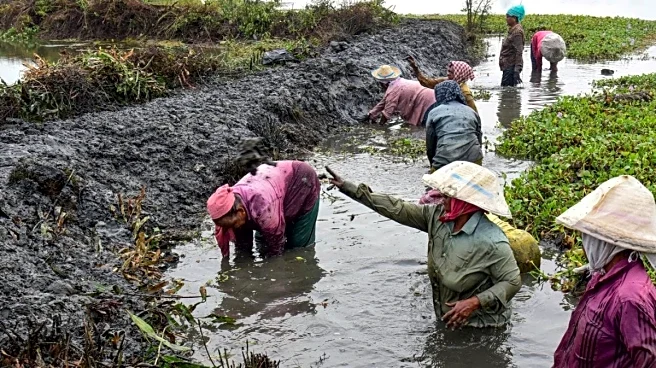
The MGNREGA scheme was not without its drawbacks in actual implementation. There were many instances of delayed wages and uneven utilisation, wherein those so employed merely dug a hole to fill it up again, without learning new skills or creating durable assets. But, equally, there is little doubt that MGNREGA dramatically lowered rural distress, provided a social safety net, empowered women workers, and created millions of person-days of employment. In the new scheme, perhaps the most worrying concern is whether states can bear the 40 per cent burden. Many states, especially those with tight fiscal balances, have expressed concern. The annual burden on a state like Telangana alone could run into ₹1,000–1,500 crore, and states fear delayed wage payments, reduced work availability, and constrained project feasibility. Poorer states may require even greater support, beyond the statutory 90:10 ratio offered to certain regions. Without adequate fiscal transfers, the scheme risks becoming a celebratory headline with limited on-ground impact.
Opposition leaders have called the move an ‘insult to Mahatma Gandhi’ and accused the government of dismantling a foundational rights-based law. Activists such as Aruna Roy have mobilised nationwide protest actions, warning of greater rural distress and reduced worker power. For the ruling party, the narrative is one of modernisation and alignment with the Viksit Bharat @ 2047 vision — a framing designed to transcend welfare and foreground development. But this political narrative runs the risk of alienating rural constituencies for whom MGNREGA was not merely a policy but a lifeline. The coming electoral cycles may well see rural employment policy become a flashpoint of political contestation, where perceptions of rights, dignity, and fiscal federalism are weaponised in campaign rhetoric.
Ultimately, both MGNREGA and the VB-G-RAM-G Act, however useful they may be in mitigating short-term poverty and rural distress, are palliatives. The real problem lies in the moribund state of agriculture and the slow development of a labour-intensive manufacturing sector. Agriculture, which employs over 50 per cent of the population, remains trapped in low productivity, inadequate incomes, poor infrastructure, and endemic unemployment and under-employment. At the same time, despite promises to raise manufacturing to 25 per cent of the economic basket, it continues to languish at around 16 per cent.
The poor are therefore caught in a vicious cycle: agriculture, their hereditary occupation, cannot provide sufficient jobs or income, while manufacturing — which could offer an alternative pathway to employment and higher wages — has not expanded in line with either political promises or expectations. Moreover, the corporate sector is relying increasingly on automation rather than human labour. What, then, happens to the poor? In such a situation, whatever the name — MGNREGA or the VB-G-RAM-G Act — the policy risks becoming a continuation of doles and freebies rather than a pathway to systemic solutions.
The writer is a former diplomat, an author, and a politician. Views expressed in the above piece are personal and solely those of the author. They do not necessarily reflect News18’s views.