

India has produced extraordinary talents who have changed the way the world thinks. One of them is Srinivasa Iyengar Ramanujan, a mathematical prodigy who revolutionised the field.
His birthday, December
22, is observed as National Mathematics Day to ensure future generations remember the man who made mathematics more than just numbers, a divine experience.
Early Life And Passion For Mathematics
Ramanujan was born on December 22, 1887, in Erode, Tamil Nadu, into a poor Brahmin family. His father worked as a clerk in a cloth shop in Kumbakonam. From a very young age, Ramanujan displayed extraordinary mathematical talent. By the age of 10, he had mastered trigonometry and algebra, though he showed little interest in other subjects.
A pivotal moment came when he discovered GS Carr’s book, A Synopsis of Elementary Results in Pure Mathematics, which listed thousands of formulas without proofs. Ramanujan not only understood them but expanded on them in his own unique way. From that point, his lifelong journey into the depths of mathematics began.
He spent days and nights immersed in equations, often writing on a slate when paper was unavailable, constantly erasing and creating new formulas in his mind.
Ramanujan credited his extraordinary insights to Goddess Namagiri (Lakshmi of Narsinghpuram), who he claimed appeared in his dreams and revealed complex formulas and their solutions. While modern science may find this mystical, it reflected Ramanujan’s belief that mathematics was a divine experience.
Struggles And Early Career
Despite his genius, Ramanujan faced numerous hardships. He struggled to find employment and eventually worked as a clerk at Madras Port Trust, dedicating his days to work and nights to mathematics.
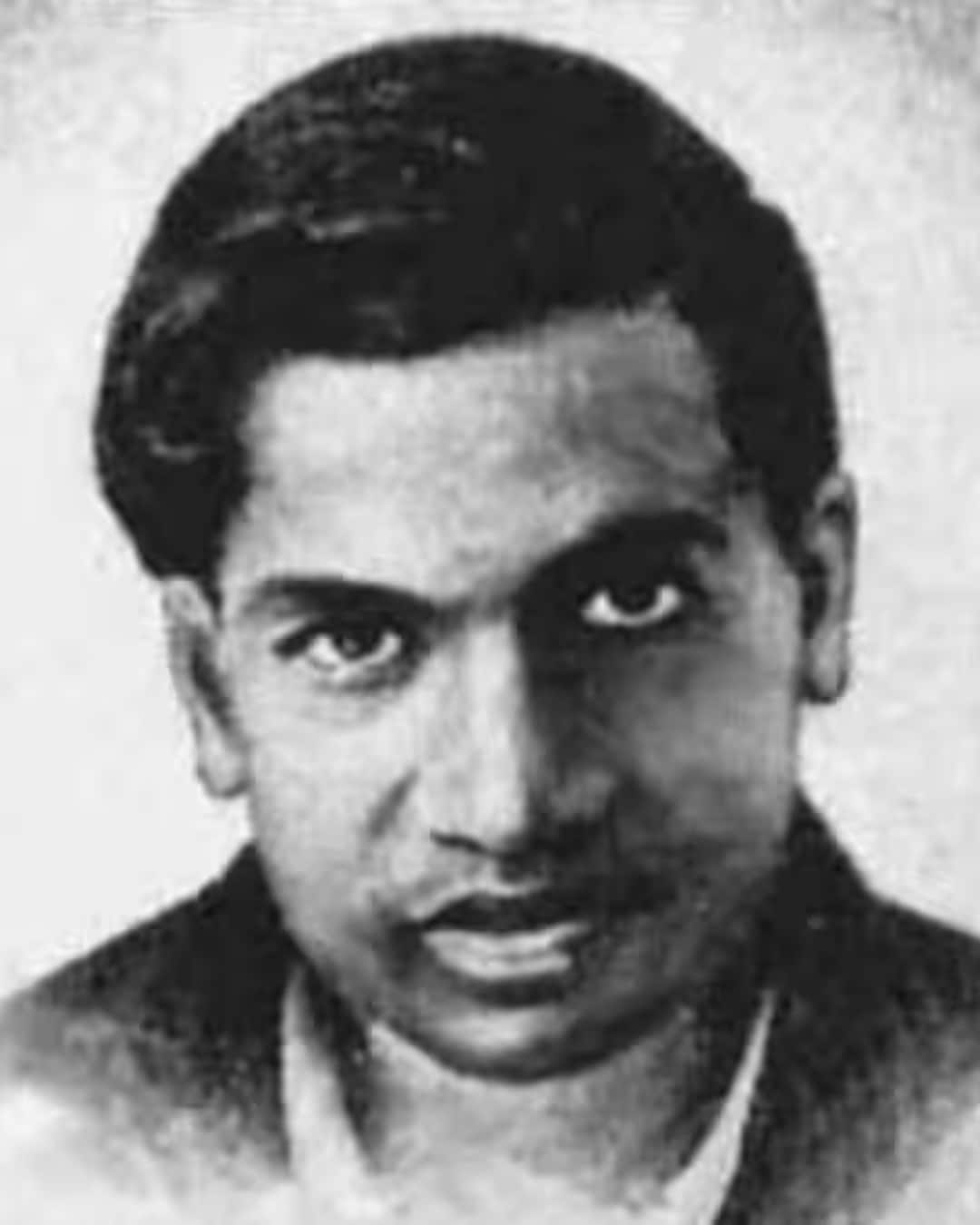
He meticulously documented his discoveries in notebooks, many containing formulas that were not understood by the contemporary mathematical community.
Letter To GH Hardy
In 1913, Ramanujan took a bold step, writing to English mathematician GH Hardy, enclosing over 120 formulas. Initially, Hardy doubted his sanity, but upon studying the formulas, he was astounded. Hardy later remarked, “These are either the formulas of a great genius or a fraud… and it can’t be a fraud.”
This led to Hardy inviting Ramanujan to Cambridge University, marking the beginning of his international recognition.
Journey At Cambridge
Ramanujan arrived in England in 1914, joining Hardy and JE Littlewood to make revolutionary contributions to number theory, infinite series, partitions, and mock theta functions. He introduced concepts like the Ramanujan prime, Ramanujan theta function, and Ramanujan conjecture, still studied today.
He discovered an infinite series for π (pi), now used in computer algorithms. His brilliance was recognised with Fellowship of the Royal Society of London, making him the youngest Indian to receive this honour.
Health Struggles And Return To India
The cold climate, lack of vegetarian food, and tuberculosis weakened Ramanujan. He returned to India in 1919 but succumbed to illness on April 26, 1920, in Chennai, at just 32 years old. By then, he had written over 3,900 formulas and theorems, many of which remain unsolved and foundational to modern research.
Ramanujan’s notebooks, including the ‘lost notebook’ discovered in 1976, continue to guide research in modern mathematics, quantum physics, black hole theory, computer science, and cryptography. His life demonstrates that talent and passion can surpass resources and formal education.
Hollywood Recognition
Ramanujan’s extraordinary journey inspired the 2015 Hollywood film The Man Who Knew Infinity, starring Dev Patel, which portrays his genius, inspiration, and the global impact of his work.

National Mathematics Day
In 2012, the Government of India declared December 22 as National Mathematics Day to honour Ramanujan and inspire young generations. His story is not just about mathematics, but about passion, faith, perseverance, and global recognition of Indian talent.
Remembering him on National Mathematics Day is a tribute and a promise to never underestimate India’s talent. His legacy is immortal, like infinity itself.






/images/ppid_59c68470-image-177100753350744656.webp)

/images/ppid_a911dc6a-image-17710070301901476.webp)

/images/ppid_a911dc6a-image-177100572282276854.webp)