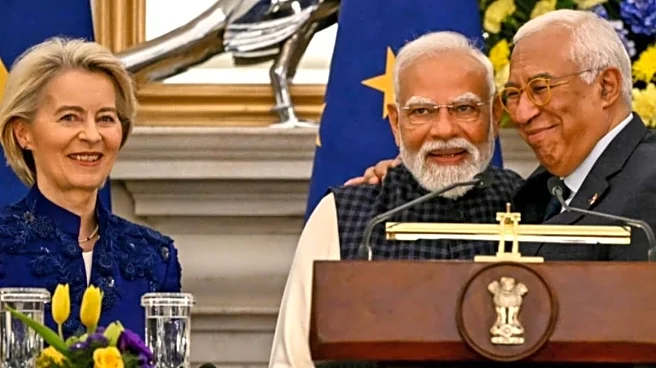

After two decades of negotiation, India and the European Union have concluded a comprehensive free trade agreement. While it covers market access, lower tariffs, and streamlined regulations, its true significance
lies in fostering trust amid a volatile global economy.
This agreement comes at a time when the global trading system is under pressure. Geopolitical tensions are affecting supply chains, industrial policy is gaining traction, and the United States — the system’s cornerstone — is adopting a more unpredictable and protectionist stance.
In this context, the India-EU free trade agreement (FTA) is not just routine diplomacy; it’s a strategic move that highlights the value of reliable partnerships.
Trade agreements between large, complex economies are inherently slow. They require detailed negotiations on standards, services, intellectual property, digital rules, sustainability, and labour provisions. The prolonged engagement between India and the EU signals their commitment to long-term alignment, making this agreement a binding decision rather than a mere symbolic gesture.
For India, this agreement represents a shift in trade strategy. After withdrawing from major regional pacts like the Regional Comprehensive Economic Partnership, India has selectively re-engaged in trade. Deals with the United Arab Emirates and Australia, ongoing talks with the United Kingdom, and now this landmark EU agreement reflect a focus on quality and diversified partnerships over broad liberalisation.
The EU deal is particularly significant due to the nature of the European market. Beyond its size, Europe is regulatory-intensive, setting global standards in areas such as data protection, environmental compliance, product safety, and competition policy. Closer integration with Europe will challenge Indian firms to meet these high benchmarks, enabling them to compete more effectively in advanced global markets.
For the EU, India offers scale, growth, and strategic balance. With a population of over 1.4 billion and robust growth rates, India is becoming a key player in global supply chains.
European companies, looking to reduce reliance on China, see India as an alternative hub for production and innovation, especially in clean energy equipment, advanced manufacturing, and digital services. Enhanced regulatory cooperation will facilitate investment, technology transfer, and joint ventures, making this transition smoother.
As the US considers a more protectionist trade stance, the deepening India-EU alignment is notable. Tariffs are being viewed in Washington as tools of economic policy, yet they function as taxes on supply chains, raising costs and injecting uncertainty into long-term investments. The mere threat of sudden trade barriers can prompt firms and governments to seek diversified economic relationships.
Countries are not abandoning the US, but they are preparing for unpredictability in its trade policy by building alternative partnerships. New trade corridors emerge, investment flows adjust, and rule-making forums progress without American leadership, eventually solidifying into structures that shape the global economy.
Thus, the India-EU trade deal is as much about setting rules as it is about reducing tariffs. Modern trade pacts increasingly establish norms in data governance, green technology standards, supply chain transparency, and industrial subsidies. By defining these rules together, India and the EU gain influence over the global economic “operating system”, compelling others to adapt to standards they did not help create.
For India, this agreement offers more than just export growth. Greater access to European markets can boost high-value manufacturing and services.
European investment and technology can accelerate India’s transition to renewable energy, sustainable urban infrastructure, and advanced industries. Simultaneously, India enhances its geopolitical profile, proving it is a serious partner in shaping global economic norms rather than merely a large market.
The broader lesson is that credibility is increasingly a source of power in the 21st-century economy. Countries and firms seek partners whose commitments are stable, whose policies are institutionally guided, and whose disputes are resolved through rules, not threats. Reliability, therefore, has become a significant form of influence.
After years of slow, complex, and often frustrating negotiations, both sides have chosen stability over spectacle and long-term alignment over short-term gains.
(Mousumi Roy writes on politics, material culture, and economic history. Views expressed are personal and solely those of the author. They do not necessarily reflect News18’s views)




/images/ppid_a911dc6a-image-177097448718985238.webp)

/images/ppid_a911dc6a-image-17709744373873034.webp)