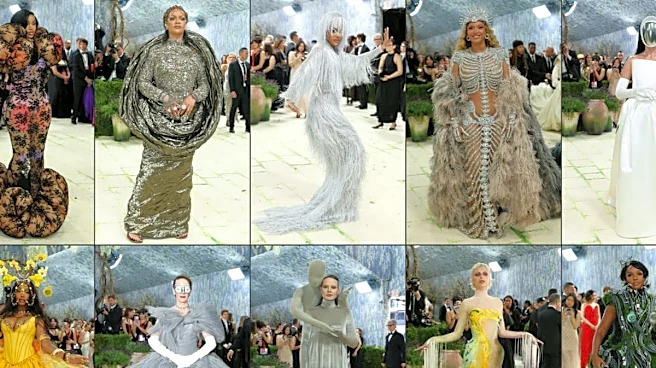




Fashion’s biggest night has a new theme, and it is certainly not what anyone expected. After months of controversy surrounding its originally planned John Galliano retrospective, the Metropolitan Museum of Art has announced ‘extraORDINARY: Fashion and the Poetics of the Everyday’ as the theme for the 2027 Met Gala.
The idea? To celebrate the beauty of everyday clothing and explore how designers transform familiar wardrobe staples and ordinary materials into extraordinary works of fashion. Think T-shirts, denim, white shirts, trench coats and puffer jackets, all getting the high-fashion treatment.
On paper, it sounds like a fascinating exploration of fashion’s relationship with everyday life. But given the circumstances surrounding the announcement,
one question is difficult to ignore: has the Met opted for a safer, more universally palatable theme after the uproar over Galliano?
Announced on November 5, the exhibition will be organised by Andrew Bolton, Curator in Charge of the Costume Institute, alongside Stephanie Kramer and Emily Mushaben. It will examine how designers reinterpret familiar garments, everyday objects and commonplace materials through craftsmanship, construction, experimentation and creative imagination.
The exhibition will also explore the relationship between clothing, memory, movement and the way we experience fashion beyond the runway. While the concept is certainly not lacking in creative possibilities, its announcement comes after a rather complicated few months for the Costume Institute.
From John Galliano To Everyday Fashion: What Changed?
To understand the sudden change in direction, we need to rewind to July 2026, when the Met announced ‘John Galliano: Horizons’, a retrospective dedicated to the British designer’s four-decade career. The exhibition was expected to showcase his work across fashion houses including Givenchy, Christian Dior and Maison Margiela, and would have been only the third retrospective dedicated to a living designer at the Costume Institute, following Yves Saint Laurent in 1983 and Rei Kawakubo in 2017.
However, the announcement was met with considerable criticism, given Galliano’s history of antisemitic and racist remarks. In 2011, the designer was dismissed from his position as creative director at Dior after videos emerged of him making antisemitic comments in a Paris bar. He was subsequently convicted by a French court for public insults based on race and religion.
The proposed retrospective was intended to address the full arc of Galliano’s career, including the controversy that fundamentally altered his public reception. However, the decision to honour his work at the Met drew criticism from several quarters, including Jewish community representatives and public officials. The timing also became a significant concern, as the 2027 Met Gala was scheduled to fall on May 3, close to Holocaust Remembrance Day.
In August 2026, Galliano and the Metropolitan Museum of Art jointly announced that the exhibition would not proceed as planned. In his statement, the designer acknowledged the hurt caused by his past words, particularly to the Jewish and Asian communities, and said he remained deeply sorry. He also recognised that meaningful atonement could not be achieved through institutional recognition or a single public gesture, but required continued accountability through one’s actions.
With the original exhibition shelved, the Costume Institute was left to develop an entirely new concept for its 2027 showcase.
Is ‘extraORDINARY’ A Creative Reset Or A Safer Choice?
This is where things get interesting. On its own, ‘extraORDINARY: Fashion and the Poetics of the Everyday’ is a compelling theme. Fashion has always had a fascinating relationship with the ordinary, and some of the most memorable runway moments have emerged from designers taking familiar silhouettes, everyday objects and unconventional materials and giving them an entirely new identity.
The exhibition will explore this through two broad ideas. ‘Familiar Forms’ will examine how designers reinterpret wardrobe staples such as T-shirts, jeans, white shirts, trench coats and puffer jackets. ‘Common Matter’, meanwhile, will focus on unconventional and often discarded materials such as paper, plastic and aluminium, demonstrating how seemingly insignificant objects can be transformed into wearable art.
The exhibition will feature creations by designers including Virgil Abloh for Off-White, Jonathan Anderson for Loewe, Pierpaolo Piccioli for Moncler and Glenn Martens for Maison Margiela, among others. These are designers who have consistently challenged conventional ideas of luxury, construction and what fashion can look like.
However, the bigger question is whether the Met’s new direction is as provocative as it sounds. The original Galliano retrospective would have required the institution to confront a difficult conversation about artistic brilliance, personal accountability and the role of cultural institutions in celebrating controversial creative figures.
The new exhibition shifts the conversation towards craftsmanship, material experimentation, consumption and the value we attach to clothing. These are important subjects in their own right, particularly at a time when sustainability, recycling and the fashion industry’s consumption habits are under increasing scrutiny. Yet, compared with the contentious questions raised by the original proposal, the new theme is undoubtedly less politically fraught.
And that does invite a fair question: is the Met choosing to explore a new creative territory, or stepping away from a difficult conversation that proved too contentious to sustain?
Andrew Bolton Says The New Exhibition Is Not A Plan B
Interestingly, Andrew Bolton has addressed the circumstances surrounding the change in direction. Speaking to The Associated Press, the curator admitted that he had no ready alternative exhibition waiting in the wings when the Galliano retrospective was cancelled.
“I had no Plan B, to be honest,” Bolton said, explaining that the new concept had to be developed from scratch.
The idea, however, was not entirely unfamiliar to him. Bolton revealed that he had been thinking about how people experience clothing in everyday life while working on the Costume Institute’s previous exhibition, ‘Costume Art’. He was particularly interested in how garments acquire meaning through memory, movement and repeated wear.
“Everyday clothes carry extraordinary amounts of meaning,” he told the publication, pointing to the emotional attachment people develop to a favourite T-shirt or pair of jeans.
Speaking to Vogue, Bolton also emphasised that the new exhibition was intended to be challenging, provocative and visually compelling, rather than simply serving as a substitute for the cancelled retrospective.
And perhaps that is precisely where the exhibition will have to make its case. Everyday fashion might sound familiar, but the way designers reinterpret it can be anything but ordinary.
The 2027 Met Gala will take place on May 3, 2027, with the exhibition opening to the public on May 9 and running until January 9, 2028. The celebrity co-chairs and official dress code are yet to be announced.
Ultimately, ‘extraORDINARY’ has all the ingredients for an interesting fashion exhibition. But given the controversy that preceded it, the Met will have to do more than simply present an appealing new theme. After all, the Met Gala has never been short of spectacle. What makes it truly memorable is when the fashion comes with something worth talking about.