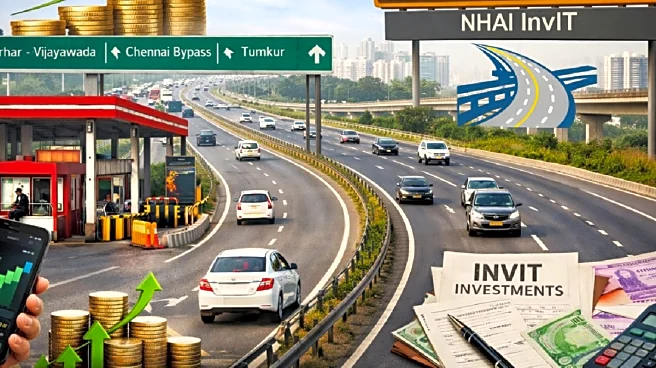


Retail investors are set to get a direct stake in India’s highway monetisation, with the National Highways Authority of India (NHAI) successfully monetising five operational road assets through its sponsored public InvIT, Raajmarg Infra Investment Trust (RIIT).
The NHAI has accepted RIIT’s bid of Rs 9,500 crore for five national highway segments covering over 260 km across four states. These are the Gorhar-Barwa Adda stretch in Jharkhand, the Chilakaluripet-Vijayawada corridor in Andhra Pradesh, the Chennai Bypass and Chennai-Tada sections in Tamil Nadu, and the Nelamangala-Tumakuru stretch in Karnataka.
“NHAI has accepted the offer of the Raajmarg Infra Investment Trust (RIIT) amounting to Rs 9,500 crores towards asset monetisation of five sections
spanning over 260 km across four States. The monetised assets include the 80.52 km long Gorhar-Barwa Adda section in Jharkhand, the 69.4 km long Chilakaluripet-Vijayawada section in Andhra Pradesh, the 32.6 km long Chennai Bypass, the 33 km long Chennai-Tada section in Tamil Nadu, and the 44.6 km long Neelmangla-Tumkur section in Karnataka,” the Ministry of Road Transport & Highways said in a statement.
The move allows investors to get returns on investments linked directly to traffic flows and toll collections on some of the country’s busiest road corridors.
How traffic converts into investor returns
Unlike greenfield infrastructure projects, highway InvITs provide exposure to completed and revenue-generating assets. The primary source of income is toll collections from vehicles using these roads, which are periodically distributed to unit holders or investors.
As highway traffic increases along with economic activity, urban expansion and freight movement, toll revenues tend to rise, thus improving the cash flow available for distribution.
NHAI chairman Santosh Kumar Yadav said the public InvIT model allows retail investors to earn relatively stable returns while participating in the development of national infrastructure.
“Through this Public InvIT, retail investors will not only gain the opportunity to earn stable and attractive returns from operational national highway assets but will also develop a sense of ownership and pride in contributing to the growth of national infrastructure,” Yadav said in the statement.
For investors, the key attraction lies in predictable cash flows rather than capital appreciation driven by market sentiment.
State-owned NHAI in November 2025 announced plans to establish Raajmarg Infra Investment Trust (RIIT) as a Public InvIT to unlock the monetisation potential of national highway assets. The first issuance for public investors is expected soon.
Part of the National Monetisation Pipeline
The transaction is part of the government’s National Monetisation Pipeline, which aims to unlock value from mature public assets and recycle capital into new infrastructure development.
Under the InvIT structure, revenue rights are transferred to investors while ownership of the highway assets remains with the government. This allows NHAI to fund fresh highway construction without adding pressure on public finances.
“Over the next 3 to 5 years, NHAI plans to provide further assets of about 1,500 km to RIIT,” the ministry stated.
A new retail-focused infrastructure asset class
Traditionally, infrastructure investments have been dominated by large institutional and global investors. The NHAI-sponsored InvIT marks a shift by explicitly targeting retail participation.
With vehicle traffic and logistics demand continuing to grow, highway InvITs offer exposure to long-term infrastructure cash flows linked directly to toll revenues rather than corporate earnings cycles.
For NHAI, the strong investor response reinforces confidence in India’s operational road portfolio. For retail investors, it creates a route to participate in infrastructure returns driven by everyday economic activity.
What are InvITs, and how can retail investors participate?
Infrastructure Investment Trusts, or InvITs, are market-listed vehicles that invest in income-generating infrastructure assets such as highways, power transmission lines and pipelines.Regulated by the Securities and Exchange Board of India, InvITs are required to distribute a large portion of their cash flows to investors, making them suitable for those seeking regular income.
Retail investors can invest in InvIT units through a demat and trading account, either during an initial offering or via the secondary market, like NSE and BSE. Returns typically come in the form of periodic distributions comprising interest, dividends and repayment of capital, linked to the cash flows of the underlying assets.
Returns, however, will ultimately depend on traffic growth and toll policy stability.


/images/ppid_a911dc6a-image-177106302538573741.webp)