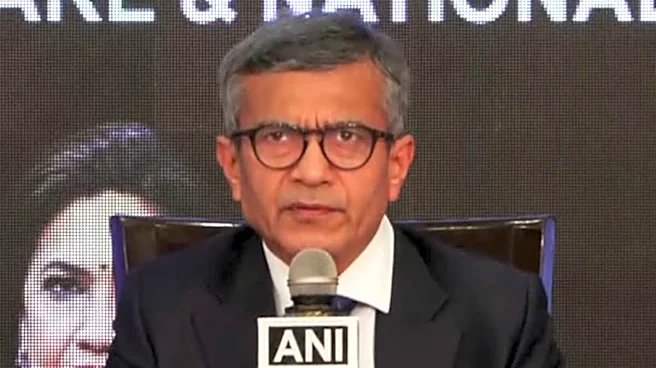




Defence Secretary Rajesh Kumar Singh on Thursday asserted that India may need to reassess its conventional missile strategy in response to evolving global conflicts, particularly developments in West Asia, and regional security challenges.
While speaking at the ANI National Security Summit 2.0 in New Delhi, Singh emphasised the growing importance of advanced weaponry, strong air defence systems, and rapid procurement mechanisms. He highlighted that recent conflicts, particularly in West Asia and developments in Pakistan’s military posture, have altered traditional assumptions around missile use.
Singh said there is now a growing rationale for strengthening conventional missile forces, as their use is no longer limited to strategic deterrence.
“So there is an emerging rationale for a conventional missile force given what has happened in West Asia and to the extent that Pakistan, for example, is building a conventional missile force. Its usage was–the paradigm was that it’ll be mostly used for strategic purposes–but now that that paradigm has shifted, we’ll have to adjust accordingly,” he said as quoted by news agency ANI.
He further added that India would not delay institutional processes while simultaneously boosting production capacity.
“We will not wait for the institutional part of raising a force will go on in parallel with providing the supply orders to industry to start scaling up production of missiles, which is a big challenge in India because so far we’ve essentially relied on one producer, one public sector producer and some in-house production capabilities of DRDO,” the Defence Secretary added.
He also stressed the need to expand manufacturing across a broader industrial base and said, “We’ll have to expand it and make it across industry on a much bigger scale, but yes both of these actions will have to be taken–that is the reading of our, of the Defence Ministry.”
Singh said ongoing conflicts in West Asia and the Russia-Ukraine war have offered key lessons for India’s defence planning. These include the importance of standoff weapons, strong layered air defence systems, adequate stockpiles of ammunition, and mobile radar and artillery systems.
He added that these insights have already influenced procurement decisions, with a significant focus on drones, counter-drone systems, and electronic warfare equipment.
The Defence Secretary said lessons drawn from ongoing conflicts in West Asia and the Russia-Ukraine war are shaping procurement and capability-building efforts.
Responding to a question on the top priorities in defence modernisation amid global conflicts, the Defence Secretary said, “Both from Operation Sindhu and from West Asia as well as the ongoing Ukraine conflicts, you do have lessons, things like the importance of standoff weaponry, of a layered and strong air defence system, of sufficient stockpiles of ammunition and missiles, of ensuring that your radars are mobile and your artillery is also mobile.”
He said these lessons have already influenced procurement decisions. “All of those lessons are fairly clear and we’ve taken those lessons and accordingly calibrated our procurements, which is why, for example, on the EP side, the bulk of what we did, almost Rs 30,000 crores worth of EP contracts after Op Sindhu, and the bulk of those contracts have gone primarily for drones and counter-drone systems, loitering munitions, and some types of radars and EW equipment as well,” Singh said.
Highlighting defence modernisation efforts, Singh said India is prioritising rapid procurement to bridge capability gaps.
He referred to the proposed “Sudarshan Chakra Mission,” a multi-layered air defence and offensive system, as part of future plans to strengthen national security.
“As you are aware, the Hon’ble Prime Minister had announced a multilayered sort of air defence and offensive system called Sudarshan Chakra Mission from the Red Fort last year. A committee under the DRDO chairperson has already submitted a kind of pre-feasibility report on that mission. So we’ll be working on all of that,” he added.
The Defence Secretary also stressed the importance of speeding up procurement processes. “Even as these committee reports come in, whether it is this or whether it’s things like the revision of DAP, we will continue to also focus on ensuring that parallelly, we do the fast-track procurement that we really need,” he said.
Singh noted that India has significantly stepped up defence contracts in recent years, signing deals worth around Rs 4.5 lakh crore over the past two years.
He said the government is working to ensure that lessons from global conflicts are effectively implemented to enhance preparedness and address emerging threats.
(With inputs from agencies)

/images/ppid_a911dc6a-image-177787486321885120.webp)





/images/ppid_a911dc6a-image-177769283411041814.webp)