
India’s 77th Republic Day
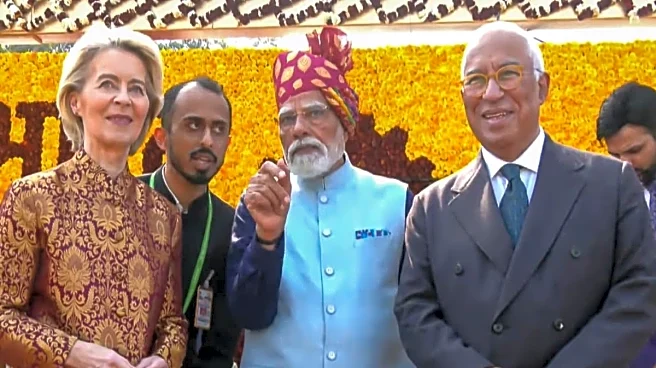
, themed around 150 years of Vande Mataram, brings two of Europe’s most influential leaders to Kartavya Path. European Commission President Ursula von der Leyen and European Council President Antonio Costa are attending as joint chief guests, a pairing that underscores the diplomatic weight of this year’s celebrations. They follow Indonesian President Prabowo Subianto, who served as Chief Guest in 2025.Their visit coincides with the 16th India–EU Summit, where trade negotiations and strategic cooperation are expected to dominate the agenda.
The presence of both leaders signals not only the EU’s deepening engagement with India but also a broader moment in which Brussels is recalibrating its global partnerships. As New
Delhi showcases its development journey, cultural diversity and military strength at the Republic Day parade, the two European leaders bring with them distinct political legacies and institutional responsibilities within the EU structure.
77th #RepublicDay🇮🇳 | President Droupadi Murmu, along with President of the European Council, António Luís Santos da Costa and President of the European Commission, Ursula Von Der Leyen, arrives at the saluting dais at Kartavya Path in Delhi to witness the parade
Prime Minister… pic.twitter.com/sE0uP9DLVA
— ANI (@ANI) January 26, 2026
Who Is Ursula Von Der Leyen?
Ursula von der Leyen — a German politician, physician and former cabinet minister — has served as President of the European Commission since 2019, becoming the first woman to hold the EU’s top executive post. Re-elected for a second term from 2024 to 2029, she oversees the body responsible for proposing EU laws, implementing policies and steering the Union through crises.
She is also widely regarded as one of the world’s most influential political figures, consistently topping Forbes’ rankings of powerful women due to her role in shaping EU policy on trade, security and climate.
Born in October 1958, von der Leyen spent her early years in Brussels, where her father served as a European Commissioner during the era of the European Economic Community. Fluent in English and French, she studied economics in Germany and at the London School of Economics before switching to medicine, eventually qualifying as a doctor in 1991. She later lived in California while her husband taught at Stanford University.
A mother of seven, she entered politics in her early forties, joining Germany’s Christian Democratic Union. Over the next decade, she held senior ministerial roles, including Family Affairs and Labour, before becoming Germany’s first female Defence Minister in 2013.
Her tenure in social policy was particularly influential: she strengthened maternity and paternity pay rights, created a legal entitlement to daycare for every child over a year old, and introduced a parental leave scheme that ensured at least two months of paid leave for fathers.
As Commission President, von der Leyen helped steer the EU through the Covid-19 pandemic, established the €750-billion recovery fund, and led Europe’s response to the war in Ukraine, including the imposition of sanctions. Her priorities continue to include the European Green Deal, boosting competitiveness, supporting Ukraine, and navigating tariff tensions with the United States.
She has described the impending India–EU trade agreement as the “mother of all deals”, highlighting the significance Brussels attaches to its partnership with New Delhi.
What The European Commission Does
The European Commission functions as the executive arm of the European Union. It proposes new laws and policies, manages the EU budget and ensures that member states implement rules correctly. It also negotiates international agreements on the Union’s behalf and represents the EU at major global forums, including the G7, G20 and summits with partner countries.
As President, von der Leyen sets the Commission’s policy direction, allocates portfolios to Commissioners, and serves as one of the EU’s most recognisable global figures.
Who Is Antonio Costa?
Antonio Costa, the President of the European Council since December 2024, is a Portuguese lawyer and seasoned political leader with deep international experience. Born on 17 July 1961 in Lisbon, he has Indian ancestral roots through his great-grandfather from Goa, and French-Mozambican ancestry through his grandmother. Costa has often said this heritage has shaped his worldview and ability to connect with regions across Asia, Africa and South America.
Before moving to Brussels, Costa served as Prime Minister of Portugal from 2015 to 2024, becoming the longest-serving Iberian head of government of the 21st century. His tenure included forging unexpected political alliances, strengthening Portugal’s profile in Europe, and cultivating ties with leaders across the Global South. He previously served as Mayor of Lisbon and held roles including Minister of the Interior, Minister of Justice and Minister of Parliamentary Affairs.
Costa resigned as prime minister during an investigation into lithium-related affairs, though he was not charged. His political stature, negotiation skills and cross-continental relationships later positioned him as the EU’s consensus choice to lead the European Council.
In his current role, Costa facilitates decision-making among the leaders of the EU’s 27 member states. He has voiced support for Ukraine and pursued diplomatic engagement in West Asia, including discussions with Syrian opposition figure Ahmed al-Sharaa in 2025.
What The European Council Does
The European Council represents the highest political authority of the European Union. Comprising the heads of state or government of all 27 member countries, along with its President and the European Commission President, it sets the EU’s overall strategic direction and priorities.
Although it does not pass laws, it guides the Union on major issues — from foreign policy to economic strategy — and provides the political impetus needed for institutional and treaty-level decisions.
Why Their Joint Visit Matters
Ursula von der Leyen and Antonio Costa together embody the EU’s two most powerful institutions — its executive leadership and its collective political authority. Their presence at Republic Day 2026, coinciding with the India–EU Summit, reflects a moment of convergence as both sides work toward a landmark trade pact and broader strategic alignment.

/images/ppid_59c68470-image-177087756975063071.webp)

/images/ppid_a911dc6a-image-177089643644622181.webp)

/images/ppid_59c68470-image-177087010153493874.webp)
/images/ppid_59c68470-image-177074753723033180.webp)
/images/ppid_a911dc6a-image-177078207758873160.webp)