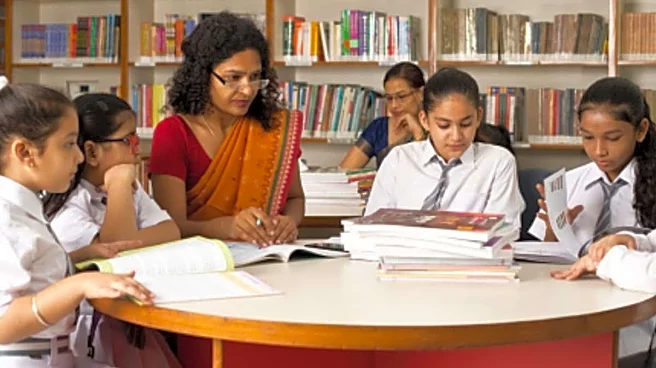

The year 2025 turned out to be one of the busiest years for the Central Board of Secondary Education (CBSE). Instead of making small changes here and there, the board took a long, hard look at its entire
system and decided to rebuild many parts of it. For decades, students had followed a fixed routine of memory-based studying, strict subject choices, and one final exam that carried almost all the weight. But the board felt this old format no longer matched the world students are growing into.
As a result, CBSE introduced updates that touched nearly every part of school life, including what students study, how they are tested, how their information is recorded, and even how many times they will sit for board exams. The aim is clear: to move toward a system that values understanding, skills, and flexibility instead of last-minute cramming.
Below is a detailed look at the major reforms that shaped CBSE’s transformation in 2025:
Curriculum Gets A Major Redesign
One of the earliest changes came through the newly released curriculum for 2025-26. The board reduced long, content-heavy chapters and shifted to:
– Competency-based learning
– Projects that involve real-life experiences
– Technology-backed lessons
– Links between different subjects
The idea is to help students learn by doing and understand ideas instead of memorising entire chapters.
Students Get More Freedom in Choosing Subjects
A major relief for Class 10 students who had taken Basic Mathematics (241) was the permission to choose Mathematics Standard (041) in Class 11. Earlier, this shift was not allowed, and many students felt stuck with their old choice. The new rule gives students more control over subjects that match their plans and interests.
Exams Now Check Skills, Not Memory
Board exams in 2025 continued moving toward competency-based questions. Papers included more MCQs, case-based problems, data questions, and real-life situations. These changes make sure marks reflect understanding, reasoning and application, not memorisation.
Internal Assessment Carries More Weight
CBSE increased the internal assessment share to 40 per cent while keeping the board exam at 60 per cent. This reduces pressure on one final exam and encourages continuous learning throughout the year.
More Skill-based Subjects Added
CBSE also worked on building a stronger link between the school and the working world. Subjects such as Design Thinking, Electronics & Hardware, Land Transportation Associate, and Physical Activity Trainer were added or updated. These subjects help students gain practical skills and prepare for future careers.
Two Board Exams From 2026
The announcement that Class 10 board exams will be held twice a year was one of the most talked-about changes.
– The first exam will be compulsory.
– The second one will be optional and meant for improvement.
The goal is to reduce pressure and give students more than one chance to perform.
APAAR ID Made Compulsory
Schools were asked to link every student’s record to their APAAR ID, a nationwide digital ID for academic history. This will help maintain smooth, error-free documentation during exams and admissions.
Stricter Checks On Student Data
To avoid mistakes in names, birth dates and subjects, CBSE introduced a candidate data verification slip. Parents and schools must confirm every detail before it goes to the board, reducing common errors that often cause problems later.
Digital Evaluation Expands Further
CBSE widened the use of digital evaluation for checking exam papers. This system improves accuracy, shortens result processing time, and lowers the chances of human error. More subjects will gradually shift to on-screen marking after pilot tests across regional centres.
New Answer-Writing Rules For Class 10
CBSE announced that Class 10 Science and Social Science answer sheets must follow strict section-wise writing from 2026. Students must write:
– In Science: Biology, Chemistry and Physics answers in separate sections
– In Social Science: History, Geography, Political Science and Economics separately
Penalties For Writing In the Wrong Section
The board made it clear that answers written in the wrong section will not be checked, even if they are correct. Students have been advised to practise this format in school exams to avoid losing marks later.
/images/ppid_59c68470-image-177107752663443042.webp)






/images/ppid_a911dc6a-image-177107705051568684.webp)



/images/ppid_59c68470-image-177107504779557732.webp)
/images/ppid_59c68470-image-177107504945830607.webp)