

There is something strange about Kerala having to ask, in 2026, whether women should be visible in public life.
For generations, Kerala has been known for its schools, its reform movements, its reading rooms, its political debates and, above all, for the quiet transformation of ordinary lives through education. Women have been part of that transformation. They have stepped out of homes, entered classrooms, hospitals, courts, offices and legislatures, and in doing so, changed the very idea of what a Kerala woman could be.
And yet, a remark by Sunni leader Kanthapuram AP Aboobacker Musliyar that women should remain at home, and that bringing women onto public platforms could have serious consequences, has brought an old question back into the middle
of Kerala’s public life.
Perhaps what makes the moment more interesting is not only the remark, but the Kerala that is listening to it.
Kerala’s history with women has never been as simple as the word “progressive” suggests. There were traditions here in which women occupied a very different place within the family from what was common elsewhere in India.
In the old tharavadu, particularly among communities that followed, the family was built around the mother’s line; it was a matriarchal society. Property and inheritance followed the female line. A woman’s children belonged to her family. Her connection to her mother’s home did not disappear simply because she married. But it would be wrong to turn this into a romantic story in which Kerala’s women were always the rulers of their homes. They were not. The karnavan, usually the senior male member of the maternal family, could hold great authority over property and family affairs. Matriliny gave women an an important place in the structure of the family, but it did not erase male power.
While one community could organise family and property through the female line, Namboodiri women could live lives of great restriction within the illam. Lalithambika Antharjanam would later give voice to the silent world of these women, writing about the walls that separated them from the larger world.
Then there were women who refused to remain behind those walls.
Akkamma Cherian came out onto the streets of Travancore and led a political movement. KR Gouri Amma entered the rough world of Kerala politics and became one of its most powerful leaders. Dakshayani Velayudhan, born into a Pulaya family, broke through both caste and gender barriers and became the first Dalit woman elected to the Constituent Assembly.
Anna Chandy entered the judiciary at a time when the profession was almost entirely a man’s world. M Fathima Beevi, another daughter of Kerala, went further and became the first woman judge of the Supreme Court.
Mary Roy fought over something that seems so ordinary today — a woman’s right to inherit property — and took the battle all the way to the Supreme Court.
There were women who fought through words too. K Saraswathi Amma wrote about marriage, patriarchy and the expectations imposed upon women at a time when a woman writing so freely could itself be an act of rebellion. PK Rosy entered Malayalam cinema, only to face the fury of a society unwilling to accept a woman crossing the boundaries of caste and gender.
These women did not wait for society to tell them that there was a place for them outside the home. They made that place for themselves.
That is why the present argument sits so uneasily in Kerala.
Chief Minister VD Satheesan has rejected the suggestion that women should be confined to their homes, calling it an outdated idea that does not belong in today’s Kerala. He has also made the point that neither the Congress nor his government supports such a position.
But what is perhaps more interesting is that he did not make this only an argument between religion and modernity. He went back to Islam itself, pointing to women such as Khadija, who was a successful businesswoman, and Aisha, who played an important role in the early history of Islam.
That is important. Because religion and women’s freedom need not be placed on opposite sides of the table. A woman may choose to observe purdah. She may choose to stay at home and devote herself to her family. She may choose a quiet and private life. There is dignity in that choice.
But another woman may want to become a doctor, a teacher, a lawyer, a journalist, a politician or a businesswoman. She may want to travel, earn, speak, study or stand on a public stage. There should be dignity in that choice too.
The real question is not whether a woman stays at home. The real question is whether she is choosing to stay there.
There is a great difference between a woman saying, “This is the life I want,” and society telling her, “This is the life you must have.” That difference is at the heart of this entire controversy.
Some Muslim religious and political voices have defended Kanthapuram’s right to express his understanding of religious practice. The Indian Union Muslim League has been cautious, with Sadiq Ali Shihab Thangal describing the remarks as a scholarly expression and suggesting that concern for women’s safety was part of the context. Religious scholars have every right to interpret and explain their faith.
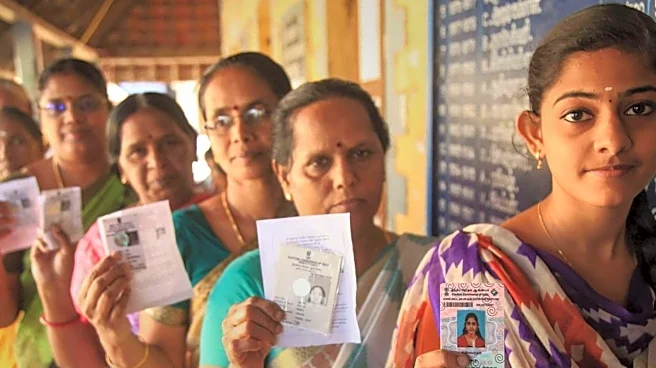
The Congress has spoken clearly about women’s participation. But it is also part of a political alliance in which the Muslim League is an important partner, and in a state where religious and community leadership has a powerful voice. It is easy for political parties to speak of equality when everyone agrees. The real test comes when equality becomes uncomfortable. Yet Kerala’s women themselves seem to have moved far ahead of this argument. They are already everywhere.
A woman does not become less Muslim because she works. She does not become less religious because she speaks in public. She does not lose her dignity because she travels or earns her own living.
And equally, a woman who chooses to remain at home does not become less ambitious, less modern or less worthy. Freedom is not about asking every woman to make the same choice. It is about allowing every woman to make her own. Perhaps this is where Kerala’s history has something to teach us.
The tharavadu tells us that there have been different ways of organising family and inheritance. The illam tells us that Kerala has also known deeply restrictive traditions. Its reform movements tell us that customs do not change by themselves. Someone has to question them.
And Kerala’s women have been among those who questioned them time and again.
What is particularly interesting is that even among Malabar’s Muslim communities, matrilineal traditions existed among sections of the Mappila community. The history of Kerala’s Muslim society, therefore, is not a single straight road either. It contains its own variations, its own negotiations between family, faith, property and women.
Remember, the story of the Arakkal kingdom of Kannur is even more striking. It was a Muslim royal family in which succession followed the female line. The history of Kerala has, therefore, known Muslim women and female lines occupying positions of authority too.
None of this means that Kerala was ever a paradise for women. It really wasn’t.
There was the woman of the tharavadu. There was the antharjanam behind the walls of the illam. There was the woman who entered the freedom struggle. The woman who entered politics. The woman who went to court. The woman who became a judge. The woman who became a nurse and travelled across the world. The woman who chose the home. And the woman who chose the public square.
They were all Kerala women. And perhaps that is why this argument feels so much larger than one religious leader’s remark. It is really an argument about who has the right to decide the shape of a woman’s life.
Kanthapuram has since clarified that he and those associated with his organisation do not believe women should be confined, buried or treated as secondary, pointing to the educational institutions and girls’ schools established by his organisation.
That clarification is important. But it also leaves us with a simple question.
Is it enough to educate a woman if, after educating her, we still tell her where she can stand? Kerala’s achievement was never merely that it taught women to read.
It was that, slowly and sometimes painfully, women began to decide what they would do with what they had learnt.
They became teachers, doctors, judges, writers, politicians, workers, businesswomen, students, mothers, leaders. They entered spaces that had once been closed to them. And perhaps that is the quiet lesson Kerala’s own history offers today. Kerala’s women have never simply been waiting for someone to tell them where they belong. They have spent generations showing us that they can decide for themselves.

/images/ppid_59c68470-image-1788515059797206.webp)