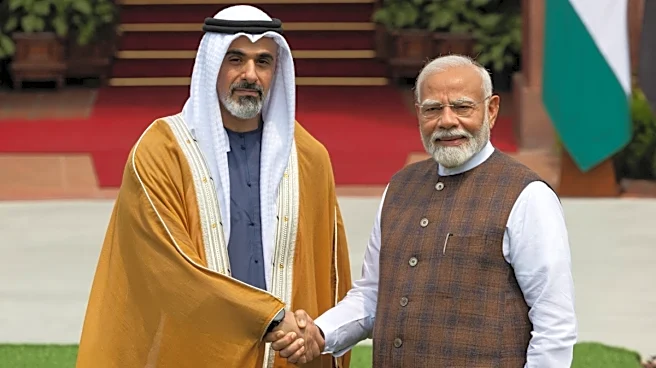



Prime Minister Narendra Modi on Saturday held bilateral talks with Sheikh Khaled bin Mohamed bin Zayed Al Nahyan, Crown Prince of Abu Dhabi, on the sidelines of the BRICS Leaders’ Summit in New Delhi.
Sheikh Khaled is leading the UAE delegation at the summit. His meeting with PM Modi comes as India, the BRICS chair, faces the challenge of navigating differences between two member countries, Iran and the UAE, over the West Asia conflict.
UAE-Iran Divide At BRICS
The West Asia crisis has emerged as a key challenge for the expanded BRICS grouping, with Iran and the UAE taking opposing positions amid the conflict.
The war has severely disrupted the Strait of Hormuz, a crucial route for global oil shipments, while crude prices have crossed $100 a barrel. The UAE, which has faced
Iranian missile attacks since the conflict began, suspended all trade and financial transactions with Iran in August.
Also Read: PM Modi’s BRICS Balancing Act: Can India Bridge The Iran-UAE Divide Amid West Asia War?
The differences have also complicated efforts to prepare a joint BRICS declaration. Kremlin spokesman Dmitry Peskov said the Iran-UAE differences had a “negative impact” and were obstructing the drafting of the statement, while expressing hope that the leaders could agree on acceptable language.
In May, BRICS foreign ministers failed to issue a joint statement during their meeting in New Delhi because of differences between Iran and the UAE. India later issued a chair’s statement acknowledging that members had “differing views”.
India’s Balancing Act
As BRICS chair, India is seeking to keep the focus on regional stability while preventing the West Asia crisis from derailing the grouping’s wider economic agenda, according to MEA sources.
As per the sources, India’s proposed approach includes condemning “unprovoked aggression” without naming any country, reaffirming sovereignty and the UN Charter, opposing the use or threat of force, protecting civilians and critical infrastructure, and backing dialogue, diplomacy and freedom of navigation.
Also Read: $26.5-Bn Deficit, $15.4-Bn Gold Imports: Why UAE Matters To India’s BRICS Trade Story
Indian officials, along with Russia, Brazil and Egypt, have held separate discussions with Iranian and UAE representatives over language that could be acceptable to both sides.
Iran wants BRICS to explicitly condemn the US-Israeli attacks and Western sanctions, while the UAE wants the declaration to recognise Iranian missile and drone attacks on Gulf territory and facilities.
Crown Prince’s India Visits
Sheikh Khaled has previously visited India twice. He travelled to New Delhi in February 2026 to attend the AI Impact Summit and had also visited India in September 2024.
His latest visit comes as BRICS seeks to manage its internal differences while maintaining focus on cooperation among emerging economies. The grouping originally comprised Brazil, Russia, India, China and South Africa before expanding to include Egypt, Ethiopia, Iran, the UAE and Indonesia.
Saudi Arabia’s position has been unclear as it has not accepted the bloc’s full membership, although it continues to participate through lower-level delegations. Foreign Minister Faisal bin Farhan Al Saud is expected to attend the Delhi meeting.


