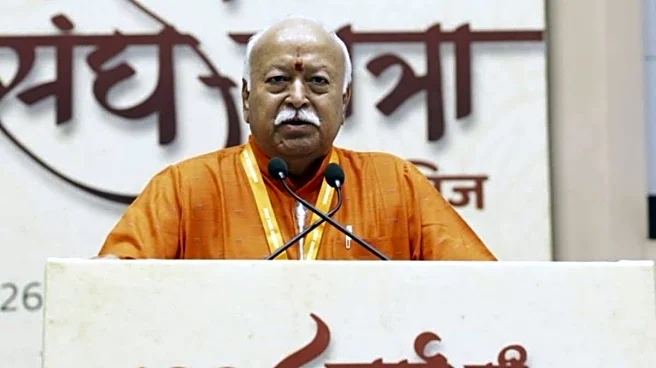

The year 2025 would be remembered for two significant civilisational milestones — completion of the Ram temple at Ayodhya and the Rashtriya Swayamsevak Sangh (RSS) turning 100. Both the events are intrinsically
linked.
The RSS played a key role in the Ram Janmabhoomi Movement when it was relaunched in 1983. The word ‘relaunched’ has been used to remind readers that it was a civilisational battle that lasted for 500 years before it came to its logical conclusion in 2019 with the Supreme Court ruling in favour of the construction of the temple. The construction of the temple was finally completed this year.
The RSS turned 100 this year on Vijayadashami. It was founded by Dr Keshav Baliram Hedgewar in 1925. Mohan Bhagwat, the current Sarsanghchalak of the RSS, is its sixth Chief Mentor. The five earlier Sarsanghchalaks include Dr Hedgewar, MS Golwalkar, Madhukar Dattatreya Deoras, Professor Rajendra Singh and KS Sudarshan.
The RSS has never witnessed any struggle over change in leadership, which is a unique phenomenon for any 100-year-old organisation. It has also consistently expanded over the last 100 years and is still going strong. The fundamental strength of the RSS is its adaptability, and the reason for that is it does not position itself as an organisation within society but sees itself more as a movement or a flow whose objective is to organise society. Hence, the RSS takes up issues that society is concerned about. It works on these issues from a contemporary perspective.
In this context, it is important to look at how the RSS defines its core philosophy of Hindutva from a contemporary perspective. Three key leaders of the RSS have carefully dwelt on this issue, and their recent thoughts on ‘Hindutva in a Contemporary Perspective’ make a fascinating study. These three leaders are: Sarsanghchalak Mohan Bhagwat, Sah Sarkaryavah (Joint General Secretary) Arun Kumar and former Sah Sarkaryavah Suresh Soni.
HINDUTVA IN MODERN CONTEXT
According to Mohan Bhagwat, “Mostly, what we hear today is about what Hindutva is not. Hindutva is not an ‘ism.’ Its direct English rendering is Hindu-ness, not Hinduism. The common meaning of ‘ism’ implies a fixed, rigid doctrine to which one must adjust oneself. Hindutva is not that.”
Everyone who has lived with Hindutva, who has accepted Hindutva, has contributed to it in their own way, according to their own ability. Even today, it is continuously evolving, he adds.
Bhagwat quotes philosopher and former President of India Dr S Radhakrishnan to explain the nature of Hindutva in the modern context: “There has been no such thing as a uniform, stationary, unalterable Hinduism.”
The sarsanghchalak then further explains the finer nuances: “In his time, the term Hinduism was in currency, but what he actually means is Hindu-ness, because it is not an ism. There is nothing in Hindu-ness that is uniform, stationary or unalterable, as these characteristics belong to the rigid definition of an ‘ism.’”
In the words of Dr Radhakrishnan: “Whether in point of belief or practice, Hinduism is a movement, not a position; a process, not a result; a growing tradition, not a fixed revelation. Its past history encourages us to believe that it will be found equal to any emergency that the future may throw up — whether in the field of thought or of history.”
PARADOX OF DEFINITION
Suresh Soni makes an interesting intervention in the context of the multiple definitions of Hindutva. “Often, the question arises — what is the precise definition? Today, people demand definitions for everything. Hindutva has had many definitions: Savarkar ji offered one; so did Lokmanya Tilak. The Sangh states — Hindutva is nationality itself. The Vishva Hindu Parishad has its own formulation suited to its objective of uniting Hindus globally.”
Soni takes the argument further by referring to the third sarsanghchalak, Balasaheb Deoras. The latter used to say that not everything can be contained within a formula or definition. “That which is vast and ever-expanding — any definition of it may either suffer from over-inclusiveness or under-inclusiveness. Therefore, a final definition cannot be fixed. But the absence of a rigid definition does not imply the absence of the entity itself.”
“People ask, ‘What is life?’ Even today, there is no universally final definition. Yet can we say life does not exist? Human rights are widely discussed today — but historically, their definitions have already changed three times. Even now, can one claim that a final definition has been attained?”
Thus, one key aspect of the RSS’ worldview regarding defining Hindutva is: “Definitions are merely conceptual tools to aid understanding within an evolving continuum. Therefore, the lack of a fixed definition of Hindutva does not place us under any burden of guilt or uncertainty.”
SPIRITUAL DEMOCRACY
Arun Kumar, the Joint General Secretary, also looks at Hindutva in the context of ‘spiritual democracy’. He explains: “In fact, democracy in the world cannot be found outside Hindu society. In Hindu Dharma, there is absolute spiritual democracy. No other religion in the world regards others as equals. They may tolerate another, but they do not accept them as equal. No one is willing to recognise anyone as equal. We alone are the ones who said, ‘Accept all paths as equal’. We have regarded all paths as true and have not labelled any as false.”
He further adds: “When the special nature of Hindu Dharma is discussed, many aspects of spirituality naturally come up. But what is the reality? Our uniqueness lies in discussing spirituality along with prosperity. In our tradition, knowledge is always accompanied by the discussion of ignorance. There is the concept of the higher (Para) as well as the lower (Apara). We have not spoken solely of the afterlife (Parlok). Over time, people gradually came to think that Hindu Dharma speaks only of the afterlife, of the rules of life, etc. We have considered every aspect in its entirety.”
“One special feature recognised in Bharat is that whatever one does, one seeks to attain perfection in that field. This is what we have called spirituality. For example, in music, we do not say ‘abandon music and only worship’. We say, your music itself is your sadhana (spiritual practice); it is your worship. By practising Nada (sound), one can reach Nada Brahma; by practising Akshara (letters), one can reach Akshara Brahma. Whatever work we do, performing it with the aim of perfection is a hallmark of Bharat. This is why a remarkable Bharatiya civilisation and culture developed in our country. Whether it is temple construction, architecture, canal building, agriculture, painting or cuisine, we have sought excellence in every field.”
(The writer is an author and columnist. His X handle is @ArunAnandLive. Views expressed are personal and solely those of the author, and do not necessarily reflect News18’s views)
/images/ppid_59c68470-image-177096762263013357.webp)

/images/ppid_59c68470-image-177096759058220494.webp)
/images/ppid_59c68470-image-177096752848059885.webp)
/images/ppid_59c68470-image-177096756236953747.webp)



/images/ppid_59c68470-image-17709675345444571.webp)
/images/ppid_59c68470-image-177096753488356394.webp)
/images/ppid_59c68470-image-177096752797974709.webp)