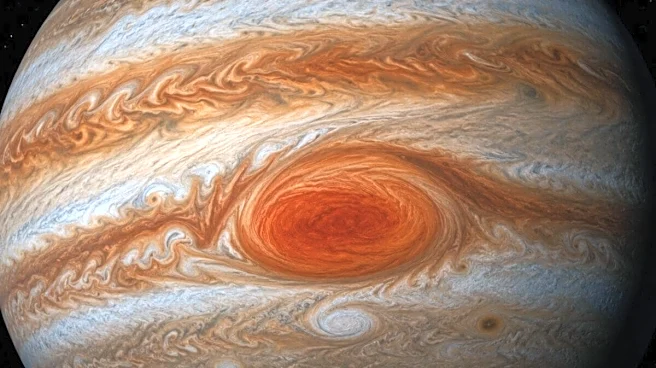






Earth has hurricanes. Jupiter has a storm so enormous that our entire planet could fit inside it.
The Great Red Spot is the name given to this giant whirlwind that has been spinning across the surface of Jupiter for ages past.
The Great Red Spot was observed by astronomers way back in the 1800s, while there are also suggestions that it could be the same storm noticed by astronomers even as far back as the 17th century. If that’s true, it has been churning through Jupiter’s atmosphere for more than 350 years.
That longevity is what makes it so extraordinary.
On Earth, even the most powerful storms eventually weaken when they move over land or cooler water. Jupiter offers no such obstacles. Since the giant does not have any solid surface, this results
in extremely lengthy storms. The Great Red Spot is basically a big high-pressure area that exists between very strong jet streams in the atmosphere of the giant planet.
And it is fast.
The winds in the storm can attain up to 400 kilometres per hour, creating a giant whirlpool that keeps moving in an eternal loop over the multi-coloured clouds of the planet. It appears from space as a big red ellipse carved out of the atmosphere of the planet.
The storm is huge, but it is not as large as it once was.
Scientists have discovered that the Great Red Spot has been shrinking for decades. In the late 1800s, it was wide enough to fit several Earths side by side. Today, it remains enormous but is significantly smaller than it was a century ago.
That has raised an intriguing question: could the Solar System’s most famous storm eventually disappear?
For now, the answer remains uncertain. Data from spacecraft such as NASA’s Juno mission continue to reveal new details about the storm’s depth, structure and behaviour. Researchers have found that it extends hundreds of kilometres below Jupiter’s cloud tops, suggesting there is still much to learn.
Until then, the Great Red Spot remains one of space’s greatest survivors—a storm older than many nations, larger than Earth and still spinning across Jupiter’s skies after centuries of relentless motion.

/images/ppid_a911dc6a-image-178218252303790784.webp)

/images/ppid_59c68470-image-178215252905721431.webp)

/images/ppid_a911dc6a-image-178194802516468958.webp)
/images/ppid_a911dc6a-image-178192355392933037.webp)





/images/ppid_a911dc6a-image-178192357973059402.webp)