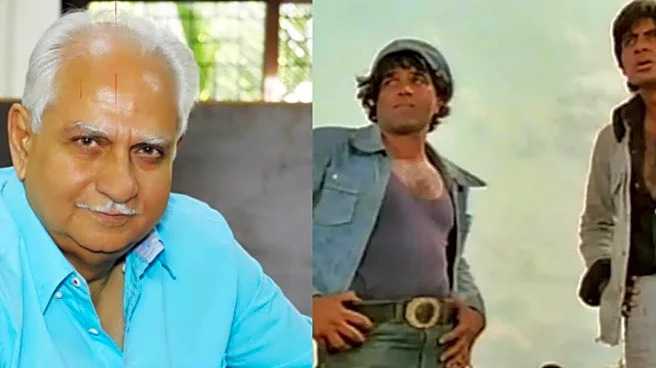

As Sholay completed 50 years this August, its legacy returned to the spotlight with a nationwide re-release—this time restoring the original ending where Gabbar Singh meets his death. Today, the film is treated
as sacred cinematic history, but few remember that Sholay was once dismissed as a reckless gamble that many believed would wreck the Hindi film industry.
Long before it became a benchmark for Indian cinema, Sholay faced the same scepticism that surrounds big-budget spectacles even today. Trade circles buzzed with anxiety over its mounting costs, echoing the debates now seen around films like Bade Miyan Chote Miyan or Game Changer. Industry voices were convinced that such extravagant spending would collapse the ecosystem and leave producers bankrupt.
A Cold Opening and Industry Schadenfreude
When Sholay finally released, those fears seemed justified. The opening weekend passed without fanfare. Theatres were quiet, ticket sales underwhelming, and early verdicts brutal. Newspapers wasted no time in declaring the film a failure, predicting that its makers would never recover the investment.
Director Ramesh Sippy later revealed that the industry’s reaction was almost celebratory. Distributors, exhibitors, and producers reportedly felt vindicated. There was a sense of relief that an expensive experiment had stumbled. As Sippy recalled, many openly said, “Good that the big film didn’t work.”
The silence was so unsettling that Sippy even considered altering the climax yet again—this would have meant a third version of the ending. But writers Salim Khan and Javed Akhtar refused to panic. They remained certain that the film would find its audience, even if it took time.
“They Took Back Their Words”
Speaking to Siddharth Kannan years later, Sippy revisited that turbulent phase. He remembered how the press initially tore the film apart, warning that unchecked budgets would destroy the industry. But within weeks, the narrative flipped.
“Five weeks later, they took back everything they wrote,” Sippy said, noting how the same publications that predicted doom admitted they were wrong. Sholay didn’t just recover—it rewrote box office history.
A Budget That Terrified Everyone
Part of the hysteria stemmed from the film’s unprecedented cost. What began as a ₹1 crore project eventually ballooned to ₹3 crore—an astronomical figure at the time. Sippy explained that ₹1 crore in the mid-1970s would roughly translate to ₹100 crore today.
To many in the trade, the numbers felt irresponsible. There was a widespread belief that the film’s scale itself posed a threat to livelihoods across the industry.
Censorship, the Emergency, and a Forced Ending
Sholay’s troubles weren’t limited to money. The censor board intervened heavily, forcing changes that reshaped the film’s climax. In its original version, Gabbar Singh is killed. But the board objected to a police officer—played by Sanjeev Kumar—taking a life on screen.
According to Sippy, resistance was futile. “This was the Emergency,” he said. “You couldn’t argue.” The director was sent back to Bengaluru to reshoot the ending, replacing Gabbar’s death with his arrest.
Finally Restoring What Was Lost
Half a century later, Sippy has finally undone what he was compelled to change. The re-release of Sholay now presents the ending audiences were never meant to lose.
“I felt terrible when they made me change it,” he admitted. “Why should the censor tell me how to make my film?”
The restored version doesn’t just alter a scene—it completes a creative journey interrupted by fear, control, and circumstance. What once nearly broke its makers now stands as proof that conviction can outlast criticism, and that even legends begin under a cloud of doubt.
/images/ppid_a911dc6a-image-177096644330164108.webp)

/images/ppid_a911dc6a-image-177096647797524739.webp)
/images/ppid_a911dc6a-image-1770966255583724.webp)




/images/ppid_59c68470-image-177096510334513942.webp)

/images/ppid_59c68470-image-177096513967066327.webp)
/images/ppid_59c68470-image-177096502906732579.webp)