

/images/ppid_a911dc6a-image-177091964365144869.webp)

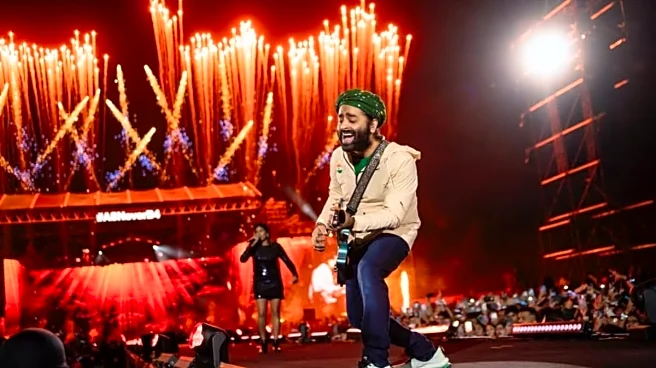
Arijit Singh’s announcement that he is stepping away from playback singing has been met with disbelief across the country.
For over a decade, his voice shaped the emotional atmosphere of Hindi cinema, from heartbreak anthems to soaring romantic ballads, making him one of the most recognisable and influential artists of his generation.
But his retirement has also pushed attention towards an equally intriguing story: how a singer at the peak of commercial success, with extraordinary wealth and global fame, continues to live a life almost entirely removed from the glamour associated with the entertainment industry.
How Much Is Arijit Singh Worth?
According to a report by The Economic Times, Arijit Singh’s net worth is estimated at around Rs 414 crore,
placing him among the highest-paid singers. His financial ascent is the result of multiple revenue streams: playback singing, live concerts, composition, royalties, brand associations, and long-term investments.
Reports suggest he earns nearly Rs 70 crore annually, a figure that reflects both his unmatched demand and his steady global audience.
Yet this material success sits in sharp contrast with the life he chooses to lead.
How Much Does He Charge For A Song Or Live Show?
Arijit’s playback fees reflect his superstar status. Various reports suggest he charges between Rs 8 lakh and Rs 10 lakh per film song, with higher figures for select projects. But the real scale of his earnings becomes visible in his concert economics.
Last year, composer Monty Sharma revealed in an interview with HT Music that Arijit charges approximately Rs 2 crore per performance. Other reports indicate that certain large-scale concerts may fetch him close to Rs 14 crore for a two-hour set, placing him in the league of the highest-paid global touring artists.
His Financial Assets: Real Estate, Cars And Long-Term Investments
Arijit has invested heavily in real estate, including four apartments in a building in Mumbai’s Versova area, each valued at around Rs 9 crore. His car collection includes a Range Rover Vogue, a Hummer H3, and a Mercedes-Benz. Even so, he is rarely seen using or displaying these symbols of wealth.
Most of his financial decisions appear to reflect security rather than lifestyle, a pattern that aligns with his personality and choices.
The Making Of A Musician: Training, Television And Early Struggles
Born in 1987 in Jiaganj, Murshidabad, Arijit grew up surrounded by music. The maternal side of his family was steeped in classical traditions — his mother was a trained vocalist who shaped his early training, while relatives ensured he grew up with rigorous discipline and an instinctive understanding of melody. It was this grounding that later gave him the technical precision for which he is known today.
He entered the industry at a time when reality shows dominated Indian television — from Sa Re Ga Ma Pa and Indian Idol to Fame Gurukul, where he first appeared at just 18. Though he did not win or even reach the finals, finishing sixth, his voice left a noticeable impact on judges Javed Akhtar, Shankar Mahadevan and KK.
After the show, he joined another reality series, 10 Ke 10 Le Gaye Dil, a musical face-off between contestants of Fame Gurukul and Indian Idol. Singh won the competition and used the Rs 10 lakh prize money to set up his own studio, a decision that quietly shaped the trajectory of his future career.
Around this time, filmmaker Sanjay Leela Bhansali spotted his potential and offered him a song Yun Shabnami for Saawariya (2007). His version, however, never made it to the final album, much like the music project he later signed with producer Ramesh Taurani, which was also shelved.
His first significant release came in 2011 with Phir Mohabbat from Murder 2, a song that earned him attention, but not yet mainstream superstardom. This was followed by tracks in films like Cocktail (2012), Barfi! (2012) and Players (2012), each adding to his reputation without quite triggering the breakthrough that would soon follow.
The Breakthrough That Redefined Modern Romance
The turning point came in 2013 when director Mohit Suri decided to cast him for Tum Hi Ho in Aashiqui 2, which turned Arijit into a nationwide sensation, earning him his first Filmfare Award for Best Male Playback Singer and establishing the sound of a generation.
The song was more than a hit; it was a cultural reset. It shifted the texture of Bollywood romance, replacing flamboyant declarations with vulnerability, longing and quiet intensity. Arijit’s voice — raw, textured, melting into Mithoon’s composition — became the new sound of love for an entire generation.
What followed was an uninterrupted streak of era-defining songs: Channa Mereya, Kabira, Ae Dil Hai Mushkil, Raabta, Phir Le Aaya Dil, Kesariya, and dozens more. He won seven more Filmfare Awards for songs, including the title track of Ae Dil Hai Mushkil.
He has also received two National Film Awards for Best Male Playback Singer — one for Binte Dil from Padmaavat (2018) and another for Kesariya from Brahmāstra: Part One – Shiva (2022).
Today, with more than 300 songs across Hindi, Bengali, Telugu, Tamil and Marathi, Arijit stands unmatched as India’s most bankable voice.
What Makes Arijit’s Voice So Distinctive?
His brilliance lies in a combination of three rare qualities:
Emotional depth: Every note feels lived. The pain in Channa Mereya, the surrender in Raabta, the yearning in Phir Le Aaya Dil — he makes listeners feel the emotion before they understand the lyrics.
Versatility: He can glide from the softness of Gerua to the vibrancy of The Breakup Song to the devotional sweetness of Maatrubhumi. His transitions between genres are seamless.
Technical precision: His classical grounding ensures immaculate pitch, control and breathwork. Even in live concerts, often considered the true test, he sounds uncannily studio-perfect.
It is this trifecta that has made Arijit Singh not just a singer but a phenomenon, a fact underscored in 2025 when he was awarded the Padma Shri for his contribution to the performing arts.
Why Arijit Chose A Life In Jiaganj
Arijit lives a remarkably modest, grounded life in Jiaganj, Murshidabad, far from Mumbai’s celebrity ecosystem. He travels to Mumbai only for work, maintains a limited presence on social media, and consciously avoids media appearances.
Residents of Jiaganj often spot him sipping tea at roadside stalls, shopping for groceries, or walking through markets with no entourage. In 2023, he was seen riding a scooter with international singer-songwriter Ed Sheeran through the narrow lanes of his hometown, an image that went viral precisely because it captured a global star choosing ordinary spaces without hesitation.
His close friend and composer Indradip Das Gupta told Times of India that while Mumbai shaped his career, Jiaganj remains the place where he feels most connected and peaceful. Arijit has long believed that success should not disconnect him from his roots.
According to ET, he built a state-of-the-art recording studio inside his home and spends increasing time there, especially after the pandemic.
Why He Enrolled His Children In A Local School
One of the most defining details of Arijit’s grounded lifestyle is his decision to enroll his sons in a local school in Jiaganj rather than a high-profile institution in Mumbai. In 2022, images of him standing quietly outside the school like any other parent spread widely online.
According to Indradip Das Gupta, this choice reflects Arijit’s belief in simplicity and discipline. He encourages his children to spend their mornings and evenings playing football instead of video games, and he wants them to grow up in a community rooted in values rather than privilege.
This philosophy — of normalcy, humility and minimal digital indulgence — underpins much of Arijit’s personal life.
The Humanitarian Side: Charity Without Headlines
Arijit is also known for philanthropic work, though he prefers to keep it private. Reports indicate that he donates to education and healthcare initiatives in rural Bengal, contributed to COVID-19 relief, and supports families in distress through his foundation. But he almost never publicises these efforts.
Why His Retirement From Playback Matters
Arijit’s decision to stop taking new playback assignments marks the end of an era. In his announcement, he thanked listeners for years of support and wrote that he would no longer be accepting any new work as a playback vocalist. His focus is now expected to shift towards independent music and composition, a long-standing creative desire he has often expressed.
For fans, the loss is emotional. For the industry, it represents the closing of a chapter in which one voice dominated an entire phase of Hindi cinema.
Arijit Singh proved that success need not come with spectacle. Sometimes, the quietest voice leaves the loudest echo.

/images/ppid_a911dc6a-image-177098954007759066.webp)



/images/ppid_a911dc6a-image-177089857481720650.webp)
/images/ppid_a911dc6a-image-177101053501199609.webp)
/images/ppid_a911dc6a-image-177100358713419284.webp)