

/images/ppid_59c68470-image-177074753723033180.webp)
/images/ppid_a911dc6a-image-177097703552553137.webp)
After a momentous 2025 that proved what was technologically possible, 2026 will test whether major space powers can sustain human and robotic missions at scale. The year is also being described by scientists as the “year of the Moon,” with the return of astronauts to lunar proximity for the first time since the Apollo era and intense global activity at the lunar south pole.
Across the world, agencies are entering 2026 with ambitions that stretch from the Earth–Moon system to Mars, Jupiter, Mercury, and even the deep intergalactic medium. The year will mark a transition from isolated feats to the operational deployment of human missions, commercial launch systems, sustainable space infrastructure, and coordinated planetary defence. For India,
it will be a defining phase in human spaceflight readiness, Earth-observation expansion, and commercial launch growth.
Why 2026 Is Being Called The ‘Year Of The Moon’?
Four astronauts will orbit the Moon for the first time in more than five decades. China will send a complex robotic mission to the South Pole. Several international payloads will ride onboard Chinese hardware. And lunar-adjacent technologies, from navigation systems to sample-analysis tools, will undergo major testing.
This lunar momentum is not just symbolic. Scientists believe the South Pole’s permanently shadowed craters could contain water ice, and its confirmation would reshape the cost, range, and feasibility of long-duration human missions to Mars and beyond.
Here are the missions and developments to watch in 2026.
NASA’s Artemis II
NASA’s Artemis II mission will be the world’s most closely watched spaceflight of 2026, not only because it is the first crewed Artemis mission but because it will take humans beyond Low Earth Orbit for the first time since Apollo 17 in 1972. The flight represents a generational return to deep space: no astronaut in more than fifty years has travelled far enough to see both the Earth and the Moon together from the far side.
The 10-day circumlunar mission will carry four astronauts—Reid Wiseman, Victor Glover, Christina Koch, and Canada’s Jeremy Hansen—on a trajectory that will swing them over 7,500 kilometres beyond the Moon’s far side. This path allows NASA to test how the Orion capsule behaves in the deep-space radiation environment, where conditions are significantly harsher than in Earth orbit.
Artemis II is designed to do something Artemis I could not: evaluate Orion’s entire life-support system with humans onboard. The crew will test carbon-dioxide removal systems, cabin-pressure controls, thermal regulation, and manual navigation capabilities while travelling well outside the Earth’s protective magnetic field. The mission will also validate communication links and emergency procedures that must work reliably before any attempt to land astronauts on the lunar surface.
NASA considers Artemis II the essential bridge between the programme’s uncrewed test phase and the planned Artemis III landing later in the decade. The mission is central to the wider Artemis architecture, which aims to establish sustained human presence on and around the Moon.
China’s Chang’e-7 Mission
China’s Chang’e-7 mission, launching in mid-2026, is the second major lunar highlight of the year. It will explore the Moon’s south pole using an orbiter, lander, rover, and a unique “hopper” spacecraft capable of jumping between illuminated and permanently shadowed regions.
The mission’s goal is to search for water ice and “volatile matter” in shadowed craters, regions that sunlight never reaches and where temperatures can plunge far below minus 200 degrees Celsius. Tang Yuhua, deputy chief designer of Chang’e-7, told state media that locating ice deposits could drastically reduce the cost and time needed to transport water from Earth for longer missions deeper into the solar system.
Chang’e-7 will also strengthen China’s international partnerships, carrying payloads from Egypt, Bahrain, Italy, Russia, Switzerland, Thailand, and the International Lunar Observatory Association.
What India Has Planned In 2026
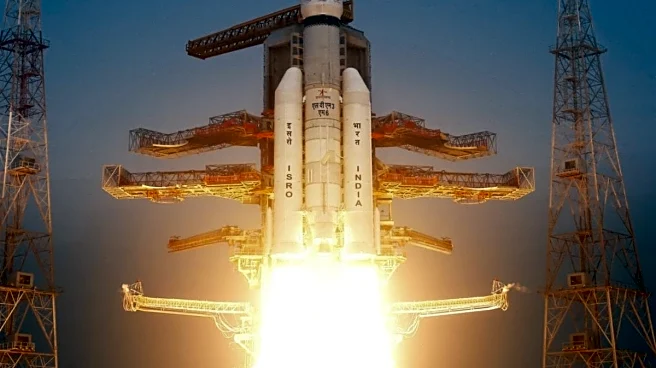
For India, 2026 will be a critical year in establishing independent human-spaceflight capacity. ISRO’s Gaganyaan programme is expected to conduct additional uncrewed missions and potentially crew-rated tests focused on recovery systems, abort mechanisms, environmental control, and life-support operations.
A major milestone will be the Gaganyaan G1 mission, scheduled for early 2026, which will carry Vyommitra, a humanoid robot designed to simulate astronaut responses and validate systems for future crewed flights. ISRO chairman S. Somanath has said that work on the programme is nearing completion, with around 90 per cent of systems already integrated.
ISRO has also planned strategic Earth-observation launches in 2026, including EOS-5, EOS-10, and GISAT-1A, which will strengthen India’s imaging and reconnaissance capabilities.
Meanwhile, Aditya-L1—India’s first solar observatory—will continue offering insights into solar storms, space weather, and their potential impact on satellites, power grids, and communication systems. By 2026, the mission promises long-duration, stable observations from the Lagrange-1 point, helping researchers better understand solar activity and its implications for the Earth’s near-space environment.
India’s private launch ecosystem is also expected to expand significantly in 2026. The success of LVM3 commercial missions in 2025 and the rapid growth of domestic startups position the country to attract larger international payloads through NewSpace India Limited.
What SpaceX Is Planning In 2026
SpaceX will pursue two parallel tracks: preparing its next-generation Starship system for deep-space logistics and continuing routine crew and cargo support for the International Space Station through the Falcon 9 programme.
The Starship super-heavy spacecraft, designed to be fully reusable, will take major steps toward operational status. SpaceX says it can carry around 150 tonnes in reusable mode and up to 250 tonnes expendable. A Starship mission is slated for November–December 2026, with the company planning to send cargo flights to Mars to test atmospheric entry and landing behaviour. These tests will feed into future crewed Mars missions.
Alongside its Mars-facing work, SpaceX will continue essential low-Earth-orbit operations. Falcon 9 will support the International Space Station through the Crew-12 mission, carrying four international astronauts as part of NASA’s global partnership model.
Overall, SpaceX’s maturing Starship architecture is expected to influence lunar logistics, satellite-constellation deployment, and long-range cargo missions.
Europe’s Big Missions
Hera: A ‘Crash Scene Investigation’ In Space
In November 2026, ESA’s Hera spacecraft will arrive at the asteroid Dimorphos to analyse the crater left by NASA’s 2022 DART impact. The mission aims to improve Earth’s long-term planetary-defence strategies by studying how a deliberate asteroid impact modifies a target’s surface and trajectory.
SMILE: Mapping Earth’s Magnetic Shield
The Solar Wind Magnetosphere Ionosphere Link Explorer (SMILE) mission, launching in April or May, will make X-ray and ultraviolet observations of the Earth’s magnetosphere. The mission will travel as far as 121,000 kilometres above the North Pole and capture continuous data for up to 45 hours per orbit. SMILE will help scientists understand how solar wind interacts with Earth’s protective magnetic bubble.
PLATO: Searching For Earth-Like Worlds
ESA’s PLATO telescope, scheduled for launch in December 2026, will search for Earth-like exoplanets orbiting Sun-like stars, expanding Europe’s role in planetary discovery.
BepiColombo: Entering Mercury’s Orbit
Orbiters from ESA and Japan will finally enter Mercury’s orbit in 2026 after years of gravity-assist manoeuvres. They will study the planet’s magnetic environment, inner core, and surface in unprecedented detail. ESA says the information could help reconstruct the history of the entire solar system.
Japan’s MMX Mission
Japan’s Martian Moons eXploration (MMX) mission will aim to collect samples from Phobos, one of Mars’s two moons. It will contribute to understanding how Martian moons formed and how materials move around the solar system.
The New Space Race: Commercial Stations, Sustainability, And AI-Driven Earth Observation
Beyond individual flagship missions, 2026 is set to accelerate major structural shifts in how the global space sector operates. As the International Space Station nears the final phase of its service life, attention is shifting towards commercial space stations that can eventually take over its role.
Platforms such as Axiom Station, which began as modules attached to the ISS, are expected to move closer to partial or fully independent operations.
In-orbit servicing capabilities, such as autonomous docking, refuelling, and spacecraft life-extension, will also begin early operational use in 2026. India’s autonomous docking expertise demonstrated through its SpaDeX mission aligns with this global shift, signalling that such technologies will no longer remain experimental demonstrations but will start to form part of routine orbital activity.
Meanwhile, Earth-observation missions like NISAR will see their first full year of continuous data generation. Governments and private companies are expected to integrate this information with artificial-intelligence tools for a wide range of applications, from climate modelling and disaster response to urban planning and agricultural forecasting. This signals a broader trend in which satellites are no longer standalone assets but nodes in global data systems tied to machine learning and cloud-based analytics.
As launch rates rise and more actors enter orbit, 2026 will also intensify efforts around space sustainability. Space-traffic management, debris mitigation, and active-debris removal, once seen as long-term challenges, are now becoming urgent priorities. Regulatory norms that were voluntary in earlier years may begin to take the shape of enforceable international guidelines as the world adapts to an increasingly crowded orbital environment.
/images/ppid_59c68470-image-177097011687097193.webp)

/images/ppid_a911dc6a-image-177089155801556978.webp)





/images/ppid_59c68470-image-177098010776243677.webp)