

/images/ppid_59c68470-image-178098757073416631.webp)
Most railway stations connect cities. Petrapole connects countries.
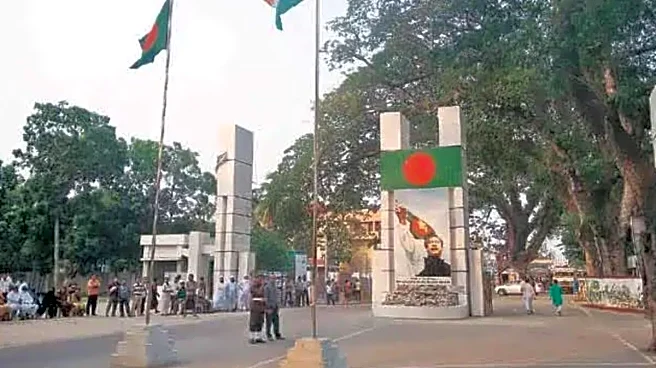
Located on the India-Bangladesh border in West Bengal, the Petrapole rail crossing forms one of South Asia’s most important international railway gateways, where passenger and freight trains physically pass through fenced border barriers and security-controlled gates directly into Bangladesh.
On the Indian side lies Petrapole.
Just across the border sits Benapole in Bangladesh.
Together, they form one of the busiest land-port and railway trade corridors between the two countries.
The experience feels dramatically different from ordinary train travel.
Barbed-wire fencing, immigration infrastructure, customs zones and border security checkpoints surround the railway tracks. Passenger
trains heading toward Bangladesh move slowly through heavily monitored gates before formally entering another nation’s railway system.
According to Indian Railways, the route became increasingly important after rail connectivity between the two countries expanded again in recent decades following long interruptions after Partition and the 1965 India-Pakistan war.
Today, the line carries both freight and international passenger traffic.
One of the most famous services is the Maitree Express, which connects Kolkata with Dhaka. Passengers undergo immigration and customs procedures before boarding, making it one of the rare train journeys in the region where international border formalities happen directly alongside railway operations.
The freight movement through Petrapole-Benapole is even larger.
Petrapole is one of India’s busiest land ports by trade volume, handling enormous quantities of goods moving between India and Bangladesh. Freight trains transport textiles, food products, industrial materials and consumer goods through the corridor continuously.
The border itself carries deep historical weight.
Before Partition in 1947, railway lines across Bengal operated as part of a far more integrated regional network under British India. Trains moved relatively freely between cities that later ended up separated by international borders.
Partition changed everything.
Rail routes were disrupted, borders hardened and many cross-border rail connections collapsed for decades. According to railway historians and reports by The Indian Express, restoring railway links between India and Bangladesh later became symbolically important because the tracks represented reconnecting parts of a once-unified transport system.
That history still feels visible at Petrapole.
Old rail alignments, customs infrastructure and fenced corridors create an atmosphere unlike almost any ordinary station. Freight yards stretch across the border zone while locomotives move cautiously between security-controlled sections monitored by border forces from both countries.
The railway crossing also highlights how strategically important India-Bangladesh connectivity has become.
In recent years, both governments expanded rail cooperation significantly through projects aimed at improving trade, passenger travel and regional logistics. Multiple dormant railway routes severed after Partition have gradually reopened.
Yet despite modernization, the Petrapole-Benapole crossing still retains something visually striking.
A train literally passes through gates, fencing and international checkpoints while remaining on the same uninterrupted railway track.
And perhaps that is what makes the station so fascinating.
In a region where borders once violently divided people, one railway line still physically stitches two countries together every single day.











/images/ppid_59c68470-image-178098759125184719.webp)
