

/images/ppid_a911dc6a-image-177071104548613514.webp)
/images/ppid_a911dc6a-image-177071443822834480.webp)
For decades, history framed India-Egypt ties largely as maritime trade across the Red Sea. Now, a remarkable discovery has expanded that narrative.
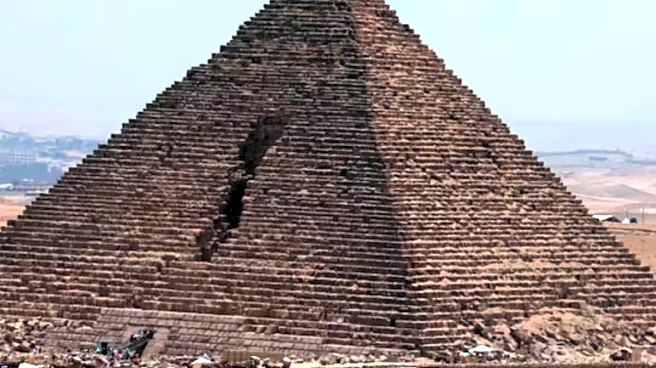
Researchers from Switzerland and France have identified 2,000-year-old Tamil-Brahmi inscriptions carved into tombs in Egypt’s renowned Valley of the Kings. The inscriptions mention a Tamil merchant named Cikai Korran, indicating that Indian traders journeyed far beyond coastal ports into Egypt’s historic interior.
The findings suggest that ancient links between India and Egypt were not limited to commerce alone. Indian merchants appear to have travelled inland to explore monumental architecture and sacred sites, leaving behind inscriptions in Tamil, as well as in Sanskrit and Prakrit, a powerful evidence
of deep cultural as well as commercial exchange.
Who Was Cikai Korran?
The name ‘Cikai Korran’ appears etched into the stone surfaces of several tombs. Swiss scholar Ingo Strauch and French researcher Charlotte Schmitt discovered and deciphered these inscriptions.
Their study reveals that around 2,000 years ago, a Tamil merchant visited the tombs of Egyptian kings, the pharaohs, and inscribed his name in eight separate places across five of the six tombs examined.
In Tamil, ‘Cikai’ translates as crown or topknot, while ‘Korran’ signifies leader or king. According to a report by The Times of India, one inscription reads ‘Cikai Korran-Vara Kant’, meaning ‘he came and he saw’.
Researchers also believe the trader may have understood Greek, as the style of carving resembles Greek inscriptions of the period.
A Glimpse Of Early Cultural Tourism
Professor Ingo Strauch of the University of Lausanne noted that, until now, evidence of Tamil traders in Egypt had been confined to coastal trading ports.
The presence of inscriptions in the inland Valley of the Kings indicates that Tamil merchants remained in Egypt for extended periods. They did not merely engage in buying and selling goods, but also travelled considerable distances to explore its architecture and historical monuments.
Sanskrit And Prakrit Connections
In total, researchers documented 30 inscriptions in the Valley of the Kings. Of these, 20 are in Tamil, while the remaining are in Sanskrit, Prakrit, and Gandhari-Kharosthi.
This linguistic diversity suggests that traders from regions beyond South India, including Gujarat, Maharashtra, and north-western India, journeyed to Egypt during the Roman era.
One Sanskrit inscription refers to an envoy from the ‘Kshaharata’ dynasty of western India who arrived in the first century AD.
Strong Evidence Of Two-Way Trade
According to senior epigraphist Y Subbarayalu and archaeologist V Selvakumar, the discovery offers firm proof of reciprocal trade.
Previously, it was widely believed that Roman merchants were the primary visitors to India. This new evidence demonstrates that Indian traders were equally active in travelling to the Roman and Egyptian empires, reinforcing the depth and dynamism of ancient commercial and cultural exchanges.

/images/ppid_a911dc6a-image-177097703552553137.webp)

/images/ppid_59c68470-image-177097268820437275.webp)



/images/ppid_a911dc6a-image-177088864928744173.webp)
/images/ppid_59c68470-image-177089753887696314.webp)