
/images/ppid_59c68470-image-176994502354269672.webp)
/images/ppid_a911dc6a-image-176994483076242116.webp)
/images/ppid_a911dc6a-image-176994487119336478.webp)
High in the trans-Himalayan landscape of Ladakh lies Hanle, a remote village cradled by rugged mountains and vast silence. Often called the roof of the world, Hanle is India’s first officially recognised Dark Sky Reserve, a place where artificial light barely exists and the night sky takes centre stage.
Over the last few years, this once-forgotten village has quietly become a favourite among astro-tourism enthusiasts.
When The Night Sky Over Hanle Turned Red
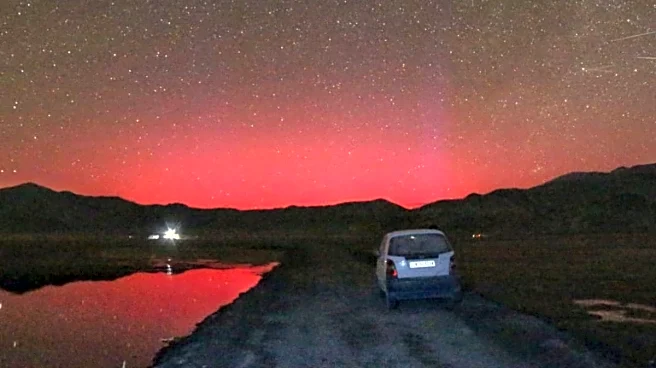
Hanle’s skies are usually calm, predictable and filled with stars. But on the nights of January 19 and 20, stargazers witnessed something extraordinary. The sky above the Hanle Dark Sky Reserve glowed an eerie red, an extremely rare sight for India. Images of the phenomenon spread rapidly online, sparking disbelief and excitement,
as aurora-like displays are almost unheard of this far south.
The Solar Storm Behind The Spectacle
The crimson glow wasn’t magic alone; it was science at work. On January 18, the Sun unleashed an intense X-class solar flare, one of the most powerful types of solar eruptions. This sent a massive stream of charged particles racing towards Earth at nearly 1,700 kilometres per second. When these particles collided with Earth’s magnetic field, they triggered a severe geomagnetic storm, classified as an S4 radiation event. Unlike the green auroras seen near the poles, Hanle only caught the upper fringes of the phenomenon, resulting in deep red hues across the sky.
A Stunning View With Serious Consequences
While the visuals were breathtaking, space agencies, including NASA and ISRO, flagged potential risks. Such intense solar storms can disrupt satellite communication, GPS navigation, banking systems and even power grids. Scientists closely monitored how the storm compressed Earth’s magnetic shield, highlighting the delicate balance between beauty and danger in space weather events.
Why Hanle Remains A Stargazer’s Paradise
Beyond this rare event, Hanle’s charm lies in its consistently pristine skies. Located in the rain shadow region of the Karakoram range, the village enjoys nearly 280 clear nights each year. Sitting at an altitude of about 4,500 metres, Hanle has minimal atmospheric disturbance and almost no light pollution. This makes it ideal for spotting the Milky Way, distant planets and even the faint Andromeda galaxy with the naked eye.
Indian Astronomical Observatory And Dark Sky Reserve
Hanle is home to the Indian Astronomical Observatory, operated by the Indian Institute of Astrophysics. A 22-kilometre radius around the observatory has been designated as the Hanle Dark Sky Reserve. Once off the tourist map, the village now attracts travellers visiting the nearby Hanle monastery, the Changthang Wildlife Sanctuary and inevitably, the observatory itself.
Best Time And How To Reach Hanle
March to October is the best time to visit Hanle, when temperatures are manageable, and skies remain clear. The village is about 270 kilometres from Leh and takes nearly 10 hours to reach by road. Hanle also serves as a base for those heading to Umling La, the world’s highest motorable road.
/images/ppid_a911dc6a-image-176994652799396215.webp)










/images/ppid_a911dc6a-image-176994543616533491.webp)