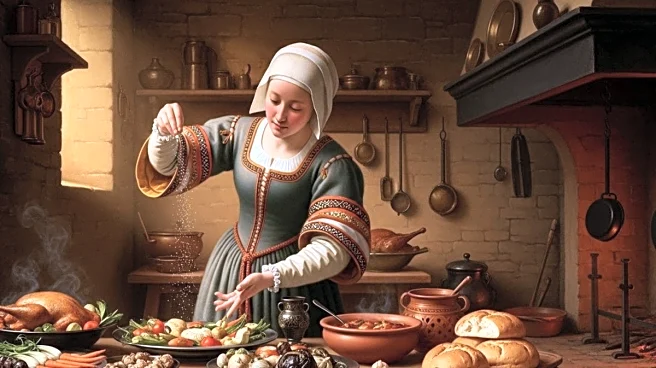

A dramatic story that has gone viral online claims that wives in medieval Europe allegedly often poisoned their husbands in the morning and then gave an antidote at night to ensure fidelity. The narrative,
which has received millions of views on social media, has captivated people’s attention by fusing grim medieval tales with romantic wit.
However, scientists and historians claim that this scenario is very different from recorded history. Rather, they characterise it as a contemporary myth that combines folklore, popular culture, and misconceptions about toxicology and medieval life.
Here’s why the claim continues to circulate online, and the explanation behind it.
View this post on Instagram
Viral Tale And Its Spread
Social media posts repeatedly claim that mediaeval women employed slow-acting poisons at breakfast and then gave antidotes every night to keep their husbands to keep their husbands dependent on them. This would prevent the poison from becoming deadly and affecting them.
The men would experience symptoms including nausea, headaches, despair, vomiting, discomfort, or shortness of breath if the husbands stayed away for an extended period of time and the antidote was not administered. Finally, his wife deliberately gave him the
antidote when he got home. In this way, he began to feel better in a few minutes. As a result, the husbands would become closer to their wives and households.
Versions of the story began circulating online as early as September 2022, and in July 2023, it was modified to include the ambiguous phrase “according to some legends.” A fast Google search yields over 8,000 variations. By May 2025, the story continued to be shared on social media as historical truth, devoid of context and intense drama.
Historical And Scientific Realities
Experts reject the concept that such a routine procedure ever occurred. A systematic poison-and-antidote ritual among women is not documented in any medieval legal, medical, or religious archives. Medieval Europe lacked the advanced knowledge of toxicology required to consistently administer poisons and antidotes in a regulated manner.
Although the effects of elements like lead and arsenic were understood, it would have been almost impossible to manage doses as depicted in the viral story. Pietro d’Abano’s Liber de venenis, published in the early 14th century, is one of the most often cited medieval works on poisons. It contains a combination of unsubstantiated claims and folklore, but nothing like a daily poison-and-antidote regimen is described.
Additionally, modern toxicology refutes the claim. Poison exposure usually results in deteriorating effects rather than controlled conditions. Medical research simply does not support the notion that a person can be poisoned regularly and still be
healthy enough to function normally.
Origins: Myth, Folklore, And Film
Similar themes can be found in literature and cultural heritage from outside of medieval Europe, such as Chinese encyclopaedias from Guangdong (1630-1696) or publications from the early 20th century that describe legendary poison-antidote stories. Janet Lindenmuth,
a law librarian at Delaware Law School uncovered comparable tales in cultural contexts that were not related to medieval Europe.
The speech in the 2001 French film ‘Le Pacte des loups’ (Brotherhood of the Wolf), which closely resembles the current meme version of the narrative, is one important cultural source that suggests the myth owes much to popular culture rather than historical
fact.
According to a 1926 Virginia Reel magazine piece, Indian wives give their husbands a steady poison with an antidote upon their return. Chinese views on Thai ladies controlling their husbands with love philtres (a drink or love potion) are documented in another
1971 story.
Why The Story Persists
The claim persists on social media because it adheres to modern narrative cliches, such as secretive female autonomy, dramatic medieval locations, and a light-hearted take on relationships. Such spectacular, bite-sized stories are readily circulated and reproduced without verification.
Did European Medieval Women Really Poison Their Husbands?
The simple answer is NO. Although poisoning has happened in the past, most notably with Giulia Tofana in 17th-century Italy, there is no proof that medieval women routinely poisoned and treated their husbands at night.
/images/ppid_a911dc6a-image-176994652799396215.webp)










/images/ppid_a911dc6a-image-176994543616533491.webp)