

/images/ppid_59c68470-image-17808850285391185.webp)

There is no doubt that Artificial Intelligence (AI) has made our lives faster and more efficient. But what if the AI boom itself ends up making some things more expensive? A recent analysis by The Washington Post argues that the global race to build AI infrastructure is creating unprecedented demand for electricity, semiconductors and industrial materials — a trend that could contribute to inflationary pressures across the economy.
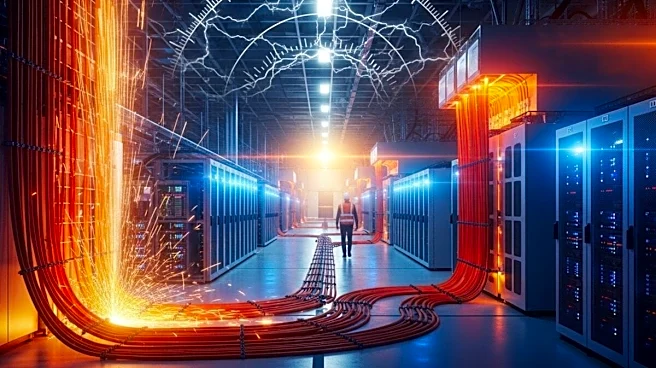
The world’s largest technology companies — Microsoft, Amazon, Alphabet and Meta — are expected to spend more than $700 billion this year on AI infrastructure, including data centres, advanced semiconductors, electricity networks and cooling systems.
Unlike previous digital booms, AI is not just about software. It requires
vast amounts of physical infrastructure, energy and raw materials. As companies compete for the same resources, experts say the AI buildout could eventually push up costs across multiple sectors.
“Iran-OPEC tensions and Silicon Valley’s AI boom are jointly shaping the next inflation cycle,” said Jaspreet Bindra, Founder, AI&Beyond. Geopolitical instability near the Strait of Hormuz is pushing crude oil prices higher, increasing fuel, freight, and food inflation in India and globally. At the same time, AI expansion is creating a massive surge in demand for energy, semiconductors, and critical industrial materials, he added.
“Data centres and chip manufacturing are highly energy-intensive, adding structural cost pressure. Together, these forces are creating a dual inflation engine, one driven by geopolitical energy shocks and the other by technology-led infrastructure expansion across the global economy,” he explained.
The effects may not be visible immediately. But if current investment trends continue, consumers could eventually feel the impact in surprising ways.
Electricity Could Become More Expensive
Every chatbot query, AI-generated image or automated search requires vast computing power running inside specialised data centres. These facilities consume huge amounts of electricity and are filled with expensive chips, servers, cooling equipment and networking hardware. The result is one of the largest infrastructure buildouts in modern technology history.
According to The Washington Post analysis, the scale of investment is now so large that it is beginning to resemble a global construction boom. Data centres are being built at an unprecedented pace, power companies are expanding generation capacity and chip manufacturers are racing to meet demand.
That spending is creating new economic opportunities. But it is also creating intense competition for resources.
The AI-driven data centre boom is becoming so large that it could reshape global energy markets. Consulting firm McKinsey estimates that nearly $7 trillion will be invested in data centres by 2030, including about $1.3 trillion on power generation, cooling systems and electrical infrastructure alone.
The scramble for power equipment has become so intense that some companies are paying not just for machinery, but for the right to secure future orders. Components such as transformers, which once had waiting periods of just one or two months, now face order backlogs stretching beyond three years. The surge in demand highlights how the race to build AI infrastructure is putting unprecedented pressure on global supply chains.
To meet that demand, utility companies are investing heavily in new power plants, transmission lines and grid upgrades. Those investments eventually need to be recovered.
In many countries, that could translate into higher electricity costs for businesses and households over time. Even where governments intervene to keep prices stable, rising infrastructure costs often find their way into the broader economy.
Cloud Services And Digital Subscriptions May Cost More
Most people use cloud computing without realising it. Streaming services, food-delivery apps, and business software rely on cloud infrastructure operated by companies such as Amazon, Microsoft and Google.
AI is making that infrastructure more expensive to build and operate. Training advanced AI models requires specialised chips that cost tens of thousands of dollars each. Running those systems also consumes large amounts of electricity.
As costs rise, technology companies may eventually pass some of them on to customers. Businesses that rely on cloud services could then increase prices for their own products and services.
Consumers may not see a direct “AI surcharge” on their bills. But they could end up paying more for software subscriptions, digital tools and online services.
Housing Around Tech And Data-Centre Hubs Could See Pressure
Another less obvious consequence involves real estate. Modern data centres require vast plots of land, reliable electricity supplies and proximity to communication networks. As AI investments accelerate, competition for suitable locations is intensifying.
In parts of the US, communities hosting major data centre projects have already experienced debates over land use, electricity consumption and local development.
As more AI facilities are built, land values around technology corridors could rise.
India is also witnessing rapid growth in data centre investments. According to industry estimates, India will require a six-fold increase in data centre capacity by 2029 — to over 5,000 MW from about 1,000 MW in 2023 — involving an investment of Rs 1.5 lakh crore.
Noida and Delhi-NCR are emerging as a major digital infrastructure hub in North India. The region boasts an upcoming $25 billion mega AI data centre hub and major campuses from big players like Nxtra by Airtel and Sify Technologies.
Mumbai continues to dominate the data centre (DC) landscape, accounting for 53% of the country’s total operational capacity of around 1,530 MW as of September 2025, according to CBRE South Asia.
While the impact is still emerging, increased demand for land and infrastructure could eventually contribute to local cost pressures.
Construction Materials May Face Higher Demand
The AI boom is not just driving demand for computers. Data centres require enormous quantities of steel, cement, copper, cooling systems and electrical equipment. This surge is driven by the massive physical infrastructure required to house, cool, and power the next generation of AI data centres.
Building thousands of facilities around the world means competing for many of the same materials used in housing, roads, factories and power projects.
Advanced manufacturing, healthcare, and defence activities hinted at selective growth opportunities. Investment in structures is projected to pivot from a 2025 decline to a modest growth of 1.8% in 2026, with AI-related data centre outlays continuing to support engineering and construction work, a Deloitte ‘2026 Engineering and Construction Industry Outlook’ report published in November 2025 read.
The AI buildout may not single-handedly cause construction inflation. But it is adding another source of demand to already stretched global supply chains.
Countries investing heavily in infrastructure, including India, could feel the effects if material costs remain elevated.
Electronics And Semiconductors Could Become Pricier
Demand for high-performance AI chips has exploded over the past two years, driving the global market to an estimated $125-plus billion. This demand is shifting the industry’s focus towards specialised hardware like GPUs and High-Bandwidth Memory (HBM) essential for training and running complex AI models.
Nvidia, the dominant supplier of these processors, has become the world’s most valuable company with $5 trillion market capitalisation largely because demand far exceeds supply.
The concern is that shortages or supply constraints could ripple through the broader technology sector.
Many modern electronics depend on sophisticated semiconductor supply chains. If AI companies continue absorbing a large share of advanced chip production, costs for certain categories of technology products could remain under pressure.
India relies 80%-90% on imported semiconductor requirements, spending over $30 billion annually on chip imports. It depends on China, Taiwan, South Korea, and Singapore to meet the rapidly growing demand for consumer electronics, automotive and telecommunications.
India’s AI and semiconductor ecosystem is being driven by “strong policy support” and “global partnerships”, stressed Bindra. “The India AI Mission is expanding access to subsidized GPU compute and large-scale AI models for start-ups and researchers. The semiconductor mission supports fabrication, design, and materials development with increasing investments. International collaborations with US tech firms are accelerating data centre and chip-related infrastructure. India also benefits from a strong semiconductor design talent pool and growing deep-tech start-up ecosystem. However, challenges such as slow execution, funding delays, and infrastructure gaps remain key constraints despite strong long-term demand and import substitution potential.”
Does Any Of This Lead To Job Cuts?
None of this means AI is bad for the economy. Many experts believe AI will ultimately increase productivity, reduce costs and drive economic growth. Over the long term, those benefits could outweigh any inflationary pressures created during the current investment boom. But the transition may not be smooth.
According to Bindra, AI adoption is creating a “mixed” employment landscape in India. Traditional IT services firms are reducing headcount due to automation and efficiency restructuring, while global technology companies are also cutting jobs as they shift towards AI-first operations. However, new opportunities are emerging in AI, machine learning, cloud computing, cybersecurity, and semiconductor engineering. “Hiring is moving from large-scale recruitment to skill-based, specialised roles. While entry-level coding and repetitive roles are under pressure, India is likely to see net job creation in high-skill, AI-driven sectors over the medium to long term,” Bindra stressed.
The technology designed to make businesses more efficient may, at least temporarily, contribute to higher costs for electricity, infrastructure, construction materials and digital services.
Thus, Bindra cautions AI and tech start-ups to “focus on securing GPU and cloud capacity early, diversifying revenue streams beyond vulnerable markets, and extending financial runway to manage uncertainty”.
He further said professionals must upgrade to AI-plus-domain skills, especially in cloud, cybersecurity, and semiconductor technologies. “Policymakers should accelerate execution of AI and semiconductor missions while strengthening energy security for data centres and chip manufacturing. Supply chain resilience in critical materials such as gases and substrates are essential,” he added.
Overall, “success will depend on adapting to higher costs and volatility while leveraging India’s talent base to build competitive AI and semiconductor ecosystems”, he suggested.

/images/ppid_59c68470-image-178098261121930712.webp)

/images/ppid_59c68470-image-178100002632635574.webp)


/images/ppid_59c68470-image-178097011947943022.webp)
/images/ppid_59c68470-image-178074753501116156.webp)
/images/ppid_59c68470-image-178089756597095710.webp)