



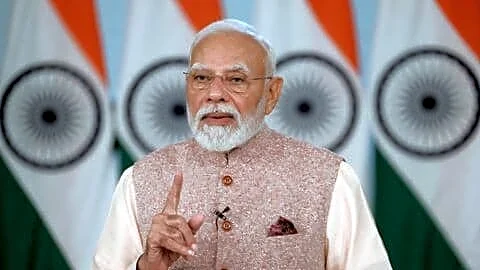
Iranian President Masoud Pezeshkian is set to arrive in New Delhi on Friday for the BRICS Summit, but his meeting with Prime Minister Narendra Modi comes at a moment when the India-Iran relationship carries significance far beyond diplomacy and trade.
With the US-Iran war continuing to disrupt the region, the Strait of Hormuz under intense pressure and energy flows facing uncertainty, Tehran has a direct interest in keeping its channels with India open. For New Delhi too, Iran is no longer just a partner in connectivity and a gateway to Central Asia. It sits at the intersection of India’s energy security, maritime interests, Chabahar ambitions and its effort to maintain strategic space between rival geopolitical camps.
The Modi-Pezeshkian meeting
on Friday ahead of the BRICS Summit on September 12-13, therefore, is expected to go beyond the usual bilateral agenda.
So, what makes Iran so important for India right now, and can PM Modi actually help end the war?
Why Iran Matters To India More Than Ever
Hormuz: The Waterway India Can’t Afford To Ignore
The biggest immediate concern is the Strait of Hormuz. The narrow waterway between Iran and Oman is one of the world’s most important energy chokepoints. For India, its importance is particularly acute because a substantial portion of the country’s oil, LPG and other energy supplies traditionally moves through the Gulf and the strait.
ALSO READ | Why The Iran War Hasn’t Triggered A Full-Blown Oil Crisis Yet; How Is India Cushioning The Impact?
The disruption caused by the Iran conflict has already forced Indian refiners to adjust their sourcing. Middle Eastern oil imports declined sharply during the conflict, with Indian refiners increasing purchases from Russia and other suppliers.
The stakes are not theoretical. Reuters reported on September 10 that escalating attacks linked to the Iran conflict pushed Brent crude above $100 a barrel, while shipping through the Strait of Hormuz faced increasing disruption.
That makes Tehran an unavoidable interlocutor for New Delhi.
India needs the Gulf’s energy, but it also needs commercial shipping routes to remain open. And because Iran exercises enormous influence over what happens around Hormuz, maintaining communication with Tehran becomes an important part of India’s energy-security strategy.
Chabahar: India’s Gateway To Central Asia
Then there is Chabahar. India’s investment in Iran’s Chabahar Port is not simply about having another port. It is about geography.
Chabahar gives India a route towards Afghanistan and Central Asia that bypasses Pakistan. It is also connected to India’s larger ambitions around the International North-South Transport Corridor.
India has a 10-year agreement to equip and operate the Shahid Beheshti terminal at Chabahar, with New Delhi committing $120 million towards port equipment. But the project has been caught in the larger US-Iran confrontation.
ALSO READ | Not An Exit: Why India Is Divesting Its Stake In Chabahar And What It Means For Ties With Iran
The US sanctions waiver that had allowed India to continue its Chabahar-related activities expired in April 2026, complicating the project’s future. India has been discussing the issue with both Washington and Tehran.
That is why Chabahar is likely to be an important item in the PM Modi-Pezeshkian conversation.
Iranian Foreign Ministry spokesperson Esmail Baghaei had said that connectivity and logistics, particularly Chabahar, remain a priority in discussions between India and Iran. Baghaei said Tehran intended to use the BRICS opportunity to continue consultations with India on areas of mutual interest.
In other words, the port is simultaneously an economic project, a connectivity corridor and a piece of India’s strategic architecture.
Energy: The Oil Dilemma
Iran was historically an important crude supplier to India. But US sanctions have severely constrained direct Indian purchases of Iranian oil.
India briefly resumed Iranian crude purchases in 2026 under a temporary US waiver, but that arrangement later expired. At the same time, India’s refiners had to respond to disruptions in Middle Eastern supplies by looking more towards Russia and Latin America.
So why does Iran matter to India’s energy security if India cannot simply buy Iranian oil? Because the question is bigger than Iranian crude.
India’s exposure is to the entire Gulf energy ecosystem and Iran sits astride the geography through which much of that energy moves. If the conflict escalates, the consequences can include higher crude prices, shipping disruptions, insurance costs and pressure on India’s import bill.
ALSO READ | Iran, Russia In Trump’s Crosshairs: Could Venezuela Become India’s Next Big Oil Bet?
Reuters reported that crude prices surged above $100 a barrel amid renewed attacks and disruption around Hormuz. For a major energy importer like India, keeping diplomatic channels open with Tehran is therefore an economic necessity as much as a foreign-policy choice.
Iran Wants India, But For More Than Trade
There is another important dimension to Pezeshkian’s visit.
Baghaei has described India’s role as important because New Delhi maintains relationships across major multilateral groupings, including BRICS and the Shanghai Cooperation Organisation.
An Iranian readout of the recent Modi-Pezeshkian meeting at the SCO said the Iranian president appreciated India’s support and cooperation during the war and urged PM Modi to use India’s extensive contacts with different parties to help move them away from “war and bloodshed” and back towards dialogue and agreement.
This means Tehran is not merely looking at India as a buyer, investor or partner at Chabahar. It sees India as a country that maintains working relationships with multiple sides of the geopolitical divide.
India has ties with Iran. It has deep strategic and economic ties with the Gulf states. It has a major relationship with the US. It also maintains close links with Russia and is engaging China. That gives New Delhi something Tehran badly needs in a crisis: access.
Can India Actually Help End Iran War?
The core dispute involves the US and Iran, their military calculations, sanctions, regional security and the wider West Asian conflict. Neither side is likely to outsource such negotiations to New Delhi.
But India can potentially play a different role; of a facilitator, interlocutor and bridge-builder.
The most important indication comes from Pezeshkian himself. The Iranian president is said to have told PM Modi that India should use its contacts with different parties to help move the sides away from conflict and towards dialogue.
That does not mean Tehran has formally asked the prime minister to mediate a peace treaty. It does, however, suggest that Iran sees value in India’s ability to speak to countries that Tehran itself may find difficult to engage directly.
The Hurdle? A Divided BRICS
Pezeshkian’s visit comes just before the BRICS summit, giving India another platform for diplomatic engagement. But BRICS itself is struggling to find a common position on the Iran war.
The conflict has exposed divisions inside the expanded grouping, particularly because Iran and the UAE, both BRICS members, now find themselves on opposing sides of the regional crisis. The UAE was targeted by Iranian missiles, making it difficult for BRICS to agree on a unified position.
Earlier, Tehran had pushed India, as BRICS chair, to get the grouping to condemn the US-Israeli military offensive against Iran. New Delhi, however, indicated that consensus among BRICS members remained elusive.
This is crucial for PM Modi. India may have good relations with Iran, but it also has important partnerships with the UAE, Saudi Arabia and the US. A strongly pro-Iran BRICS position could therefore hurt India’s balancing act.
For New Delhi, the objective is likely to be less about taking Iran’s side and more about pushing for de-escalation, protection of commercial shipping and a return to diplomacy.
So What Could Modi And Pezeshkian Discuss?
The conversation is likely to revolve around four broad tracks: Hormuz and shipping, Chabahar, energy security, and the war itself.
Ultimately, the most important takeaway from the meeting will be that India needs Iran, but cannot afford to choose Iran. India’s Iran policy is no longer about choosing between Tehran and Washington. It is about keeping both relationships workable while protecting India’s own interests.
Iran matters because of Hormuz, Chabahar, Central Asian connectivity, energy security, and now, increasingly, because India may have a diplomatic role to play in preventing a regional conflict from becoming even wider.
Pezeshkian’s visit therefore puts PM Modi in an unusual position. India cannot end the Iran war on its own. But if Tehran is asking New Delhi to use its relationships to bring the sides back towards dialogue, and if India’s own economic interests depend on that dialogue succeeding, the prime minister has every reason to try.
The challenge will be to do so without becoming a party to the conflict, without alienating the Gulf states, and without damaging India’s strategic relationship with the United States.
That balancing act, rather than any dramatic peace announcement, may be the real significance of the PM Modi-Pezeshkian meeting.






/images/ppid_59c68470-image-178902502661057205.webp)
