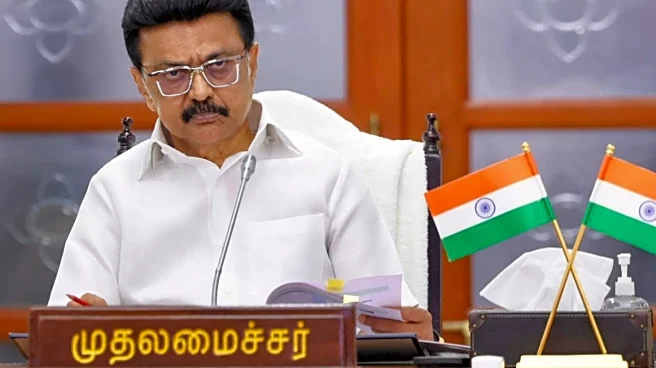

Tamil Nadu Chief Minister MK Stalin threw his support behind the University Grants Commission’s 2026 anti-discrimination regulations, calling them a “delayed but welcome step” while raising concerns about
their implementation and independence.
In a detailed statement posted on X (formerly Twitter), Stalin defended the regulations amid growing backlash, describing them as essential reforms for a higher education system “scarred by deep rooted discrimination and institutional apathy.”
“Since the BJP came to power at the Union level, there has been a visible rise in student suicides within Indian HEIs particularly among SC and ST students. This has been accompanied by repeated attacks and harassment targeting students from South India, Kashmir, and minority communities. In this context, equity safeguards are not a matter of choice but an unavoidable necessity,” Stalin wrote.
The Chief Minister specifically endorsed the inclusion of Other Backward Classes (OBCs) within the framework, comparing current opposition to the backlash faced during the implementation of Mandal Commission recommendations.
“The present UGC_Rollback backlash is driven by the same regressive mindset. The Union Government must not allow such pressure to dilute these regulations or their core objectives,” he said.
However, Stalin raised serious doubts about the effectiveness of the enforcement mechanism, particularly questioning how Equity Committees chaired by institutional heads could function independently. Citing the suicide of Rohith Vemula, where vice-chancellors themselves faced allegations, Stalin wrote, “It is difficult to see how Equity Committees chaired by institutional heads can function independently, especially when many higher education institutions are led by RSS supporters.”
He called on the Centre to not only maintain the regulations but strengthen and revise them to address structural gaps. “If the Union BJP Government is serious about preventing student deaths, ending discrimination, and reducing dropout rates among students from backward communities, these regulations must not only be strengthened but also revised to address their structural gaps, and enforced with real accountability,” Stalin stated.
What UGC Guidelines Say
The UGC’s 2026 regulations represent a significant expansion of the 2012 framework. Key provisions include:
- Expanded definition of discrimination covering caste, tribe, religion, gender, disability, race and place of birth
- Mandatory Equal Opportunity Centres at every higher education institution
- Equity Committees with representation from SC, ST, OBC, women and persons with disabilities
- Strict compliance mechanisms with penalties including denial of programme approval and withdrawal of recognition
The regulations have sparked protests across several states, with critics arguing that the expanded definition of discrimination is vague and open to misuse. Some have raised concerns about whether universities have the capacity to implement the guidelines uniformly. Supporters, however, point to data showing a sharp rise in discrimination-related complaints in recent years, arguing that stronger enforcement mechanisms were overdue.
All UGC-recognised institutions are required to implement the regulations with immediate effect.
/images/ppid_a911dc6a-image-177104210287325129.webp)

/images/ppid_a911dc6a-image-177104202793221357.webp)
/images/ppid_a911dc6a-image-177104206710214315.webp)
/images/ppid_a911dc6a-image-177104202907093694.webp)
/images/ppid_59c68470-image-177104014803952296.webp)

/images/ppid_59c68470-image-177104006389961167.webp)
/images/ppid_a911dc6a-image-177103853218557950.webp)



/images/ppid_a911dc6a-image-17710364781122582.webp)