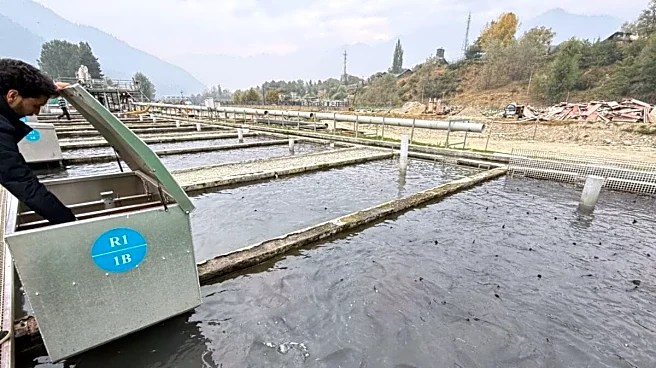



As salmon gains popularity in Indian restaurants, sushi bars and supermarkets, a fish farm in Jammu and Kashmir is preparing to offer consumers a homegrown alternative. Khyber Aquaculture, which operates an integrated, technology-driven trout farming and processing facility in the Valley, is betting that Himalayan trout can compete with salmon on freshness, quality and speed of delivery.
The company aims to take trout raised in Kashmir beyond regional markets and establish it as a premium seafood option across India, with plans to eventually enter international markets. Its strategy centres on a simple proposition: deliver locally farmed fish to consumers faster, reducing the time and distance involved in bringing seafood to the plate.
Positioned
by the company as Asia’s largest trout farm, the facility combines fish breeding, rearing, processing and packaging under one roof. It also uses a Recirculating Aquaculture System (RAS), a technology that treats and reuses water in a controlled environment, allowing fish production to be managed more systematically.
Speaking to News18, Khyber Aquaculture Director Yunus Trumboo said the company wants to take Kashmir’s trout to global markets over the next few years as it expands production.
“The idea is to consolidate an industry which is booming in Kashmir. We have 600 farmers who produce one and a half tonnes a year, and most of that gets consumed in Kashmir itself. This pushed us to start this Asia’s largest farm. Currently, we do around 1,500 to 1,700 metric tonnes. We are expanding it to reach 7,000 metric tonnes to also go beyond India to the global market,” he said.
The facility’s integrated model is designed to give the company greater control over the production chain, from the early stages of fish development to the final product ready for distribution. By bringing farming and processing together, Khyber Aquaculture aims to serve different market segments, including restaurants, retailers and consumers looking for premium seafood for home cooking.
At the centre of this strategy is RAS technology, which enables water to be filtered, treated and reused within a controlled farming environment. Unlike conventional open-water systems, RAS allows operators to monitor and manage key water-quality parameters. However, its efficiency depends on reliable energy supplies, effective water treatment, regular maintenance and careful operational management.
The company has sourced machinery and technology from Denmark and France, drawing on European aquaculture expertise to support its expansion plans.
Can Kashmir’s Trout Become an Alternative To Salmon?
For Khyber Aquaculture, freshness is a key selling point. The company believes that locally farmed trout can reach consumers faster than imported salmon, which travels long distances before arriving in Indian markets.
“We have tried fish with big chefs across India, and the response is amazing. They see it as a positive replacement for salmon. Chefs and consumers know salmon they consume isn’t fresh, whereas this fish is grown in India and it reaches your plate within 36 hours,” Trumboo said.
The 36-hour delivery window is central to the company’s pitch to restaurants and consumers. However, trout and salmon are different fish, with distinct flavour profiles and culinary uses. The company’s aim is to position trout as an alternative for certain premium seafood applications rather than as a direct substitute in every market segment.
The business is also preparing to offer its products in multiple formats to broaden its reach. Its initial range will include fresh, chilled and frozen trout, allowing it to target both the food-service industry and retail consumers. It plans to subsequently introduce value-added products, including ready-to-cook curry cuts and offerings for sushi and sashimi preparations.
The move towards processed and convenient formats could help the company reach consumers who may be unfamiliar with cooking trout at home. It could also enable restaurants and retailers to source fish in formats suited to their requirements, rather than relying exclusively on whole fish.
Kashmir’s Trout Industry Looks Beyond The Valley
Kashmir has a long association with freshwater trout, supported by its cold-water rivers and streams. Much of the region’s traditional trout production has catered to local demand, limiting the extent to which the fish has reached consumers elsewhere in India.
Trumboo said the region has hundreds of farmers involved in trout production, with much of the output consumed locally. The company’s expansion plans are aimed at building a larger market for the fish by increasing production capacity, improving processing capabilities and developing distribution channels beyond Jammu and Kashmir.
The facility’s reported production figures and proposed expansion indicate the scale of the company’s ambitions. Khyber Aquaculture aims to increase its output to 7,000 metric tonnes, positioning the operation to serve a wider domestic market and potentially export to international destinations.
For that ambition to materialise, the company will need to scale production while maintaining quality, build a reliable cold chain, manage transport costs and establish consistent demand among restaurants, retailers and households. Competing in the premium seafood market will also depend on pricing, consumer awareness and the ability to deliver a consistent product.
If its plans succeed, Kashmir’s trout could move beyond its identity as a regional speciality and gain a wider presence in India’s premium seafood market. The longer-term ambition is to take a fish raised in the Himalayas to consumers across the country and, eventually, to international markets.