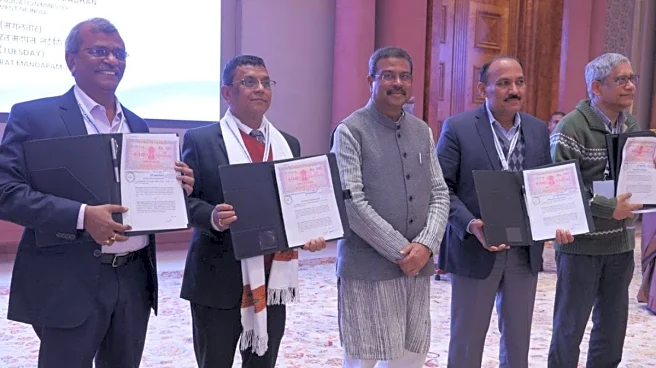




Education Minister Dharmendra Pradhan emphasised the importance of aligning our curriculum with national priorities. He proposed the creation of an industry-led curriculum committee to develop courses based on new and emerging job roles and 21st-century requirements. He also stated that PhD programmes should be industry-centric and stressed that our premier technological institutions must come under an accreditation framework.
Additionally, the Minister highlighted that NITs and IIESTs are set to become vibrant hubs of applied education, research, innovation, and future-ready workforce development. He added that their contributions will be pivotal in driving national progress and realising the vision of Viksit Bharat.
Chaired the 3rd Meeting of
the Standing Committee of Indian Institutes of Science Education and Research.
Reviewed all 7 IISERs on their academic and research outputs and on their future plans. Suggested for more student-focused approaches for unleashing the full potential of… pic.twitter.com/mTTSEqACN9
— Dharmendra Pradhan (@dpradhanbjp) January 13, 2026
Chaired the 13th Meeting of Council of National Institutes of Technology, Science Education and Research.
Reviewed presentations on elevating academic and research standards, enhancing governance efficiency and further boosting innovation and entrepreneurship at our NITs and… pic.twitter.com/HcUYNA6Wxg
— Dharmendra Pradhan (@dpradhanbjp) January 13, 2026
According to the official press release, key points discussed during the meeting included:
1. Reforms:
– Aligning curricula, assessment, academic programmes, and research with critical and emerging technologies such as Industry 4.0, green hydrogen, manufacturing, artificial intelligence, data analytics, cybersecurity, quantum technologies, and semiconductors to advance India’s progress towards Aatmanirbhar Bharat and Viksit Bharat by 2047 through excellence in science, technology, and innovation.
– Creating specialised PG/M.Tech. programmes to meet specific industry requirements.
– Implementing comprehensive PhD reforms, including:
– Industry-led and Industry-funded PhD programmes
– Product-based PhD initiatives
– Assigning PhD tasks to faculty based on their performance
2. Innovation:
– Focusing on building strong innovation and entrepreneurship ecosystems to shift from job seekers to job creators.
– Establishing incubation centres immediately in the 13 NITs that currently lack them.
– Initiating Research Parks in at least 10 NITs.
– Organising a pitching Conclave in July 2026 for start-ups incubated in NITs, in partnership with investors and industry stakeholders.
3. Accreditation:
– All NITs and IISERs agreed to complete External Peer Review within one year.
– Recognising accreditation as a crucial quality assurance mechanism, with institutions committing to actively participate in the national accreditation framework (NAAC).
4. Inclusivity:
– Promoting inclusivity through the use of ‘Bharatiya Bhashas’ and the adoption of artificial intelligence for multilingual learning. Committing to taking necessary steps to enable learners from diverse linguistic backgrounds to learn effectively.





/images/ppid_a911dc6a-image-177091603470987751.webp)

/images/ppid_59c68470-image-177091512468282453.webp)

/images/ppid_59c68470-image-177091507434334309.webp)