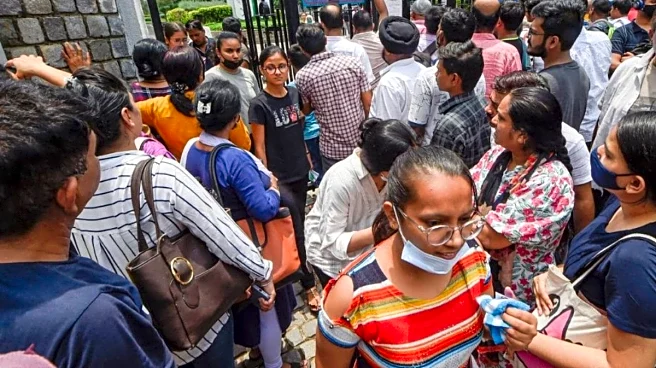

When Abhishek Kashyap, an MBBS graduate working at a reputed medical college in Lucknow, read the revised NEET-PG 2025 cut-off notification, he felt that years of preparation had collapsed into uncertainty.
He had scored positive marks but narrowly missed the earlier qualifying threshold. The revised cutoff—which allows candidates with even negative scores to participate in counselling—has left him questioning whether effort still counts. He is now considering options abroad, even though he knows the pathway has become narrower and far more expensive. “I am exhausted, and it feels like, why did I choose to become a doctor? I scored positive marks, studied hard while working double shifts, and still feel like the system has moved against all that hard work. Right now, it feels like money matters more than merit.”
Another aspirant, Raghav Bansal, working at a hospital based in New Delhi, who missed out despite scoring above zero, has decided to reattempt NEET-PG next year. “This no longer feels like a merit-based system,” he said. “It feels like money and timing matter more. I have no option but to re-attempt next year.”
On Friday, the Medical Counselling Committee released the schedule for Round 3 counselling, with choice filling open from January 16 to January 26. The seat allotment process will begin on January 27, and results for MD and MS admissions are scheduled to be announced on January 29.
What exactly has changed—and why the government says it had to act
Last week, the Union health ministry sharply lowered the NEET-PG 2025 qualifying cut-off, including reducing it to zero percentile for certain categories. In effect, candidates with negative marks (-40) are now eligible to enter counselling if seats remain vacant. Central government officials told News18 that the decision is final and not unprecedented, arguing that cut-offs have been lowered to zero percentile in earlier years as well.
“The only change this year was the notification by the National Board of Examinations in Medical Sciences, specifically mentioning negative 40 instead of just zero percentile. This is the reason why the usual notification became a controversy,” said an official privy to the development. “It’s not the first time the cut-offs have been lowered to zero percentile. It’s a usual move, nothing new here.”
According to officials, the revision aims to ensure optimal utilisation of postgraduate medical seats, which are critical for expanding India’s pool of trained medical specialists. “Leaving such seats vacant undermines healthcare delivery and leads to the loss of valuable educational resources,” he pointed out.
No impact on the quality of doctors: Govt officials
Officials at the union health ministry as well as at the National Board of Examinations in Medical Sciences emphasise that all NEET-PG candidates are MBBS-qualified doctors who have completed their degrees and internships, and that the exam primarily serves as a ranking mechanism to enable transparent, merit-based seat allocation through centralised counselling.
“Those who are not capable will get filtered out. First, during counselling, even in private colleges, they are likely to be offered only non-clinical seats based on their marks. Second, even if they enter a clinical branch, they may not be able to clear the PG course and could drop out midway. Finally, if they do complete the PG course with good ranks and marks, it would mean they are fully trained by then. In that case, how would their negative scores matter?” said the official quoted above.
Another senior official from the Ministry of Health, who spoke to News18 on condition of anonymity, said, “The cut-offs have been lowered only to open the doors for counselling; no one is being offered seats directly. There is a long journey from sitting in counselling to entering the operation theatre. It takes many years, and anyone who is mediocre will fall off along the way and will not be able to sustain.”
Why does the issue tilt towards money versus merit?
Critics argue that the vacancy problem is not evenly spread across the system but is concentrated largely in private medical colleges, where postgraduate fees can start at around Rs 75 lakh and climb steeply depending on the speciality.
According to government data, around 18,000 seats are left vacant after two rounds of counselling. At least half of these seats are in private medical colleges, whereas the remaining seats in government colleges are for non-clinical subjects including anatomy, microbiology, pathology, etc. – the subject least in demand by medical students as it takes away the opportunity to do medical practice but pushes more into academic or teaching front.
Hence, aspirants are likely to chase the clinical seats available now only with private medical colleges—albeit at higher prices. Seats in private medical colleges remain unfilled because candidates either cannot afford the cost or do not believe the training exposure justifies the price.
Why going abroad is no longer an option?
With the overseas option increasingly out of reach and private postgraduate seats financially prohibitive, more than half a dozen aspirants told News18 that they feel trapped between repeating an uncertain exam cycle and paying unaffordable fees—turning what was once a test of merit into a test of endurance.
“Before 2017, fees at private medical colleges were around Rs 35 lakh for the complete PG course, but today one needs more than Rs 75 lakh to complete the same. Earlier, students had the option of going to China, Russia or other smaller countries to pursue medical degrees and then return to India. Those doors are now closed, as India has tightened its regulations and degrees from many of these countries—due to differences in syllabus, language or training structure—no longer make students eligible for a licence to practise in India,” said DN Trivedy, an education consultant who earlier dealt with the preparation of foreign medical graduates examination.
“Under current regulatory norms, overseas medical degrees are recognised for practice in India only if they meet prescribed curriculum, duration, internship and licensing requirements, effectively closing off many of the routes that existed earlier. Viable destinations are now limited to a small group of countries such as the US, UK, Canada, Australia and New Zealand, where entry is highly competitive, and costs can exceed Rs 7–8 crore,” Trivedy explained.
Neeraj Chaurasiya from Delhi-based Gurukul Education Consultancy also echoed similar views. “In the majority of countries, Indian students are not eligible to sit for licensing exams in the host countries. They can complete a degree, but can’t work there. This creates a dead-end situation for students who are studying or planning to study abroad, as they may neither be able to return and work in India nor practise in the country where they studied.”
Meanwhile, the Federation of All India Medical Associations (FAIMA) has criticised the sharp cut-off reduction, arguing that repeatedly diluting qualifying thresholds undermines the credibility of NEET-PG and demoralises aspirants who prepare for years. The doctors’ body said the focus should be on fixing structural issues such as high fees, seat distribution and counselling design, rather than lowering standards to fill vacancies and threatening to go on nationwide protest.
Also, the Federation of Resident Doctors’ Associations (FORDA) has expressed concern, saying the decision reflects poor long-term planning in postgraduate medical education.
/images/ppid_a911dc6a-image-177066409223017092.webp)

/images/ppid_a911dc6a-image-177066405770410781.webp)


/images/ppid_59c68470-image-177066254410022291.webp)

/images/ppid_59c68470-image-177066256867843432.webp)
/images/ppid_59c68470-image-177066254567845048.webp)




/images/ppid_a911dc6a-image-177066053933489438.webp)