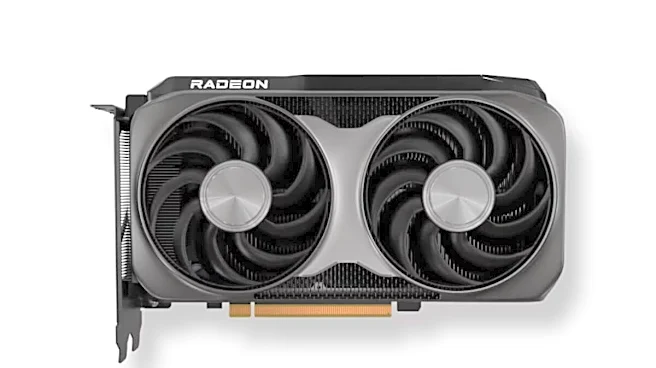




AMD has quietly added a new card to its Radeon lineup, the RX 9050, an entry-level RDNA 4 graphics card priced at $279 and built specifically for 1080p gaming rather than chasing benchmark headlines.
What’s actually inside the card
The RX 9050 runs on a heavily cut-down version of the same Navi 44 chip found in the Radeon RX 9060 XT. It packs 16 Compute Units and 1,024 stream processors, roughly half the core count of the full Navi 44 silicon, alongside 16 ray accelerators, 32 AI accelerators, and 32MB of Infinity Cache. The retail version pairs this with 8GB of GDDR6 memory on a 128-bit bus, delivering up to 288GB/s of bandwidth.
Clock speeds sit at a 1,920MHz game clock, boosting up to 2,600MHz, and AMD rates the card at just 92W of total board power, low enough to run comfortably
in older systems without needing a beefier power supply or additional cooling.
AMD’s own performance numbers
AMD is pitching this specifically as a 1080p “Medium settings” card, and has published its own benchmark figures to back that up: 60 FPS in 007: First Light, 96 FPS in Cyberpunk 2077, 131 FPS in Forza Horizon 6, and 85 FPS in Pragmata. Esports titles fare considerably better, with AMD citing up to 227 FPS in Counter-Strike 2 and as high as 593 FPS in Valorant.
One important caveat worth knowing before taking those numbers at face value: AMD tested these figures on a Ryzen 7 9800X3D, a high-end CPU that costs more than the graphics card itself. Anyone pairing the RX 9050 with a more modest, budget-appropriate processor, which is realistic given this card’s price point, should expect somewhat lower real-world performance than AMD’s official figures suggest.
The features you’re actually paying for
Being a genuine RDNA 4 card rather than a rebadged older chip matters here. The RX 9050 supports AMD’s latest FSR upscaling technology, third-generation ray tracing accelerators, second-generation AI accelerators, and full AV1 hardware encode and decode for streaming or recording without taxing the CPU. Display output includes one DisplayPort 2.1a port, supporting up to 80Gbps, and two HDMI 2.1b ports.
Alongside the card, AMD also released its Adrenalin 26.7.1 driver, which adds day-one support and early multiplayer access for the upcoming Gears of War: E-Day.
The 4GB version isn’t actually for you
There’s also a separate 4GB variant of the RX 9050, but it’s worth being clear about what this is. AMD has confirmed directly to press that this version is reserved exclusively for pre-built OEM desktop systems and will not be sold as a standalone retail card. Beyond the lower memory, it also uses a narrower 64-bit memory bus instead of the retail card’s 128-bit bus, roughly halving available bandwidth on top of the reduced capacity. Notably, this marks AMD’s first 4GB desktop GPU since the Radeon RX 6400 back in 2022, and with several newer games already treating 8GB as a baseline requirement, it’s a spec that’s genuinely hard to recommend even in a budget prebuilt.
How it actually stacks up against Nvidia
At $279, the RX 9050 undercuts Nvidia’s most relevant current-generation rival, the GeForce RTX 5050, which launched at a $249 MSRP but is currently selling closer to $309 at US retail. For context on real-world performance, AMD’s own RX 9060, a more powerful card with 28 Compute Units, has averaged around 19.8 percent faster than the RTX 5050 in independent testing. Since the RX 9050 has roughly half the RX 9060’s core count, it’s realistic to expect it to land much closer to RTX 5050 parity rather than clearly beating it, AMD’s marketing framing aside.
Where you can actually buy it, for now
The RX 9050 has launched exclusively in Asia-Pacific, Japan, and Latin America. AMD has not announced a release date for North America or Europe, and there’s no confirmed timeline yet for India either. Indian buyers are likely to see it later, most probably first through pre-built desktops, some of which may use the lesser 4GB OEM variant rather than the full retail card.
Rising memory prices, driven largely by surging AI infrastructure demand, have already pushed up costs across phones, laptops, and now graphics cards, and Nvidia is reportedly preparing to raise its own GPU package prices by as much as 30 percent. Seen against that backdrop, a genuinely affordable, current-generation GPU like the RX 9050 is a rarer thing than it might first appear, assuming it actually reaches shelves at its advertised $279 price once wider availability kicks in.
If you’re building a first 1080p gaming PC on a tight budget, or looking to replace an ageing Radeon RX 6000 or RX 7000-series card without spending big, the RX 9050 is a reasonable entry point, provided you buy the proper 8GB retail version and keep expectations realistic for anything beyond esports titles and medium-setting AAA gaming.
/images/ppid_59c68470-image-17855150220023933.webp)

/images/ppid_59c68470-image-178550005543052507.webp)


/images/ppid_59c68470-image-178549003264230764.webp)


/images/ppid_59c68470-image-178552252365725054.webp)