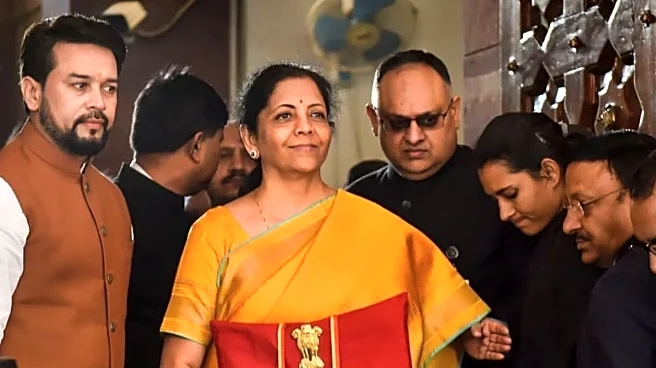

The Budget presentation on Sunday, February 1, 2026, held few surprises. It made three marquee announcements — raising the capex budget by Rs 1 lakh crore to Rs 12.2 lakh crore. This will certainly help
to keep GDP growth on track at around 7 per cent per annum via continued infrastructure development. However, there are no direct incentives for greater private sector capex unless companies choose to take up one or other of the several incentivised sectors for boosting manufacturing.
The macro-economic markers have been preserved intact by this prudent Budget, marked by incremental continuity rather than big-bang initiatives.
The fiscal deficit target has been set at 4.3 per cent of GDP for 2026-27. The government will target a debt-to-GDP ratio of 55.6 per cent of gross domestic product for 2026-27, with the intention of lowering this going forward. Total government debt stands at 85 per cent of GDP, with the Centre accounting for 57 per cent of it. This, as it stands, compares well with most other developed countries.
Second, there is an allocation of Rs 40,000 crore for electronics manufacturing, namely semiconductor or chip manufacturing. This is a second tranche to promote this vital sector, its R&D efforts, and training.
Third is the plan to develop seven high-speed rail corridors between major growth-oriented cities. These are Mumbai-Pune, Pune-Hyderabad, Hyderabad-Bengaluru, Hyderabad-Chennai, Chennai-Bengaluru, Delhi-Varanasi, and Varanasi-Siliguri.
Religious and pilgrimage tourism, which has become a significant economic contributor in recent times, with visitors to Ayodhya contributing 1 per cent of GDP and Varanasi proving to be a magnet with the largest number of visitors in the country, received careful attention in the Budget. New pilgrimage tourism circuits will be developed not only for Hindus but also for Buddhists.
Several neglected ASI-designated monuments will also receive restoration funds and initiatives. Other circuits for trekking in Himachal Pradesh and Uttarakhand will also be developed. Yet more for bird watching will be developed in Kerala, Assam, and other states.
Many of the other announcements were intended as long-term structural adjustments to various sector incentives and duties towards the Viksit Bharat targets for 2047. One example is customs duty exemptions on components and parts to boost civil and defence aviation. India is keen to manufacture its military and civilian aeroplanes domestically, along with commercial ships and containers. This is in addition to a big push for military-oriented ships and submarines, and even another aircraft carrier, for the Indian Navy and Coast Guard. India is expanding its ports, container handling and trans-shipment facilities, along with setting up new ports along both coastlines and in the Andamans. A sum of Rs 10,000 crore will be invested in container manufacturing.
There is also a boost for inland waterways expansion for rare earth mining corridors in several states such as Odisha, Kerala, Andhra Pradesh, and Tamil Nadu to aid transportation via these waterways.
There was a boost given to the intended establishment of data centres by foreign entities, with a tax exemption provided till 2047, juxtaposed with encouragement for them to provide cloud services internationally and to Indian entities via Indian intermediaries.
Likewise, another Rs 10,000 crore was set aside as an incentive to develop the bio-pharma space. India will also use Rs 20,000 crore to develop carbon capture facilities. Seaplane manufacturing will be facilitated. Fishing at sea is being incentivised with no tax, and dropping off the catch abroad will be treated as an export.
There were incentives announced for education and skilling. A large number of small incentivisations for a variety of items were included in this Budget. The tax compliance process too has been eased.
Given a fragile stock market that has underperformed other emerging markets, plagued by FII withdrawal and heightened volatility, it could have done with some encouragement. A lot of money was sucked into a slew of IPOs in the primary market over the past year, and pronounced rupee weakness has not helped. Capital gains tax easing and removal of withholding tax on FIIs would have greatly enthused the market, but it was not to be. Instead, there was a 50 per cent hike in STT on futures and 150 per cent on options, estimated to raise a modest Rs 25,000 crore.
These impositions, on the face of it, are not large in their direct impact on F&O traders, but sharply damaged market sentiment, at least in the first reaction. The market fell the hardest in the last six years. This could drive more FIIs away in the short to medium term towards freer markets elsewhere and reduce liquidity even in the cash market.
There was a pre-Budget expectation for a boost in defence spending, particularly for aatmanirbhar manufacturing. This did come in the Budget with a 15.3 per cent hike to Rs 7.84 lakh crore, of which only Rs 2.19 lakh crore is for capital outlay. This did not please the Street, with profit-taking seen in defence stocks that had risen some 16 per cent in the run-up. It could also be that some further purchases will happen on an ad hoc basis going forward, as and when negotiations are finalised. There is probably a case for many important, even reformist, initiatives being taken off-Budget in the future.
In the end, this Union Budget was a continuity Budget, signalling stability within the constraints of a tight fiscal situation and geopolitical turbulence.
(The writer is a Delhi-based political commentator. Views expressed in the above piece are personal and solely those of the author. They do not necessarily reflect News18’s views.)






/images/ppid_59c68470-image-177012256007374908.webp)

/images/ppid_59c68470-image-177012252617289779.webp)
/images/ppid_59c68470-image-177012253357226261.webp)
/images/ppid_59c68470-image-17701225696484365.webp)