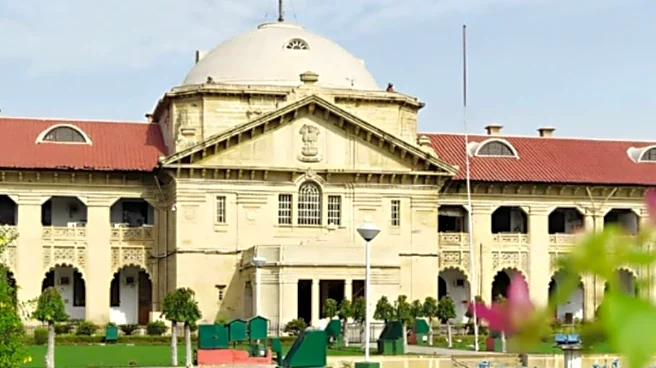





The Allahabad High Court has ruled that a wife cannot be denied maintenance from her husband merely because her parents are supporting her financially during a period of distress.
The court made the observation while allowing a criminal revision petition filed by a woman and her two minor children against an order of a family court in Bulandshahr.
The family court had earlier rejected the woman’s claim for maintenance, though it had granted Rs 3,000 per month to each of the children.
Setting aside that decision, the High Court held that parental assistance cannot replace a husband’s legal obligation to maintain his wife under Section 125 of the Criminal Procedure Code. It also noted that the family court had failed to properly assess the adequacy
of maintenance for the children, calling the earlier amount “wholly inadequate”.
What the court observe?
Justice Garima Prashad observed that a wife cannot be denied maintenance from her husband under section 125 of the Criminal Procedure Code (CrPC) merely because her parents support her financially during times of distress.
The court emphasised that the income of the wife’s parents should not be considered her income, and parental assistance cannot replace the legal obligation of the husband to support his wife.
The wife had initially filed an application under Section 125 CrPC seeking maintenance from her husband, alleging that after marriage, she was subjected to harassment, taunts and cruelty by him and his family members.
It was alleged that her husband, the second opposite party in the petition, is a retired army personnel who stopped maintaining marital relations with her and later informed her that he had married another woman.
She alleged that in January 2020, she was assaulted and expelled from the matrimonial home along with the children, and since then, she has been residing at her parental home with no independent source of income and is dependent upon her parents.
Against her plea, the husband pleaded that the wife had left the matrimonial home without sufficient cause and that she was allegedly maintaining illicit relations with certain persons.
He further stated that during his service in the Army, Rs 11,303 was deducted every month from his salary and paid to his wife and children until his retirement in November 2020.
He claimed that after his retirement, he receives a pension of about Rs 21,025 per month and has no other source of income.
After hearing the arguments of both parties, the family court disbelieved the wife’s case on the ground that she could not prove specific incidents of dowry demand, assault or second marriage.
The court further observed that the allegations made by both sides were unproven and that the wife had failed to establish cruelty.
Accordingly, the family court concluded that she was residing separately without sufficient cause and was therefore not entitled to maintenance.
During the course of the hearing before the high court, the wife took the plea that the family court adopted an approach contrary to the very object of section 125 CrPC, as it decided the proceedings as if it were a full-fledged matrimonial trial on cruelty and adultery.
In response to her husband’s allegations of adultery, the bench noted that no independent witness, documents, or reliable evidence were presented to support the claim.
The court stated that the bar under Section 125(4) CrPC applied only when the wife is proved to be living in adultery. It stressed that mere allegations, suspicion, or character assassination cannot deprive a wife of maintenance.
The court also found fault with the Family Court’s award of Rs 3,000 per child per month and termed it “wholly inadequate, unrealistic”.
It added that the amount was insufficient to cover the minimum reasonable expenditure of school-going children, such as food, clothing, education, books, transport, and medical needs.
Thus, modifying the family court’s order, the high court, in the judgment dated June 17, directed the husband to pay a monthly maintenance of Rs 5,000 to the wife. It also enhanced the maintenance amount for the two minor children to Rs 4,000 each.
(With inputs from PTI)