
The 21st century has witnessed the weaponisation of trade in ways that would have seemed unthinkable during the globalisation consensus of the 1990s. In July 2025, the United States signalled this new
reality by imposing tariffs ranging from 10 to 20 per cent on Indian goods, subsequently expanding them to 25 and 50 per cent, explicitly punishing India for purchasing Russian oil. The move carried a singular message: alignment with American strategic priorities must supersede national interest.
The United States was not alone in deploying tariffs as an instrument of coercion. China has restricted technology exports; the European Union has weaponised green trade standards; smaller nations have learnt that economic pressure is now as consequential as military posture. In this fractured landscape, India faced a choice familiar to many rising powers: capitulate to pressure, escalate reciprocally, or chart a third path grounded in diversification and strategic patience.
India chose the third path. The response was not theatrical, no tit-for-tat tariff wars, no inflammatory rhetoric, no performative nationalism. Instead, New Delhi reaffirmed its sovereign right to make independent energy choices and pursued a carefully calibrated strategy rooted in a principle articulated nearly two centuries earlier by British Foreign Secretary Lord Palmerston: “We have no eternal allies, and we have no perpetual enemies. Our interests are eternal and perpetual, and those interests it is our duty to follow.”
This is not the language of non-alignment from the Cold War era, where non-aligned meant neutral or absent from great-power competition. India today operates in a world of constant engagement with multiple powers. Strategic autonomy, as Modi’s government has practised it, means something more precise: the capacity to engage all powers on terms set by India’s interests, rather than accept the false binary of choosing sides.
Building Domestic Resilience Against External Pressure
India’s capacity to weather external coercion rests on deliberate domestic capacity building. Over the past decade, the government has invested heavily in infrastructure and manufacturing, treating these not as ends in themselves but as prerequisites of strategic independence.
The National Infrastructure Pipeline, which allocated Rs 44 lakh crore for implementation, has reshaped India’s trade logistics. Port turnaround times have been reduced by 40%, directly enhancing export competitiveness. This seemingly technical improvement has profound strategic implications: faster ports mean shorter capital cycles, lower working capital requirements, and greater resilience against supply shocks. It translates to practical independence.
The Production Linked Incentive (PLI) scheme, launched in 2020 with an outlay of Rs 1.97 lakh crore across 14 key sectors, has become India’s most consequential industrial policy instrument. By November 2024, it had attracted Rs 1.76 lakh crore in committed investments, generating over 12 lakh direct and indirect jobs. India’s electronics manufacturing sector, a sector of strategic significance for both consumer markets and defence applications, has expanded from USD 48 billion in 2019 to USD 115 billion by 2025, with companies like Apple shifting 14 per cent of iPhone production to India.
Apple’s presence alone signals to the world that India is no longer merely a low-cost assembly hub but a location for significant manufacturing footprints. The pharmaceuticals sector, which supplies 20 per cent of global generic drugs by volume, provides additional leverage. When a nation controls the global supply of medicines, its ability to withstand tariff pressure becomes structural, rather than contingent.
By 2024–25, India’s total exports reached a record USD 824.9 billion, up 6 per cent YoY. Within that figure, services exports surged 13.6 per cent to USD 387.5 billion, with IT and information technology services accounting for 68 per cent of the services basket. Electronics exports jumped 32.5 per cent, and pharmaceutical exports grew 9.4 per cent. The diversification across sectors and geographies meant that tariff pressure on one sector does not translate to economic catastrophe.
Energy Diversification as Strategic Autonomy
The immediate trigger for American tariffs was India’s Russian oil purchases. It presented the clearest illustration of strategic autonomy in practice. In 2022, during the Russia-Ukraine conflict, when global crude prices threatened to breach USD 150 per barrel, the United States privately urged India to increase Russian oil purchases. India responded by ramping up imports, purchasing millions of barrels at USD 20–30 below Brent prices. It was not an ideological decision, but a pragmatic one. India averted a global inflation spiral, shielded its 1.4 billion citizens from fuel-price shocks, and cut its import bill by USD 7–8 billion annually.
Today, India sources crude oil from over 40 countries across five continents: Russia, Iraq, Saudi Arabia, the United Arab Emirates, the United States, Brazil, Nigeria, and smaller producers in Latin America and Africa. No single nation controls India’s energy lifeline, and it is a statement of fact. When the United States sought to punish India for Russian purchases, India responded by reaffirming the rationale: the affordability of fuel for its citizens and the security of its energy supply. It did not apologise for serving the interests of 1.4 billion Indians.
The Modi government’s detailed statement from the Ministry of External Affairs on 6 August made this clear. India has diversified not because it opposes any particular nation but because volatility and over-dependence are vulnerabilities. It also has a counterintuitive benefit: it makes India indispensable to multiple powers. And while China has become the primary customer for Russian oil, the arrangement constrains Chinese autonomy, whereas Middle Eastern producers depend on Indian demand.
Deepening Strategic Partnerships Through Trade
Parallel to domestic capacity building, India has accelerated free trade negotiations to reduce dependence on any single market. The Comprehensive Economic Partnership Agreement with the United Arab Emirates, signed in 2022, lifted bilateral trade to USD 85 billion by 2024. The Economic Cooperation and Trade Agreement with Australia, also signed in 2022, is projected to reach USD 45 billion in trade by 2027, representing meaningful market access and investment flows.
The United Kingdom Free Trade Agreement, concluded in May 2025, grants Indian businesses nearly tariff-free access to British markets, particularly for IT services, financial services, and professional services. The European Free Trade Association partnership, which entered into force in October 2025 after 16 years of negotiation, brings a unique feature: EFTA countries have committed to invest USD 100 billion in India over 15 years.
Negotiations with the European Union, spanning 18 years, are targeting a conclusion soon. New Zealand concluded its FTA with India in December 2025. Brazil and India have agreed to expand their Mercosur trade partnership. India has also formalised free trade negotiations with the Eurasian Economic Union, reflecting a deliberate strategy to diversify partnerships beyond the traditional Western alignment.
The portfolio of agreements is strategically designed. When the United States imposed tariffs, it assumed India would roll over, but India had alternatives. The EU market was opening; the UAE had become a significant trade partner; Australia offered agricultural diversification; Britain provided services opportunities. These agreements reduce the cost of any single power’s coercive action. More subtly, they showcase that India is not accepting trade on others’ terms.
Technology and Clean Energy: India’s Strategic Edge
The semiconductor and green hydrogen sectors together show how India is converting strategic intent into concrete technological and energy capabilities. The India Semiconductor Mission, backed by Rs 76,000 crore in support, has cleared 10 projects across six states with cumulative investments above Rs 1.60 lakh crore. Micron is committing USD 2.75 billion to an assembly and testing facility in Gujarat, while Tata Electronics is pursuing a USD 10 billion fab partnership with Taiwan’s Powerchip Semiconductor Manufacturing Corporation.
In September 2025, India unveiled its first made-in-India semiconductor chip, the Vikram 32-bit processor, developed by ISRO’s Semiconductor Laboratory for space and defence uses. Designed to withstand the extreme conditions of launch and space, its successful fabrication demonstrates that India now possesses indigenous design and manufacturing capabilities for high‑reliability semiconductors in domains central to national security.
This matters for strategic autonomy because semiconductors underpin modern military systems, digital infrastructure, and consumer electronics. As the global semiconductor market moves towards USD 1 trillion by 2030, India’s emerging capability positions it as a trusted partner for democracies seeking secure, diversified supply chains. Unlike China, India is not viewed as a systemic geopolitical competitor in this domain, and unlike Taiwan, it is not exposed to the same level of existential military risk.
The National Green Hydrogen Mission complements this technological push by re‑engineering India’s energy base. With Rs 19,744 crore allocated till 2029–30, the mission targets at least 5 million metric tonnes of green hydrogen annually by 2030, supported by 125 GW of additional renewable capacity. It is expected to attract Rs 8 lakh crore in investments, create 6 lakh jobs, and cut fossil fuel imports by Rs 1 lakh crore.
India has already secured corporate commitments for electrolyser manufacturing and large‑scale green hydrogen production, with pilot projects underway in shipping, steel, and mobility. Crucially, the mission is designed to make India not only a major consumer but also a producer and exporter of green hydrogen and its derivatives.
Energy independence, like technological self‑reliance, underwrites every other dimension of sovereignty. A state that can design its own high‑end chips and generate its own clean energy is far harder to bully, sanction, or isolate, and far better placed to shape, rather than merely absorb, the shocks of a fragmenting global order.
Managing China Without Containment
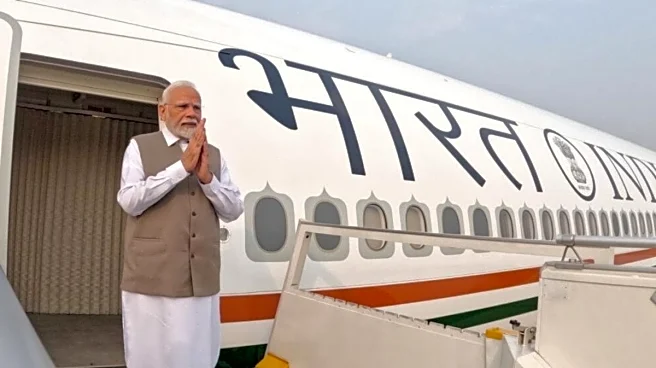
In August 2025, Prime Minister Modi visited Tianjin to attend the Shanghai Cooperation Organisation summit, his first visit to China since 2018. The timing, following weeks of American tariff pressure, was not accidental. It was India signalling that its options remained open, that it would not be cornered into an anti-China alliance merely because the United States demanded alignment.
The approach has been mischaracterised as hedging. It is not. Hedging implies a lack of clarity about preferences. India’s preference is clear: it prioritises sovereignty and autonomy. China represents an option within India’s strategic toolkit, one exercised judiciously, not ideologically. India’s relationship with China is defined by realism stripped of sentiment. Border tensions, asymmetry in manufacturing power, and competing regional visions ensure that rivalry remains structural. Yet India avoids framing this rivalry as ideological or civilisational, which would limit diplomatic options and raise domestic expectations for confrontation that the state has little interest in accelerating.
The SCO summit brought together three major powers; India, China, and Russia. All experiencing strain with the United States. Yet this convergence does not signal an anti-Western bloc or a new axis. It signals, more modestly, that India retains the freedom to engage with powers as circumstances warrant. The moment Trump’s pressure proved counterproductive to American interests, the moment India’s significance to American strategy became apparent, the possibility of recalibration emerges. India, by refusing to capitulate, had preserved its leverage.
The Economics of Autonomy
The precise contribution of strategic autonomy to India’s economic performance cannot be quantified, but the correlation is evident. When India pursued diversification across energy suppliers, it cushioned itself against price shocks that might have devastated other economies. When it invested in domestic manufacturing, it created alternatives to dependence on imports. When it negotiated trade agreements from a position of confidence, backed by a 1.4 billion-person consumer market, a skilled workforce, and emerging technological capabilities. India secured commitments rather than accepting scraps.
By contrast, the costs of abandoning autonomy are evident in other nations’ experiences. Smaller economies that aligned too closely with larger powers found themselves economically exploited. Nations that over-invested in single trade relationships discovered vulnerability when those relationships were weaponised. India has chosen a different path: engagement without subordination.
The Domestic Foundation of External Strategy
This entire edifice rests on a foundation that is easily overlooked: India’s domestic political consensus on strategic autonomy. When Trump demanded that India abandon Russian oil purchases, Modi faced pressure from the American administration. But Modi also faced pressure from domestic constituencies, the farmers, the rural poor, small businesses, for whom letting American agricultural products into Indian markets, or abandoning energy security would have been a death sentence. He chose not to compromise on their behalf.
This was not a theater in nationalism. If India surrenders on agricultural access to appease American demands, Indian farmers lose confidence in the state. If India backs down on its energy policy to satisfy American pressure, energy-dependent sectors lose confidence. Strategic autonomy is thus not a luxury; it is a prerequisite for domestic political stability.
As global politics fragments into competing power blocs, India offers an alternative model: a power that influences global outcomes without surrendering autonomy, that engages all powers on terms set by its own interests, and that accumulates leverage through diversification rather than through alignment. It is not non-alignment in the Cold War sense; India is deeply engaged with the United States on defence, technology, and trade. Nor is it hedge-clipping, which implies contingency. It is Strategic Autonomy in practice, pure and simple.
While India may not be leading a bloc this time, it will also not submit to one. Its influence grows not through dramatic confrontation but through persistence, appearing at every negotiating table, engaging every power, and refusing false choices. In an era obsessed with alignment and loyalty tests, India represents a different model: sovereignty through flexibility, power through patience. This is the new non-alignment. And on Republic Day, it is worth recognising that this model is not merely viable, it is becoming the defining feature of India’s rise.